Sometime in the dark and mist-shrouded vistas of time past — 1946 rings a distant bell — my parents moved into a fine old house on the 1400 block of Cameron Street. It was a good working class neighborhood at the time, maybe even with respectable middle class pretenses.
With the horrors of the Great Depression and then World War ll behind them, they must have had a lot of hope and big dreams, if not a lot of money, at that time. If they had a little extra money left over at the end of the month, they might walk down the half block to Dewdney Avenue to the Utopia Cafe. At that time, it was a good family restaurant run by a Greek chap named George. I think my dad told me once that at that time they could both dine there for about a quarter but I may be making that up.
But then things got a little weird. George sold the place to a rather eccentric chap named Roger Ing, originally from Canton. At first, that was all we knew about him. He ran the place — featuring the above menu — throughout the ’70s and beyond. In the early days, most of his clientele were people from the neighborhood, like me. If Scott Collegiate, located a few blocks north and a few blocks west, had an official clubhouse, it was the Utopia, or U-Ball as it was sometimes referred to. There was a corner table at the front of the place that you could only sit at if you belonged. I was allowed to sit there, in certain circumstances. It was one of those unspoken things.
Roger’s English was never all that great, although it was rumoured he understood more than he let on. He wandered around the place in his own little world delivering cheeseburgers and orders of chips and gravy and topping up cups of coffee. Nothing out of the ordinary, I suppose, but for one day when I stopped in for a coffee en route to my piano lesson. I had my music books with me. Roger sat down at my table, transfixed by a Beethoven sonata I was working on. He opened the cover and looked at the music carefully. Then he took out a ball point pen and drew a perfect caricature of a bust of Beethoven on the cover. Under it he drew a staff of music and “Ludwig van Beethoven, 1770-1827.”
Beethoven, by Roger. I probably bought this along with a grilled cheese and coffee for ten bucks or so circa 1990.
Well, you could have knocked me over with a feather. What on earth did Roger know about Beethoven? How did he know how to draw like that? I’d known him for years but never suspected he knew anything about art or music. After that little episode, Roger treated me a little differently, I thought. If I had books with me, which I usually did, he would sit with me for a minute and leaf through them muttering to himself. If I bothered to ask him about his interest in these books, or his knowledge of Beethoven, I don’t remember now. Or if I did, maybe he didn’t answer me. As I say, his grasp of English was never all that strong.
Enter Art McKay — literally. Art was an artist of great renown in Regina and beyond, a member of the “Regina Five,” on faculty at the University of Regina’s Fine Art Department. As I was told the story, he just happened to wander into the Utopia early one evening for a cup of coffee. He immediately recognized Roger as a former student, a foreign student from Canton who had come to Regina to study art at the college (University of Saskatchewan, Regina Campus at that time) in the 1950s. Roger obviously recognized his former professor. Soon enough a sketch pad materialized and they began trading drawings, just the two of them in the dim lights of the Utopia with the door locked to the outside world.
From that point on, things began to change rapidly at the Utopia. Roger transformed the unused banquet room (from the days of George) at the back of the place into his studio. Paintings began to emerge from the studio — strange, wild, crazy, intelligent, ironic, weird and wonderful paintings that were grouped around a number of motifs, including UFOs, flying hamburgers, tigers, as in William Blake’s tygers, the Mona Lisa, the rodeo and bulls, delicate little birds on a branch and of special interest to me, portraits of Beethoven and Shakespeare and other artists of note from days gone by.
Roger scoured the second hand stores for paintings and prints and painted over top of these, spilling onto the frame, retaining and revealing some of the original work underneath. (Also, his friends and fellow artists brought him prints and paint-by-numbers they found at garage sales, frames and all.) His output was astonishing. The quality of the work was insanely uneven. So many experiments, some that worked, some that didn’t. It didn’t seem to matter to him. The paintings kept streaming out from the banquet room at a prodigious rate. (We regulars would peak in when we were at the back feeding our dimes into the pinball machines, The Queen of Hearts and Buckaroo!)
For all of this, Roger certainly had his time in the sun, his late in life more than fifteen minutes of fame, and deservedly so. There is a wealth of information about him and his art and the Utopia on the internet, including a very good documentary by Regina author and artist Judith Silverthorne, titled Roger Ing’s Utopia, among others.
My story ends on a personal note. I returned to Regina for a few years in the early 1990s after Roger had begun his ascent to fame and adulation. (From Regina, I moved to Calgary where my playwriting career took flight.) One day before I left, I went into the Utopia in the late morning and sat at the old corner table. It was a quiet morning and Roger brought me a coffee and sat down with me, just as he had twenty years earlier when he drew his little portrait of Beethoven on the cover of my sonata.
I explained to him that I was moving to Calgary, that it was a good opportunity at a good theatre. After a moment he looked at me and said, “You show them. Show them what the boys at the corner table can do.”
There is of course the physical voice created in the throat of the individual which may be pleasant or otherwise. There is also the authorial voice,that of the writer which although silent, through the words on the page insinuates itself in your mind. That’s what we’re going to talk about today.
The reason the man with the screechy voice (see yesterday’s post) and I were talking in the first place was on account of the Portugese author Jose Saramago, in particular this book, Skylight. Mr. S.V. and I share a love of Saramago and his work which is enough to override any concerns I might have with his vocal production.
It might shock you (maybe you should sit down!) that Saramago’s novel All The Names is my favourite novel, period. Don’t ask me why — it just is and that’s all there is to it.
Yet I don’t recommend you rush out and buy it. It’s not an easy book to read, in fact none of his books are, with sentences that run on for hundreds and hundreds of words and paragraphs that go on for pages and pages. It can be a little intimidating. Most of us prefer to see a lot of white space on the page and Saramago doesn’t give you very much of that. Still, for serious readers, All The Names is, in my humble opinion, well worth the effort.
I’ll say this for Mr. S.V. He’s a reader. He’s one of the few people I know who has read Saramago and can have a serious conversation about him. AND SO IT CAME TO PASS that the other day we ran into each other at the coffee shop and fell into talking about literature and JS from P and I asked him if he was aware of the book pictured above, Skylight. He was not familiar with it and so I gave him the down and dirty as I will do for you now, dear reader, to reward your patience for having read this post for the last three hours or however long it’s taken you to get this far.
Skylight is actually the first novel Saramago wrote. He was in his early 30s when he completed it. He sent it to a publisher in 1953. The publisher lost the manuscript. It was only found in 1989 when they changed offices. They said, “It would our great honour for us to publish this manuscript,” to which Saramago replied. “Thank you, no.” He was already famous by that time, although still a few years away from being awarded the Nobel Prize in 1998.
According to Pilar del Rio in his introduction to the novel, “Being ignored by that publishing house had plunged him into a painful, indelible silence that lasted decades.”
During his lifetime, he never approved the publication of Skylight, but kept it on his desk for years and years. His explanation for this, from later in the introduction: “No one has an obligation to love anyone else, but we are all under an obligation to respect one another.”
It was finally brought into print in 2014, after he had passed away in 2010. In Saramago’s words, it was “the book lost and found in time.”
In my mind it’s a fascinating story of how one of the world’s great authors was silenced for so long by what may well have been a clerical error.
Mr. SV was intrigued by my description of the book’s history. I offered to lend it to him and even found it and carried it around for a few days before I saw him again. In the meanwhile, he had ordered it from somewhere and read it. As I mentioned, he’s a great reader.
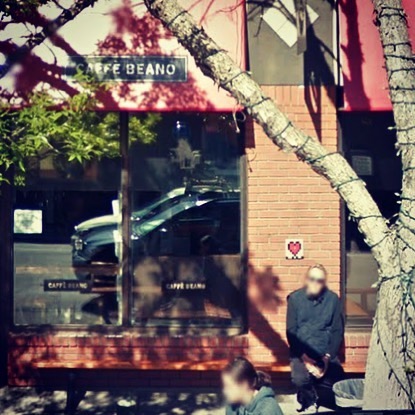
At the height of my fame (notoriety?) I appeared on the Google Earth image of Caffe Beano in Southwest Calgary. You could say I was hanging out there quite a bit at the time.
I’m not sure if I’m alone in this, but I have always been very sensitive to the tonal qualities (or lack of) of the human voice. It is said that beauty is only skin deep, but in my experience, it has more to do with the quality of a person’s voice than the quality of their skin.
Someone wrote a critique of a piece by, I believe, Beethoven saying it sounded like a cat’s claws on a window pane. I can’t remember the exact reference. It’s probably in Diana Rigg’s great compendium No Turn Unstoned. (Great book if you can find it, a collection of incredibly negative reviews of great works of art, particularly theatre. Yes, the same Diana Rigg who starred in The Avengers.)
Well, that’s just a variation of the tired old “nails on a blackboard” saying which probably doesn’t resonate as much now that we have whiteboards and colourful markers instead of blackboards and not so colourful chalk.
A horrid, terrible, irritating voice. If I hear that I run the other way. It makes me wonder, are such people aware of how grating and offensive their voices are to others? Do they never think of doing something about it? Voice lessons, for example? It’s a problem that can be fixed. I know these things. I studied with the great voice coach David Smuckler at York University in Toronto. Many moons ago now, Johnny. (Or whomever.)
(Where are we going with this, Eugene? Focus, man, focus!)
This is all by of saying that I know a man whom I see at Caffe Beano from time to time with a high screechy voice. It’s so pronounced I was describing him to a fellow patron (trying, after years of knowing him) to learn his name. I mentioned the voice and the fellow patron (whose name I don’t know) knew right away the person I was talking about.
I was looking for him because I had a book for him. That book will be the subject of Vox Humana 2 so stay tuned!
Meanwhile, I had written in my journal a description of the voice that became so, shall we say, fluid that I believe it may qualify as a literary conceit, along with Mr. Eliot’s etherized patient. This description longed to be freed from the pages of my journal and was really the impulse for writing this post in the first place. So here it is —
He has a voice like a rusty gate swinging open in the late afternoon of a cloudy day in autumn with the wind and swirling leaves. Someone in a long black cloth coat has pushed the gate open. We can’t be sure if he’s coming or going. Presumably there is an old house beyond the gate but whether our friend in the long black coat is returning, say from work, or heading out, perhaps to the library, we will never know.
Remember to check for part two of this fascinating discussion of whatever it is.




 eugene stickland