In front of the Utopia Cafe on Dewdney Avenue, circa 1990.
My post about Aydon Charlton the other day brought to mind the neighborhood we grew up in, the old north end of Regina, Saskatchewan, Canada. Aydon and I shared the pedigree of being Albert-Scott men, Albert Elementary School and Scott Collegiate. Kids from the south end of town would look down on us I guess, but we were proud to have graduated from both of those schools.
Fun Fact. I once read that more students who started at Albert School went to jail than graduated from high school. Or maybe I just dreamed that. It’s not too big a stretch to imagine that it’s true. Interesting times, interesting place, for sure.
Nowadays they call it the core or North-Central. What had been a good working class neighborhood when I grew up there has fallen on a hard times. Macleans magazine called it the worst neighborhood in Canada, worse even than Vancouver’s infamous East Hastings area.
I knew the hood had fallen into hard times since I left back in the 1980s. (My parents stayed on in the house on Cameron Street until they, like most of their old neighbours, sold for what they could get and moved to the south end.) But I never thought it was that bad.
Last summer my wife Belina and I traveled back to my homeland. She came directly to Calgary from the Philippines and had never been to Saskatchewan. (Imagine!) We stayed at a hotel in the south end. (Where I ran into my high school art teacher, one of my favourite teachers of all time, still going strong!) We had tickets for the Rough Rider game, thanks to my friend Scooter. (Yes, I have a friend named Scooter.)
We planned to spend one morning touring around my old neighbourhood. I was afraid of what I’d find there, and I wasn’t sure how Belina would react if it was really as bad as Macleans made it out to be. We set out on a beautiful morning in June. We went into a Tim Hortons for some coffee and donuts. The woman working there was from the same province in the Philippines as Belina. Off to a good start.
We drove past my old house on Cameron Street. The front veranda was gone but otherwise the house and yard were in good shape. The lovely old elm trees arched high above the street, dappling the light of the early summer sun. The street seemed tranquil, hardly the ravaged war zone I had been expecting. All in all, the old neighbourhood looked pretty good that morning. I’m not sure I’d want to live there again. I’m not sure I’d be comfortable walking around there at night like I did as a kid. All in all, we had a nice day, seeing the sites of my younger years.
I thought it might be worthwhile to attempt some stream-of-consciousness sketches of the neighborhood I grew up in. Stream of what? Just my little way of making sure I’ll never make a million dollars from this blog of mine. (Sorry Belina!)
Here you go . . . .
these streets we walked along in broken down sneakers and jeans cuffs scraped down to hanging threads under the canopy of lofty branches verdant and dark and cool in summer, black and skeletal and sketched against a stark white sky and the crunching of footsteps on the snow (still in sneakers despite our mothers’ pleas to wear the boots they paid good money for) back and forth along the avenues past the library and David’s confectionery past the school we went where the recess battles were lost and won further along to the playground its pool empty and derelict in winter blue and shiny under the glow of distant street lights in summer when despite the tall chain-link fence we were drawn to climb over and go skinny dipping (only once for me thank you) although the water was cold and the prairie nights cool and it never lasted long enough to feel it was worth the effort unless of course there were girls involved but unlike the movies there were never girls involved and if we would cross the playground to the south side we would discover the foundation of the jail they kept Louis Riel in before they hanged him although we didn’t learn anything about that in school so what did we know anyway more likely we would turn north and walk the two blocks to our high school if we had any reason to be there, basketball in the winter, baseball in the summer and fall, bit just as likely we’d go back home and see what was on the two channels we got on tv back then
Where to begin, eh? Sometimes the simple things become utterly complex on account of the interrelated nature of events and memory and friendship and even where we came from.
Let me start by saying that my friend Aydon Charlton passed away last week. Aydon was a family friend, as we might say, and yet more than that. His parents and my parents were good friends back in the day, in the old north end of Regina,Saskatchewan. He was older than me by perhaps a decade or so, more of a friend to my older brother Tom than to me. Yet through our family connection and our church, St. Peter’s Anglican (since desanctified) we knew each other.
When I arrived at the University of Regina English Department, Aydon was very much present, completing his MA. I may not be remembering this correctly but I believe his thesis was on Wilkie Collins, which was unusual enough to be memorable even all these decades later. (You know doubt remember, dear reader, that Wilkie was Charles Dickens’ great companion, and the author of a very fine novel, The Woman in White.) (Among others.)
We were part of the same cohort, acolytes of an eccentric, charismatic prof, my namesake Eugene Dawson, as well as his colleague, Ray Mise. They were Americans, exotic to us Saskatchewan boys, I guess. They were hard drinkers and so we learned to be too along with learning a few things about literature and literary criticism. I think I can say that Gene had more influence on my development than any of my other teachers. Aydon probably would have said the same of Gene, but maybe including Ray as well. It was an interesting and profound introduction to the world of arts and letters, to say the least
You can say what you like about Facebook, and it would probably be true, but it brought Aydon and I together years later and we had some good conversations over the last few years. He was fond of sharing photos of his parents, and I would be sure to comment as I remembered them fondly.
In a few of those exchanges, Aydon told me the story of his father turning an unassisted triple play at the St. Peter’s annual church picnic. Remembering some of the congregation of the time, choristers and lay readers and the like, that didn’t seem like that big a deal to me, but in Aydon’s mind it was one of the great athletic feats of the Twentieth Century. It was obviously important to him, he told me that story at least three times. Who was I to argue?
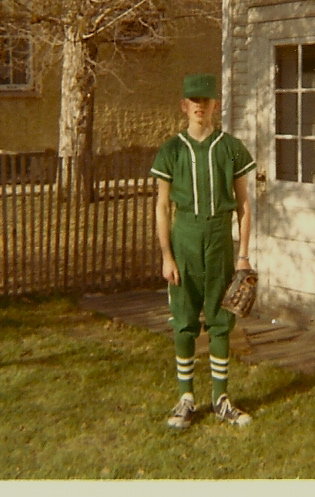
This picture is of me in my Senators Little League uniform. It was a good team year in and year old, coached by the legendary Joe Resch whose son Glen played goalie for the New York Islanders and the Colorado Rockies. During one of my seasons with the team, I fell into a miserable hitting slump. There didn’t seem to be any hope to get out of it. I began dreading our games.
One evening, Aydon’s dad Phil came over to our house, not to visit with my dad, but to see me. He had with him a Sports Illustrated magazine with an article on hitting by the great Ted Williams. A little research tells me that it was likely the July 8, 1968 issue featuring “Ted Williams on the Science of Hitting” on the cover. Phil gave me the magazine, saying “I hear you’ve been in a bit of a slump. Maybe this will help.”
I read it. Did it help? I’ll say! I distinctly remember the next game coming to bat in one of the later innings when Joe Resch turned to the guys in the dugout and said, “Here comes Stickland again. He’s 5 for 5 tonight! Man oh man!” The power of the written word, friends.
When Aydon told me the story of Phil turning the triple play, I countered with the Ted Williams story. It was a funny kind of bonding, later in our lives. All the more poignant now that he’s gone. Aydon was a good man with a brilliant sense of humour. Requiescat in pace.
A tribute to the Blue Jays and their return to the World Series. And to remember and honour Aydon and his dad, Phil.
There is of course the physical voice created in the throat of the individual which may be pleasant or otherwise. There is also the authorial voice,that of the writer which although silent, through the words on the page insinuates itself in your mind. That’s what we’re going to talk about today.
The reason the man with the screechy voice (see yesterday’s post) and I were talking in the first place was on account of the Portugese author Jose Saramago, in particular this book, Skylight. Mr. S.V. and I share a love of Saramago and his work which is enough to override any concerns I might have with his vocal production.
It might shock you (maybe you should sit down!) that Saramago’s novel All The Names is my favourite novel, period. Don’t ask me why — it just is and that’s all there is to it.
Yet I don’t recommend you rush out and buy it. It’s not an easy book to read, in fact none of his books are, with sentences that run on for hundreds and hundreds of words and paragraphs that go on for pages and pages. It can be a little intimidating. Most of us prefer to see a lot of white space on the page and Saramago doesn’t give you very much of that. Still, for serious readers, All The Names is, in my humble opinion, well worth the effort.
I’ll say this for Mr. S.V. He’s a reader. He’s one of the few people I know who has read Saramago and can have a serious conversation about him. AND SO IT CAME TO PASS that the other day we ran into each other at the coffee shop and fell into talking about literature and JS from P and I asked him if he was aware of the book pictured above, Skylight. He was not familiar with it and so I gave him the down and dirty as I will do for you now, dear reader, to reward your patience for having read this post for the last three hours or however long it’s taken you to get this far.
Skylight is actually the first novel Saramago wrote. He was in his early 30s when he completed it. He sent it to a publisher in 1953. The publisher lost the manuscript. It was only found in 1989 when they changed offices. They said, “It would our great honour for us to publish this manuscript,” to which Saramago replied. “Thank you, no.” He was already famous by that time, although still a few years away from being awarded the Nobel Prize in 1998.
According to Pilar del Rio in his introduction to the novel, “Being ignored by that publishing house had plunged him into a painful, indelible silence that lasted decades.”
During his lifetime, he never approved the publication of Skylight, but kept it on his desk for years and years. His explanation for this, from later in the introduction: “No one has an obligation to love anyone else, but we are all under an obligation to respect one another.”
It was finally brought into print in 2014, after he had passed away in 2010. In Saramago’s words, it was “the book lost and found in time.”
In my mind it’s a fascinating story of how one of the world’s great authors was silenced for so long by what may well have been a clerical error.
Mr. SV was intrigued by my description of the book’s history. I offered to lend it to him and even found it and carried it around for a few days before I saw him again. In the meanwhile, he had ordered it from somewhere and read it. As I mentioned, he’s a great reader.
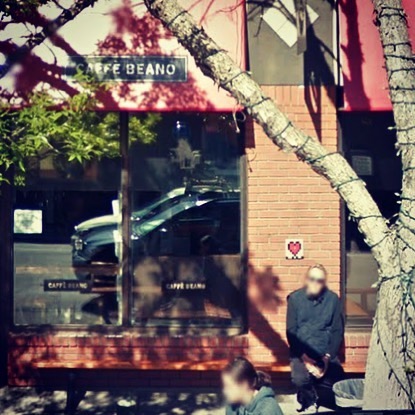
At the height of my fame (notoriety?) I appeared on the Google Earth image of Caffe Beano in Southwest Calgary. You could say I was hanging out there quite a bit at the time.
I’m not sure if I’m alone in this, but I have always been very sensitive to the tonal qualities (or lack of) of the human voice. It is said that beauty is only skin deep, but in my experience, it has more to do with the quality of a person’s voice than the quality of their skin.
Someone wrote a critique of a piece by, I believe, Beethoven saying it sounded like a cat’s claws on a window pane. I can’t remember the exact reference. It’s probably in Diana Rigg’s great compendium No Turn Unstoned. (Great book if you can find it, a collection of incredibly negative reviews of great works of art, particularly theatre. Yes, the same Diana Rigg who starred in The Avengers.)
Well, that’s just a variation of the tired old “nails on a blackboard” saying which probably doesn’t resonate as much now that we have whiteboards and colourful markers instead of blackboards and not so colourful chalk.
A horrid, terrible, irritating voice. If I hear that I run the other way. It makes me wonder, are such people aware of how grating and offensive their voices are to others? Do they never think of doing something about it? Voice lessons, for example? It’s a problem that can be fixed. I know these things. I studied with the great voice coach David Smuckler at York University in Toronto. Many moons ago now, Johnny. (Or whomever.)
(Where are we going with this, Eugene? Focus, man, focus!)
This is all by of saying that I know a man whom I see at Caffe Beano from time to time with a high screechy voice. It’s so pronounced I was describing him to a fellow patron (trying, after years of knowing him) to learn his name. I mentioned the voice and the fellow patron (whose name I don’t know) knew right away the person I was talking about.
I was looking for him because I had a book for him. That book will be the subject of Vox Humana 2 so stay tuned!
Meanwhile, I had written in my journal a description of the voice that became so, shall we say, fluid that I believe it may qualify as a literary conceit, along with Mr. Eliot’s etherized patient. This description longed to be freed from the pages of my journal and was really the impulse for writing this post in the first place. So here it is —
He has a voice like a rusty gate swinging open in the late afternoon of a cloudy day in autumn with the wind and swirling leaves. Someone in a long black cloth coat has pushed the gate open. We can’t be sure if he’s coming or going. Presumably there is an old house beyond the gate but whether our friend in the long black coat is returning, say from work, or heading out, perhaps to the library, we will never know.
Remember to check for part two of this fascinating discussion of whatever it is.
When I decided to resume this blog of mine, my wife who is from the Philippines got very excited. She had seen something on Facebook about a Filipino who was making millions of dollars from his blog. Lots of flashy cars and beautiful beaches, attractive people in various states of undress. You get the idea.
I had to explain to her that my blog isn’t like that. “So what’s it about?” she asked. “Art, experimental art at that, writing, the writing process, steam of consciousness, photography, that kind of thing –” Beyond that I didn’t know what to say. “How are you going to make any money doing that?” she asked. “Well, as usual, I’m not,” I replied, somewhat defiantly. I think she understood.
Maybe I don’t know exactly what this is, this blog of mine. I’m OK with that. The one thing I know for sure is that I’m not about to make a million dollars from it.
The more I think of it, having come back to it again after a fairly lengthy hiatus, maybe it’s something of a scrapbook. Remember those? Fragments, ideas, photos, images, ramblings, musings, sketches, not complete but perhaps leading somewhere, perhaps not.
I like that. Let’s go with that for now and see where it leads us, if anywhere.
“Oh, do not ask ‘What is it?’ Let us go and make our visit . . .”
Last summer here in Calgary, Alberta, we had an amazing thunder and lightning storm. I sat on my balcony — rather bravely because the lightning was flashing and the thunder was booming close by — trying to get a shot of one of the flashes of lightning. All I had to do was hold up my phone and take a pic and I would have an amazing shot of a flash of lightning. Right? Not exactly. I never did get a shot of the lightning, but I managed to get a photo of the top of a building a few blocks away. I showed my failed attempt to a few friends and they thought it was pretty cool, actually. The more I looked at it and thought about it, the more I had to agree, it is pretty cool. Call it “Lightning,” if you want, or just call it a happy accident, which is what it was.
Hello out there, wherever you are. Welcome once again to my all-but-moribund blog.
I see I wrote a post four years ago announcing my triumphant return to these cyber pages, and then nothing. Just an eerie silence. Four years! What the hell? I guess I wasn’t back after all. But this time, I mean business! This time I’m really back, no fooling around. At least I think so.
We shall see and time will tell.
In the meanwhile (ie, between now and the end of time), I share with you some kind of poetic ramblings from my daily journal for your consideration. It is my plan, ongoing, to share some things I am working on, for your consideration. And so without further ado:
(Hmmmm. What shall I title this? October 12, 2025? Sure. Let’s go with that.)
October 12, 2025
OK now son you’ve been here before you know the rules you know the ropes you know what to do you know the ins and the outs and the highs and the lows just keep your head down and your phone in your pocket and your eyes on the page and try and forget that fight you had for the hundredth time and that once again your bank account is as empty as a drunken promise and that tooth ache that is not going away and that summer that is gone with a cold winter looming and the winds have turning cold and try and forget the landlord raising the rent and the politicians who lie and the church that stands empty and your pencil lead that keeps breaking and your hip that is aching and your heart that is yearning and your lungs that are burning and your hands that are shaking and that the plans you are making will surely fall apart and nothing you say or do or think will make the slightest bit of difference in a world steeped in greed and lies and anger and hatred and anything else and everything else none of that matters all that matters is you here now this broken pencil the blank page patiently waiting take a deep breath and begin again —
End of whatever that was.
Thanks for reading! See you soon. I won’t let four years go by the time, promise.





 eugene stickland