Imagine two somewhat soggy rugrats entering this grand establishment!
To end this reminiscence of early days in Regina . . .
At some point, I had to travel further south than Taylor Field.
It was on a late autumn evening in 1970 (possibly spring of ’71, on any account, long long ago!) which means I was 14 years old. I was sitting in the Copper Kettle coffee shop on Scarth Street smoking cigarettes and drinking coffee and writing in my journal.
That used to be the real reason for going into a coffee shop on a rainy evening way back then, to have a comfortable and dry place to have a cigarette. How the world has changed during my brief time in it. Well, we have to adapt, I guess. Within reason.
(Christ almighty! That was 55 years ago! And here I sit in Caffe Beano, sans cigarette, still writing in my journal. Have I not evolved at all?!) (And more to the point, what was I doing in a downtown cafe all alone on a Friday night, smoking cigarettes of all things! At 14!!)
Anyway, tt was a dark and stormy night when into the Copper Kettle came a boy from my school. He was a grade ahead of me. He was from Edmonton, much more glamorous and interesting than I could ever hope to be. He spotted me and came directly over to my table which surprised me mightily — I didn’t even know that he knew who I was, or that I even existed.
He sat down at my table, ordered a coffee and we sat and smoked a couple of cigarettes. Then he asked me, “What are you doing tonight?” (As if sitting in a coffee shop downtown smoking cigarettes wasn’t enough! Could there be more?!)
I’d like to think I was worldly and erudite enough to say something like “You’re looking at it,” but probably not.
“You want to go on an adventure?” he asked.
“Sure, I guess,” I said, not sure at all.
We left the coffee shop and went out into the rain. In front of us, there was Victoria Park, and to the left, across Victoria Avenue, the beautiful Hotel Saskatchewan. I followed my new friend as we walked up to Victoria, then crossed Scarth until we were standing at the bottom of the small stairway leading into the hotel.
“Come on,” he said.
“We can’t go in there,” I said.
“Why not?” he asked.
“We’re not allowed,” I said.
He looked at me like I was insane. “Of course we’re allowed,” he said. “It’s a hotel.”
Seeing my hesitation, he said the words that would stay with me the rest of my life: “Just act like you belong and you’ll be ok. ”
And so I did. And I’ve been doing it ever since.
We passed the elegantly-dressed doorman into the lobby then went down the main corridor past the elevators, my friend walking ahead of me, me tagging along behind. Finally he turned off into a small. ornate salon: in the salon, a grant piano and a couple upholstered chairs.
He took his wet coat off and threw it over one of the chairs and then sat at the piano. I sat on anther chair with my soggy coat still on and listened in mute disbelief as he began to play. Although I’d grown up in a house with a piano and had taken lessons when I was younger, it was like I was hearing the instrument for the first time.
For the life of me, I can’t remember what he played but I do remember it was what is known as classical music. It may have been some Mozart, maybe some early Beethoven, maybe a little Bach. It hardly mattered. I sat enthralled.
He played for twenty minutes or so, lost in his own little world. He transported me somewhere I had never been before. I never wanted that moment to end. But of course it did. Finally he stood up abruptly and put on his coat and said, “We better get out of here before they kick us out.”
I recall that I basically ran home that night, down Victoria to Albert, under the subway to Dewdney, over to Cameron and then the last half block to my house. My mom and dad were in the living room, probably watching TV.
“Did you have a nice evening, dear?” my mom must have asked. How could she have known my world had been shaken, that everything had changed for me in the brief time I’d been away?
“It was fine,” I said, then asked, “Mom, would it be possible for me to take piano lessons again?”
My mom was a church organist and a fine musician. I think she stared to cry when I asked her that. The answer was never in doubt.
And so I began piano lessons a few weeks later at the Conservatory on College Avenue.
My world had changed.
“Act like you belong.”
Words to live by.
Thanks for reading.
PS. For anyone interested in learning more about the venerable Hotel Saskatchewan, my friend Jeff Itcush has a short video on Youtube titled Jeff Returns Home — to the hidden world of the Hotel Saskatchewan.
Sometime in the dark and mist-shrouded vistas of time past — 1946 rings a distant bell — my parents moved into a fine old house on the 1400 block of Cameron Street. It was a good working class neighborhood at the time, maybe even with respectable middle class pretenses.
With the horrors of the Great Depression and then World War ll behind them, they must have had a lot of hope and big dreams, if not a lot of money, at that time. If they had a little extra money left over at the end of the month, they might walk down the half block to Dewdney Avenue to the Utopia Cafe. At that time, it was a good family restaurant run by a Greek chap named George. I think my dad told me once that at that time they could both dine there for about a quarter but I may be making that up.
But then things got a little weird. George sold the place to a rather eccentric chap named Roger Ing, originally from Canton. At first, that was all we knew about him. He ran the place — featuring the above menu — throughout the ’70s and beyond. In the early days, most of his clientele were people from the neighborhood, like me. If Scott Collegiate, located a few blocks north and a few blocks west, had an official clubhouse, it was the Utopia, or U-Ball as it was sometimes referred to. There was a corner table at the front of the place that you could only sit at if you belonged. I was allowed to sit there, in certain circumstances. It was one of those unspoken things.
Roger’s English was never all that great, although it was rumoured he understood more than he let on. He wandered around the place in his own little world delivering cheeseburgers and orders of chips and gravy and topping up cups of coffee. Nothing out of the ordinary, I suppose, but for one day when I stopped in for a coffee en route to my piano lesson. I had my music books with me. Roger sat down at my table, transfixed by a Beethoven sonata I was working on. He opened the cover and looked at the music carefully. Then he took out a ball point pen and drew a perfect caricature of a bust of Beethoven on the cover. Under it he drew a staff of music and “Ludwig van Beethoven, 1770-1827.”
Beethoven, by Roger. I probably bought this along with a grilled cheese and coffee for ten bucks or so circa 1990.
Well, you could have knocked me over with a feather. What on earth did Roger know about Beethoven? How did he know how to draw like that? I’d known him for years but never suspected he knew anything about art or music. After that little episode, Roger treated me a little differently, I thought. If I had books with me, which I usually did, he would sit with me for a minute and leaf through them muttering to himself. If I bothered to ask him about his interest in these books, or his knowledge of Beethoven, I don’t remember now. Or if I did, maybe he didn’t answer me. As I say, his grasp of English was never all that strong.
Enter Art McKay — literally. Art was an artist of great renown in Regina and beyond, a member of the “Regina Five,” on faculty at the University of Regina’s Fine Art Department. As I was told the story, he just happened to wander into the Utopia early one evening for a cup of coffee. He immediately recognized Roger as a former student, a foreign student from Canton who had come to Regina to study art at the college (University of Saskatchewan, Regina Campus at that time) in the 1950s. Roger obviously recognized his former professor. Soon enough a sketch pad materialized and they began trading drawings, just the two of them in the dim lights of the Utopia with the door locked to the outside world.
From that point on, things began to change rapidly at the Utopia. Roger transformed the unused banquet room (from the days of George) at the back of the place into his studio. Paintings began to emerge from the studio — strange, wild, crazy, intelligent, ironic, weird and wonderful paintings that were grouped around a number of motifs, including UFOs, flying hamburgers, tigers, as in William Blake’s tygers, the Mona Lisa, the rodeo and bulls, delicate little birds on a branch and of special interest to me, portraits of Beethoven and Shakespeare and other artists of note from days gone by.
Roger scoured the second hand stores for paintings and prints and painted over top of these, spilling onto the frame, retaining and revealing some of the original work underneath. (Also, his friends and fellow artists brought him prints and paint-by-numbers they found at garage sales, frames and all.) His output was astonishing. The quality of the work was insanely uneven. So many experiments, some that worked, some that didn’t. It didn’t seem to matter to him. The paintings kept streaming out from the banquet room at a prodigious rate. (We regulars would peak in when we were at the back feeding our dimes into the pinball machines, The Queen of Hearts and Buckaroo!)
For all of this, Roger certainly had his time in the sun, his late in life more than fifteen minutes of fame, and deservedly so. There is a wealth of information about him and his art and the Utopia on the internet, including a very good documentary by Regina author and artist Judith Silverthorne, titled Roger Ing’s Utopia, among others.
My story ends on a personal note. I returned to Regina for a few years in the early 1990s after Roger had begun his ascent to fame and adulation. (From Regina, I moved to Calgary where my playwriting career took flight.) One day before I left, I went into the Utopia in the late morning and sat at the old corner table. It was a quiet morning and Roger brought me a coffee and sat down with me, just as he had twenty years earlier when he drew his little portrait of Beethoven on the cover of my sonata.
I explained to him that I was moving to Calgary, that it was a good opportunity at a good theatre. After a moment he looked at me and said, “You show them. Show them what the boys at the corner table can do.”
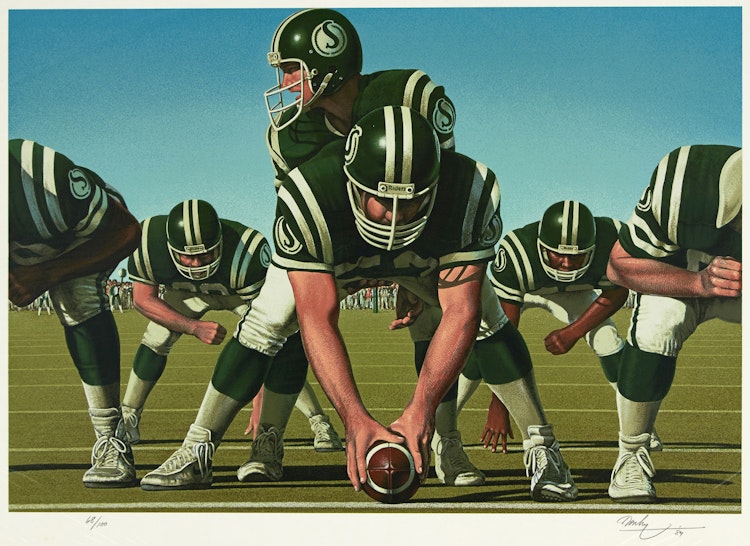
Ken Danby’s great painting, Roughriders. Everything has changed, yet the feeling remains. Timeless.
More nonsense, this time about football, as we try to erase the memory of the World Series from our Canadian minds!
I grew up only a few short blocks away from the setting of this painting, which was old Taylor Field. If the Riders are going towards the south end zone, then you could almost see my house between the QB and the running back on the left.
Growing up so close to the action, it was impossible not to become a life-long fan, which at times is both a blessing and a curse. We’ll see what happens this year!
Thanks for reading more stream-of-consciousness whatever it is!
we had a pee wee football and some nights we would play catch on dewdney avenue on the sidewalk in front of dewdney drugs and the doctor’s office on the corner and paramount cleaners and johnny the barber and the utopia cafe and gondola pizza and the little co-op store on the corner but this was a long time ago and I may be forgetting something anyway if you got good at it you could throw those little balls a long way and with any luck catch one that had been thrown a long way which is a good feeling maybe you know it and maybe it’s not all that surprising that we played with a football because taylor field where the roughriders played was only a block south of us so naturally football was very important to us sometimes we would cross elphinstone and walk over to the exhibition grounds and run around on the infield in front of the grandstand where they practiced and they had a machine that was a bright yellow frame with black arms of stiff rubber protruding from the inside of the frame which you had to run through if you could make it i guess those black rubber arms emulated the arms of the defensive linemen and linebackers and what made it special and even magical in a way to run through that thing was knowing that george reed himself would have been running through it a few hours earlier a brush with greatness unlike any other and we probably had the pee wee with us when we went there or maybe even a real football
In front of the Utopia Cafe on Dewdney Avenue, circa 1990.
My post about Aydon Charlton the other day brought to mind the neighborhood we grew up in, the old north end of Regina, Saskatchewan, Canada. Aydon and I shared the pedigree of being Albert-Scott men, Albert Elementary School and Scott Collegiate. Kids from the south end of town would look down on us I guess, but we were proud to have graduated from both of those schools.
Fun Fact. I once read that more students who started at Albert School went to jail than graduated from high school. Or maybe I just dreamed that. It’s not too big a stretch to imagine that it’s true. Interesting times, interesting place, for sure.
Nowadays they call it the core or North-Central. What had been a good working class neighborhood when I grew up there has fallen on a hard times. Macleans magazine called it the worst neighborhood in Canada, worse even than Vancouver’s infamous East Hastings area.
I knew the hood had fallen into hard times since I left back in the 1980s. (My parents stayed on in the house on Cameron Street until they, like most of their old neighbours, sold for what they could get and moved to the south end.) But I never thought it was that bad.
Last summer my wife Belina and I traveled back to my homeland. She came directly to Calgary from the Philippines and had never been to Saskatchewan. (Imagine!) We stayed at a hotel in the south end. (Where I ran into my high school art teacher, one of my favourite teachers of all time, still going strong!) We had tickets for the Rough Rider game, thanks to my friend Scooter. (Yes, I have a friend named Scooter.)
We planned to spend one morning touring around my old neighbourhood. I was afraid of what I’d find there, and I wasn’t sure how Belina would react if it was really as bad as Macleans made it out to be. We set out on a beautiful morning in June. We went into a Tim Hortons for some coffee and donuts. The woman working there was from the same province in the Philippines as Belina. Off to a good start.
We drove past my old house on Cameron Street. The front veranda was gone but otherwise the house and yard were in good shape. The lovely old elm trees arched high above the street, dappling the light of the early summer sun. The street seemed tranquil, hardly the ravaged war zone I had been expecting. All in all, the old neighbourhood looked pretty good that morning. I’m not sure I’d want to live there again. I’m not sure I’d be comfortable walking around there at night like I did as a kid. All in all, we had a nice day, seeing the sites of my younger years.
I thought it might be worthwhile to attempt some stream-of-consciousness sketches of the neighborhood I grew up in. Stream of what? Just my little way of making sure I’ll never make a million dollars from this blog of mine. (Sorry Belina!)
Here you go . . . .
these streets we walked along in broken down sneakers and jeans cuffs scraped down to hanging threads under the canopy of lofty branches verdant and dark and cool in summer, black and skeletal and sketched against a stark white sky and the crunching of footsteps on the snow (still in sneakers despite our mothers’ pleas to wear the boots they paid good money for) back and forth along the avenues past the library and David’s confectionery past the school we went where the recess battles were lost and won further along to the playground its pool empty and derelict in winter blue and shiny under the glow of distant street lights in summer when despite the tall chain-link fence we were drawn to climb over and go skinny dipping (only once for me thank you) although the water was cold and the prairie nights cool and it never lasted long enough to feel it was worth the effort unless of course there were girls involved but unlike the movies there were never girls involved and if we would cross the playground to the south side we would discover the foundation of the jail they kept Louis Riel in before they hanged him although we didn’t learn anything about that in school so what did we know anyway more likely we would turn north and walk the two blocks to our high school if we had any reason to be there, basketball in the winter, baseball in the summer and fall, bit just as likely we’d go back home and see what was on the two channels we got on tv back then
I took this in Moose Jaw on a trip back a few years ago.
Last weekend I gave a reading and conducted a workshop at the Rascals, Rogues and Outlaws Writers’ Conference presented by the Saskatchewan Writers’ Guild and the University of Saskatchewan at the U of S in Saskatoon. My fellow readers were novelists Catherine Bush from Toronto and Rosemary Nixon from Calgary (currently living in Saskatoon) and poet Alex Porco who now hangs his hat in North Carolina. I believe we all acquitted ourselves admirably and those in attendance seemed to come away with something to think about. Maybe even some of them were inspired by what they saw on stage to go home and take another shot at writing the Great Canadian Novel.
Beyond the conference itself, the weekend hit at me at a deeper level, at more or less a patriotic or nationalistic level, as for me in going back to Saskatchewan, I was going back home. Of course I’m from Regina, the Capitol, the Athens of Saskatchewan, and as such am normally bound by the traditions of the province to sneer at Saskatoon, but in this instance I was only too happy to dispense with that rather empty ritual. (Just this once, mind you.)
I am of the finest Saskatchewan pedigree. My father’s people came over from England in the very early days of the 20th Century. Grandpa, whom I never met, set up a forge in the bucolically-named town of Maryfield in the south-eastern part of the province. My mother’s people had homesteaded around the same time in the Alsask region. My grandma and grandpa eventually bought a farm in the Broadview area and that’s where my mother was raised.
My mom’s dad, William Hunter, was said to have been a mover and a shaker in the formation of the CCF Party, precursor to the NDP. I once heard a rumour that the Regina Manifesto was actually typed on his typewriter, but I have no way of proving that. You can see I came by my politics honestly.
By the time my sister and brothers and I came along, our mom and dad were living in the old north end of Regina, in the shadow of Taylor Field. Well, two blocks away. When they moved in, it was a prosperous working class (with pretensions to middle class) neighbourhood. By the time they moved out, down to the south end, it was called by Maclean’s Magazine the worst neighbourhood in Canada. Well, things change.
When I was in university, at the University of Regina, I was a pretentious, mustachioed, tweed-clad, pipe-smoking twit with no greater dream than to get the hell out of Regina and move to Toronto. And I did that. I went to York University and got myself an MFA in playwriting and dramaturgy at York University.
It grieves me, as a westerner at heart, to say that I had a great time in Toronto and that I believe it’s one of the best cities anywhere, in any country. But it really is a wonderful place, at least it was back in the ‘80’s. And yet, I looked around me one day, actually I looked above me, and I couldn’t see the sky, and I realized I hadn’t seen it for some time. So I moved back home in the late 1980’s. Really, on account of the sky.
I tried to make a go of it, but those were disasterous times for Saskatchewan economically. I tried to make it but I just couldn’t. So when I had an offer to have a play of mine produced in Calgary, I did like hundreds of thousands (yes, literally) of my fellow Saskatchewanians have done over the decades and took the Trans Canada west to Calgary. And here I have been now for 20 years.
Where does the time go?
Coming to Calgary led to two of the best writing gigs in the country, at the time. First, as playwright in residence at Alberta Theatre Projects and then as a feature columnist for the Calgary Herald. (Sadly, neither really exists anymore, in quite the same way. This blog is in many ways a continuation of that column. I haven’t figured out how to get them to pay me for it, though.)
When I began at the Herald, my publisher told me there are over 300,000 people in Calgary originally from Saskatchewan. It’s often referred to as Saskatchewan’s biggest city. “So govern yourself accordingly,” he said. And I did. I wrote primarily to a Saskatchewan audience. Well, pan-prairie on any account. But don’t get me wrong. I never would have had the type of career I’ve had if I hadn’t come to Calgary when I did. I was in the right place at the right time.
I have many good friends in Calgary and I love the city. It drives me nuts sometimes, but any city will do that. It’s a great city, a great place to live. After all, 300,000 of us Saskatchewan immigrants can’t be wrong.
Still, in going back to the homeland, something tugs at the heartstrings, some kind of inherent sense of kinship, of belonging, that exists quite beneath the realm of thought or awareness. I suppose no matter where you grew up, you feel it when you get back to your original home.
It’s healthy, I think, to celebrate that feeling. I always say, if you want to know where your home is, look at your health card. That will tell you all you need to know. But when I look to my heart, I know that my true home will always lie a few hundred miles east of here.
There’s a poem that I made from a monologue from a play of mine that I meant to read on the weekend, but that I never got around to. Don’t worry, I’m not about to keel over and die, at least I hope not, but the poem sums up the elegiac feeling I’m referring to. So here it is again. (Looking over at my poetry page, I am reminded I read this as part of my eulogy for my mother at her funeral a few years back.)
Home
It’s an issue of space.
You start out on the farm,
That great, vast prairie
To run and tumble in
The endless horizon
And the great dome of the sky
Boundless, unfettered.
But your mother calls you back
Back into the house
And it’s a big fine house
With many rooms
Sheltering a family, a home.
And then you muddle around and
The space around you expands and
Contracts to the seasons of your life
Your enterprise.
Yet at a certain point
You feel the walls begin
To close in around you
From a house
To an apartment
To a room in a home
Until finally
You are left
In just the smallest of spaces
A wooden box
And the prairie opens up
And you are lowered down into it
Home again
The circle complete.
______________________
Thanks for reading.
Here’s my old buddy Jack Semple, one of Saskatchewan and Canada’s finest musicians. This is from the Ironwood here in Calgary, but he still lives back home. We went to Scott Collegiate together, back in the day.
"I go to encounter for the millionth time the reality of experience and to forge in the smithy of my soul the uncreated conscience of my race."
One of my jobs these days is teaching what I would call “culturization” to a class of internationally educated professionals at a place called Alberta Business and Educational Services. (Please see my post from last August, Work Work Work.) While we focus mainly on the English Language, we also spend a lot of time talking about the culture these new Canadians find themselves in. Naturally this week we spent some time talking about Easter, which in turn got me thinking about Good Fridays and Easters past and how it was celebrated in this part of Canada when I was a child.
The religious aspect is very different now from when I was a kid, say 9 years old as I was in 1966, whereas the secular side seems pretty much the same. No big surprise there, as we have changed from a fairly religious society into a secular one over the course of my lifetime.
I was raised in an Anglican household which is hardly charismatic or fundamentalist, but even so I remember Good Friday being a very serious day. Certainly in my early years we attended church on Good Friday, although that seemed to taper off as I got into my teens. Well let’s face it, the whole thing tapered off when I got into my teens. The deal made was that after confirmation, around 13 or so, you could make up your own mind, and so like most of my friends, I made up my mind not to go anymore.
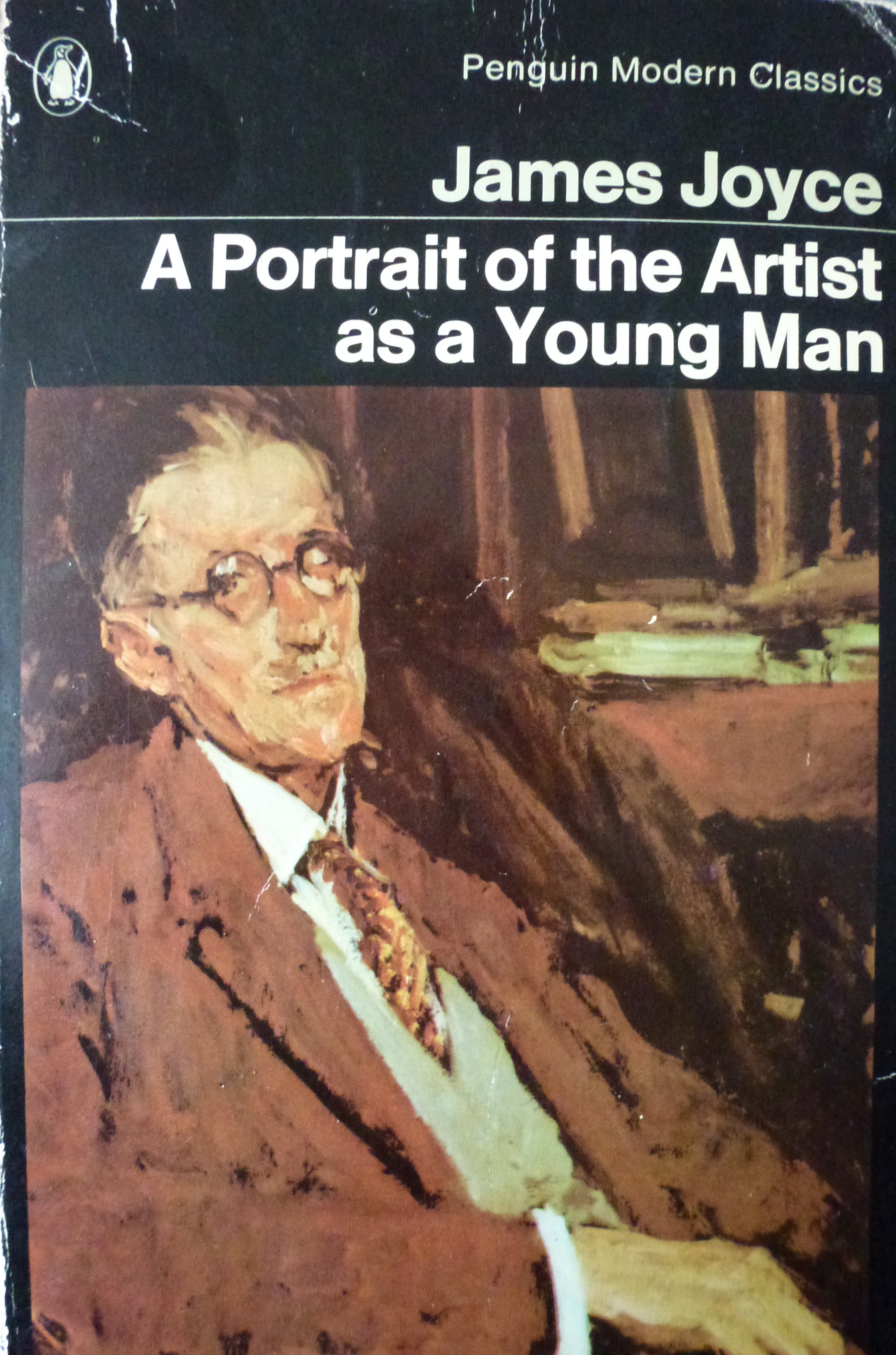
If I needed any “confirmation” that I was on the right track, it came when I got to college (around 1976) and read James Joyce’s Portrait of the Artist as a Young Man. We all read it back then, us artsy types, as we shifted our sense of the holy from religion to art. That book, maybe more than any other, influenced my decision to spend my life in the realm of aesthetics. Back in 1976, such a pursuit precluded religion of any description. At least for many of us it did. I don’t think much has happened to change that in the last 40 years or so.
And yet I remember with some lucidity St. Peter’s Anglican Church in the old north end of Regina on Good Friday as it was in the 1960’s. Obviously there was no theatrical tradition in Regina at that time to influence my decision years later to become a playwright (the Globe Theatre, like so many Canadian theatres, was founded in the early 1970’s), but the church provided plenty of dramatics. The image I remember most vividly was the black crepe that covered all of the crosses and other iconography on Good Friday morning. “Somber” doesn’t begin to evoke the feeling it helped create in the church for that particular service. Although my mother was hardly strict, even at a young age I could tell that unwarranted displays of levity would not be appropriate and would be dealt with severely. I’m not sure that I was able to grasp the religious or theological significance of the day, but I knew something good was not happening, which in my youth made me question why on earth they called it “good” Friday in the first place.
But then things got turned around in a few days, thanks mostly the intervention of the secular component of the holiday, the Easter Bunny. This was Santa Clause’s leporine counterpart who as I understood it eschewed a reindeer-powered contrivance and simply hopped from house to house delivering chocolate bunnies and chickens and jelly beans and the like to all good children, everywhere! (We had no idea at the time that other children elsewhere in the world weren’t just like us.) He even took the time to hide them in shoes and under pillows and other places that were so clever some years we’d be still be finding stale confections well into the summer – the piano bench! My baseball glove!
It may not seem much but in those days, citizens of this part of the word did not regularly stuff themselves with sugar-based edibles. Chocolate was still something of a special treat. I read somewhere that the average serving of a Coke around that time was 8 ounces, and you might have one only a few times a week. Nowadays an average Big Gulp, a staple of some daily diets, is something like 32 ounces. And that’s just the tip of the iceberg, or the slushy-berg. (The need North Americans have developed for sugar is beyond the scope of this post, to put it mildly.)
On any account, Easter came. I’m not sure when I was young if I really understood the concept of resurrection – I probably didn’t understand the concept of death, if I even do now – but importantly, beyond the religious aspect, it came with chocolate and yes, the church was transformed, the black cloth all gone, flowers everywhere, the congregation belting out a wobbly Halleluiah Chorus, hugs and handshakes all round and even the minister was smiling down on us; back home some new clothes to wear, the big meal prepared, the Lenten abstinence having come to an end so the wine was flowing (but not too much!), the air blue with cigarette smoke and pipe smoke, my brother still alive and my grandma arriving and slipping a quarter into my hand which in those days went a long way at the candy bar or, if one was of a literary bent, and being already overburdened with chocolate, towards the purchase of two Archie Comics . . .






 eugene stickland
