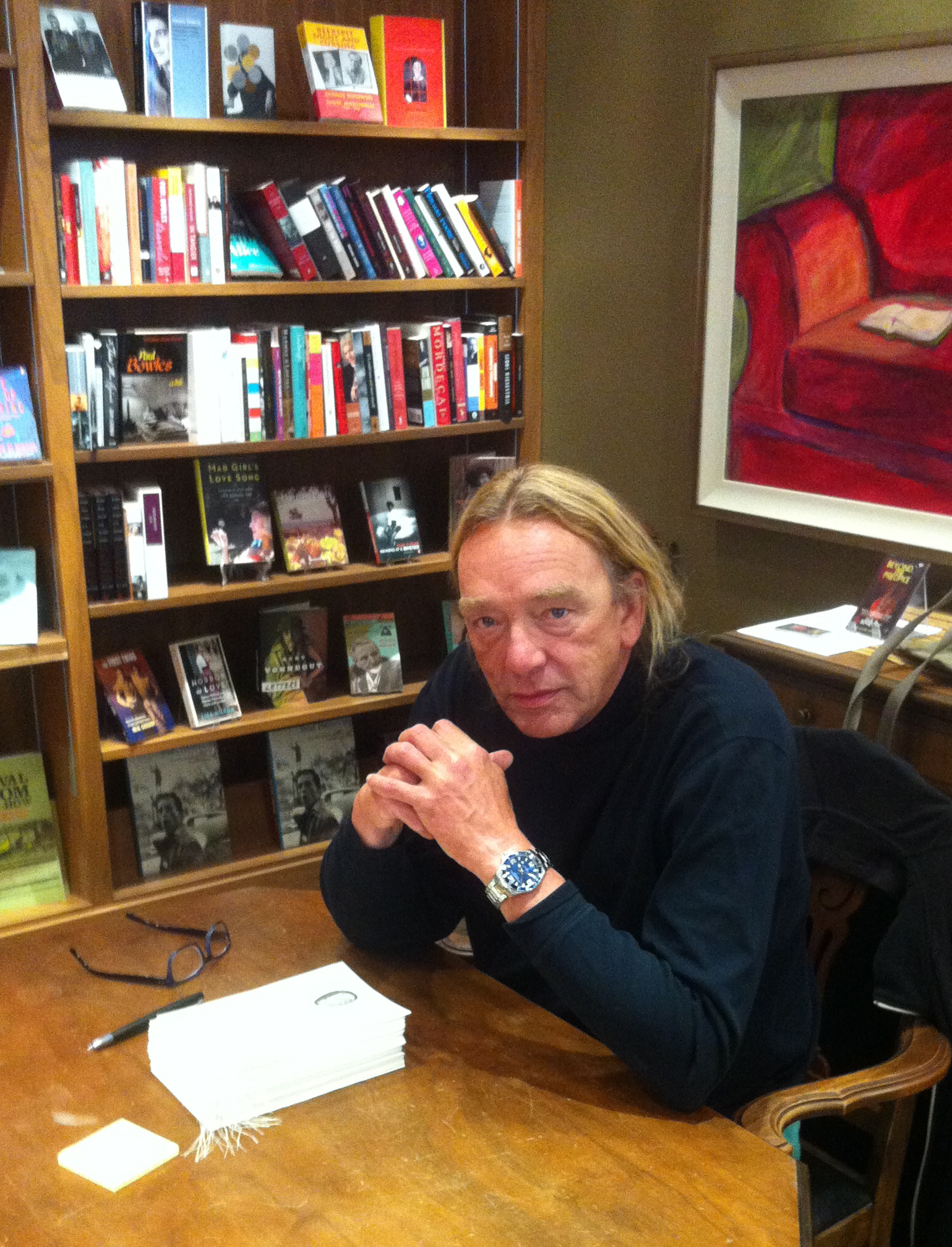
Hard at work, signing and numbering the books. I’m actually much better looking than this in real life.
If you should happen to meet someone who claims they know what’s going on these days with publishing, run the other way. No one knows. If anyone might know, it might be me, but I’m telling you I don’t know. Therefore, no one really knows. And there certainly is no secret.
When first there were computers and clumsy dot-matrix printers back in the early 80’s, it didn’t seem to change much, and so it was business as usual for writers for a few more decades. We carried on the same as we did when we were typing.
It seems to me (another way of saying I have no idea what I’m talking about but I’m going to say it anyway) that not a lot of attention was paid to printers in the early days of computers because the theory was that we would soon become a “paperless society.” That’s what they told us and we believed them.
I don’t know how many trees I’m personally responsible for slaughtering since then, but probably a small forest.
And yet, at the same time, they weren’t entirely wrong, these experts. The fact that you are reading this post electronically, as we say, is proof of that.
The one area of printing that befuddled the experts from the beginning was the book industry. Rather than roll over and die, it seemed to flourish in the electronic and later digital age. It seems to me (again, no idea, just saying) there were two (at least) reasons for this. For one, those of us in the literary community supported the industry as well as we could in the best way we could, by buying books. I know so many people like myself who own a Kobo or Kindle and an iPad or other tablet who still (and always will) prefer the “real thing” as it were. And the book industry responded by creating nicer books. It’s true. Books, as physical entities, as artifacts, are much nicer now than when I was a student of literature in the 70’s and 80’s.
Being in the publishing business myself, I know that it is possible to create beautiful books. Especially with a small press like B House, where we do very small runs of our books, it’s possible to create books that are beautiful inside and out, as it were. (We like to think that not only do they look nice, but that what’s inside them is worth reading as well.)
While I’ve been hard at work (not really, but you get my drift) publishing the work of others, I was recently rewarded with a publication of my own by an even smaller press than B House called 100 têtes Press, run by Calgary poet Paul Zits. 100 têtes is somewhat oxymoronically (I love that word) a chapbook press. All the books are created by Paul himself. The care he takes with typesetting and selection of papers results in very beautiful and unique books. He even sews them together on a sewing machine on his dining room table.
Here’s what Paul has to say about it:
Written, the name 100 têtes translates into English as “one hundred heads.” Spoken, the name takes on a second possible translation, namely “without a head.” The name, appropriated from Max Ernst’s 1929 graphic novel, La femme 100 têtes, reflects Zits’ own personal interest in collage-work and literary montage. From their materials, design and binding, reflected in each book’s unique presentation, is 100 têtes belief in the book as art object. But the name is also meant to emphasize the Press’ community-driven focus, made up of, simultaneously, one hundred heads and no heads.
It is the mandate of 100 têtes Press to publish local writers, both new and established, of any genre, with an emphasis on experimental and conceptually resonant poetry, prose and visual art.
The name of my book is Silent Suite and it exists in a limited edition of 40 copies, signed and numbered by the author himself. (That would be me.) It contains three short, sparse poems which I wrote really in reaction to the oh so busy wordy poems I’m used to hearing at poetry readings these days. (Remember the famous line in Amadeus – “Too many notes, Mozart.” I feel like saying that to young poets nowadays – “Too many words!” Hmmmm. Maybe I did just say it. That feels better!)
So, here we see at least a trend in publishing – smaller runs of uniquely produced books which can quickly become collectors items given the small numbers involved. The problem, as you can probably tell, is that no one makes any money from this. That’s the problem as I see it when it comes to publishing in the modern era. As bad as it was for writers in the past, it only seems to be getting worse. The resume expands even as the bank account shrinks. What else is new?
Because Paul is not in it for the money, as they say, his suggested price for the book was $4.00. The day I signed them at Shelf Life Books (there’s a link to Shelf Life to the left – that’s where you can buy a copy, or through me directly), manager Will Lawrence (always the sharp businessman) countered by suggesting a price of $8.00 per book.
After much strenuous negotiation between publisher and book-seller, finally a compromise was reached — $6.00 a book!
As I say, none of us is getting rich, but we at least have the satisfaction of bringing a funky new book into the world.
I managed to sneak one of my classes on stage at the Jack Singer after a tour of the downtown library.
In 2009 I began a very interesting adventure in teaching at a school in north east Calgary called Alberta Business and Educational Services, or ABES, as it is known. They had just come up with an idea for a program aimed at helping internationally educated professionals, primarily in the health care field, find meaningful employment in the health care system here in Alberta. (I have written about ABES before: please see Work, Work, Work from August, 2011.)
I know we have all had a cab driver who comes from somewhere else and who has a PhD in some exotic field or other. I know it doesn’t seem right to most of us that we accept such talented people into Canada and then give them little or no opportunity to practice in their particular area of expertise.
Well, this program at ABES allowed me the opportunity to do something about that. The idea was that they would study for 12 weeks with me, and then study the very practical program in sterile processing that would allow them to become medical device reprocessing technicians. In other words, they would be cleaning up the instruments from the operating rooms and other areas of the hospital.
One might argue the merits of training former surgeons how to clean up the instruments they had used in their home countries as a matter of routine, but it was at least a door into health care services here. Compared to what a lot of them had been doing, such as cleaning floors at Tim Horton’s (as a pharmacist from Afghanistan was doing) or stacking apples at Superstore (as a surgeon from India was doing) or delivering pizza (which a veterinarian from Iran was doing), etc. etc. etc., this new gig we were offering in the hospitals was very prestigious and the pay wasn’t bad either.
For my part, it hasn’t been ESL, exactly. My boss at ABES, Mitchell McCormick, refers to it as “teaching a cultural vocabulary,” which is an apt description. Let me give an example of how I can build a whole week of lessons from something that emerges organically from the class.
During the last federal election, one of my students, a doctor from Cairo, asked me one morning, “What eez ziz I am seeing on all of zeez signs everywhere, Fote, Fote, Fote?”
“Fote? Oh, you mean vote.”
“Zeez eez exactly vot I am saying: Fote.”
Well, I explained, we were in the midst of a federal election and we were being encouraged to vote. And as I said this, it dawned on me that the entire concept of a free election, which we take so much for granted in Canada, to the point that most of us don’t even bother to vote, was an entirely new concept to many of my students, depending on their country of origin.
This allowed me to tell them about our political parties (maybe one in ten would typically know who our Prime Minister is, for example) and the history of politics and Canada going all the way back to Sir John A. (And despite the fact all of my students had handled many ten dollar bills in their time here, none of them knew the name or significance of the old boy on the ten, let alone the guy on the five, but of course we would get to Laurier eventually.)
So, a reasonable exercise was then to find out what ridings they all lived in, who their MP was, who was running in the election, the nature of their platform, etc. etc. etc. In a subsequent provincial election we did the same thing.
You get the idea. What I teach is very practical, meaningful and inclusive. All of my instruction is aimed at helping my students get a job, and instilling the feeling that they are informed and valued members of our community.
This program has been a remarkable success by anyone’s standards, with a completion rate of 97% and an employment rate of nearly 90%. For me, personally, it has been a good fit into my lifestyle, providing some structure and steady income for roughly half of the year, and then affording me the freedom for my other pursuits the other half. This summer, for example, has been taken up with the writing of a novel. But even as I have taken the time to write my novel, there is now a growing concern that the program may not be renewed.
I have seen firsthand just how effective this program is, not just in terms of job training, but perhaps more importantly restoring a sense of hope in our students, and the attendant dignity that goes along with having a meaningful job that allows them to provide for their families.
Unfortunately, the funding for the program has always been tenuous and now we are worried that despite its unparalleled success, it could be cancelled altogether. Honestly, there are so few good opportunities out there for the community we are serving with this program that it would be extremely unfortunate if the funding were not renewed.
You know, it’s not easy immigrating to a new country. I know the alienation and even despair my students feel when they first walk into my class. Yet, I have seen so many of them grow and take their place in our community thanks in no small part to a cool little program in a cool little school just a little east of Deerfoot.
We put together a short video, narrated by yours truly, which I am including below for your further edification. If you agree with me and can see for yourself the importance of this program, please feel free to share this post or just the video itself with others, including MLA’s and other people who could influence a decision on the future of this program.
In the words of the poet, “Don’t it always seem to go, seems you don’t know what you’ve got till it’s gone . . .”
This, the final object I will talk about in this mini series of my life, is a little different from the others because it actually allows me to get out of the apartment where all the other objects can be found. But in going through this exercise of telling my story through 10 objects, it would be impossible to talk about the last four years or so without talking about my bike.
It’s a 30 cm single gear Skyway from Mountain Equipment Co-op with fixie option but I’m not that crazy. As with most of the objects on my list, there’s a story about how it happened to come into my possession.
Three and a half years ago, I was struck by a car as I was crossing 17th Avenue, which is a busy thoroughfare in my city of Calgary. I was a pedestrian, crossing in a crosswalk on a green light. A car came up the street behind me and turned left. The driver never saw me. Suddenly I was crawling off the busy street towards the sidewalk in the rain, in an awful lot of pain.
He hit me hard enough to etch the insignia on his vehicle’s bumper into the skin of my back through a light ski jacket. I sustained cracked ribs and some damage to my left hip and elbow as well as whiplash.
It all happened so fast. There I was, minding my own business, on my way home to do my laundry and the next moment, flying through the air above 17th Avenue. How quickly and dramatically our lives can change.
The doctor at emergency was convinced I must be in seriously great shape to have taken such a hard hit and walk (or limp, at least) away from it. It didn’t really seem all that grave at the time. I even had enough wherewithal while at emergency to flirt with my nurse who had actually seen a few of my plays and thought I was kind of a big deal. But there were lingering implications.
The physical effects weren’t all that bad, really, although cracked ribs are hardly a walk in the park in springtime. Yet after the ribs had healed and I could turn my neck again, I found myself sinking into a kind of funk, a lethargy that nonetheless was tinged with a sense of panic if I had to too much, especially if I had to do more than one thing at a time. I consulted a friend who knows about such things (ie, a shrink) and it seems I was going through some manner of post traumatic stress disorder.
I was growing rather soft and spongy, physically. All of which was surely leading to a low-grade depression, which I am prone to at the best of times. A friend of mine, one of those extreme-sports-iron-man-triathalon lunatics, got fed up with just sitting by and watching this happening. He came up with a form of therapy that worked both physically and emotionally: I needed to start moving around again, and a new bicycle would be just the thing. (My own bike had been stolen a year or so earlier.)
And so we went over to MEC one day and he very generously bought me this one.
The first summer I had it, I was honestly too terrified of the traffic to use it much. Plus, I couldn’t turn my neck far enough to see what was behind me which is simply not a good idea when riding a bike in a busy city. But I’ve always loved riding a bike, and so I kept pushing it and little by little, day by day, rode more and more until now it’s become second nature.
This in part led to the decision that after 40 years of having a car, I no longer needed one. The decision was partly financial as I really don’t make enough money to justify the expense. It also had to do with my health and general well-being. I didn’t like being spongy. At my age maybe there’s only so much you can do, but everyday I’m out there I figure that by riding, I am making things a lot better than they would be if I wasn’t out there.
And finally, the decision to opt out of the whole automobile-gasoline dependency addiction that most North Americans suffer from has been one of the most liberating things I have ever done. I’m hardly militant about it , but sometimes when I ride past or through a traffic jam and see the looks of frustration or anger or despair on the drivers’ faces, I can’t help but feel a little smug.
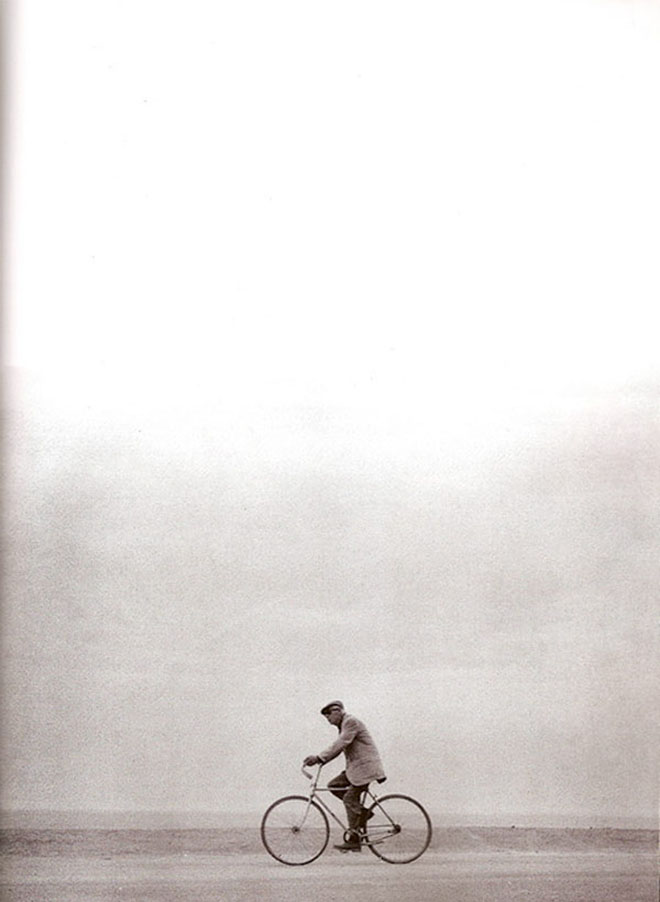
I’m not the only writer of a certain age to turn to a bicycle for solace and companionship. Henry Miller famously wrote My Bike & Other Friends (1977) and if you’re interested in cycling and literature, this is a very good book to read. I found this wonderful photo of Miller which I wanted to share with you:
Funny to think that the author of Tropic of Cancer ended up here.
To answer a question posed in earlier posts: if my house were on fire, which object would I take? I don’t really know for certain, but I would certainly make a speedy getaway from the flames on my bike.
And who knows, maybe once I got out on the street, freed from the tyranny of my possessions, I’d just keep going and never look back, free as a bird.
One of my favourite musicians, who is also an avid cyclist, happened to write a song about burning down a house, so that seems like a good place to end this examination of my life through ten random objects. Enjoy.
Certain fountain pens, such as my Mont Blanc 149, are filled by placing the nib in a bottle of ink and then using the mechanism (with some pens it’s a plunger, with others like my Mont Blanc you twist the end) the ink is drawn up into the barrel of the pen. With other pens you can use cartridges which is neater but not as much fun. Filling the pen from an ink well leaves excess ink on the nib of the pen which needs to be wiped off.
You can use a tissue or a paper towel for this, but I have this special cloth intended solely for this purpose. It is 10” square made of very soft white fabric, zig zag cut on all sides. An abstract pattern on the cloth develops as you use it, growing each time you fill your pen. Because there are so many different colours of ink, the palette for this piece of found art is limitless. It becomes a kind of historical road map – you can see all the different colours you have used over the years.
I can look at the traces of green ink on this cloth, for example, and be taken back to the time when my girlfriend Katie passed away. I wrote a tribute/eulogy as a form of therapy, I guess, that sprawled to about 40,000 words. That particular colour of green is Mont Blanc’s British Racing Green. I used the entire bottle writing that document. I will never use it again.
There are many colours and they bleed and blend into a myriad of shapes, making a found abstract art object of my pen cloth.
Selecting the cloth as my 9th object in this exercise allows me the opportunity to talk about a few of my pens. I should begin by mentioning that I have always preferred fountain pens to ball points or roller balls. I began buying pens back when I was in high school. That was in Regina in the 1970’s and there wasn’t much selection to be found, anywhere.
It really wasn’t until I moved to Calgary in 1994 that I found the sanctum sanctorum of fountain pens at Reid’s Stationers on 17th Avenue. In my mind, this is one of the best, if not the best, repositories of fountain pens in the world. The other notable place is the Fountain Pen Hospital on Warren Street, near the World Trade Centre site, in New York. But I prefer Reid’s and almost all of my pens were bought there.
To name but a few . . . one of the first pens I bought and probably the cornerstone of my collection is a Mont Blanc Meisterstück 149. This is a big fat classic fountain pen with a huge gold nib. It is probably the most beautiful object that I have in my possession.
I had wanted one since the 1970’s. I used to go into the old Birk’s Store in Regina when I was a boy and look longingly at this pen. Back then I think it sold for $300.00 or so, which was way beyond my means. Nowadays I think the 149 retails for about $800.00, making it still way beyond my means, but there’s a nice story as to how I came to acquire the one I have.
Around the year 2000, Alberta Theatre Projects where I was playwright in residence almost crashed and burned financially. But for some very generous support from a number of Calgary companies, mostly in the oil patch, the company would have gone under.
I did a number of writing jobs for some of these companies and certainly went above and beyond what was expected of me as ATP’s resident playwright. As a result, when the dust settled and the company was actually left with a bit of a surplus, Gie Roberts, the general manager, said to me one day, “Why don’t you go down to Reid’s and buy that pen you’re always yakking about and send me the bill?”
What a day that was! And what a generous gesture that was! It was easily the most significant purchase of my entire life. And I was left with a classic fountain pen as well as a beautiful reminder of the wonderful ten year stint I had with that theatre company.
I have two pens, a Graff by Faber Castell and a Lamy 2000, that have a direct association with a friend of mine who was an operative for the CIA based in Calgary. He introduced me to the beauty of the Graff and to this day it is one of my favourite pens. I inherited the Lamy when he passed away a few years ago. It’s the pen I tend to use on an everyday basis.
And my friend really did work for the CIA. Honest. I don’t make these things up.
I could go on and on all day about my pens but I’ll leave it at that. If you’re interested in getting a decent pen for yourself and you’re in Calgary, I recommend a visit to Reid’s Stationers on 17th Avenue across from Western High School. They have pens ranging from $10.00 to $3,000.00 and the staff will help you find the pen that’s right for you. Mention this blog and who knows, they might even throw in a free bottle of ink. After all, I am known there.
In looking for a musical selection for this post, it was a bit of a creative leap, but I found the perfect song for a series of blog posts about the importance of objects, or things, in our lives.
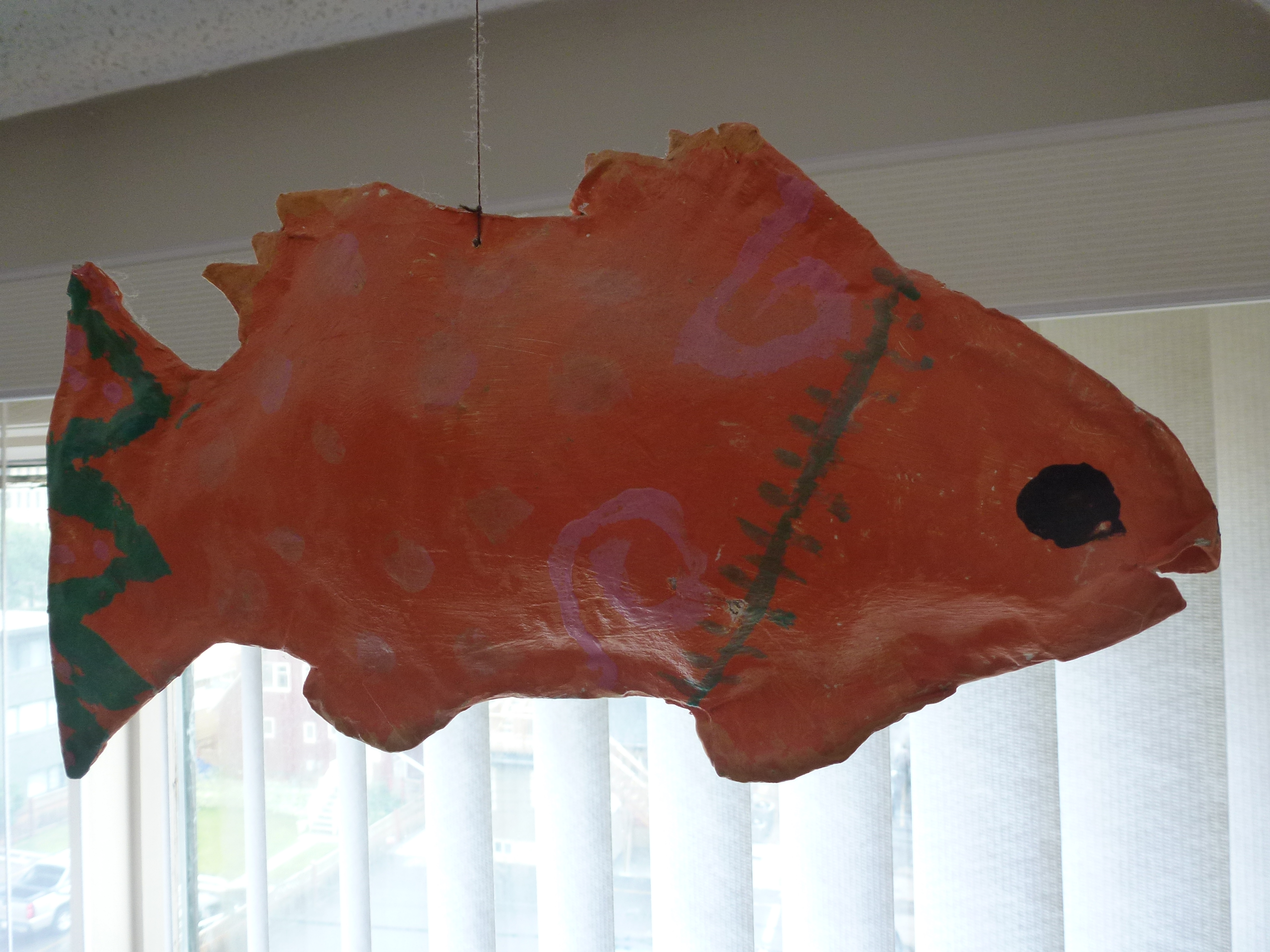
This rare object hangs in my living room. It is about 12 inches long, predominantly orange with green flashings along the tale and just behind the head, and with subtle mauve design work along the sides.
It was created by the artist Johanna Stickland when she was a predominant member of the so-called Hillhurst School. For the artist, it represented a triumphant emergence from her turbulent plasticine era, shortly before she went on to master other forms such as pencil crayons and oil pastels.
I think Hanna was about 8 when she brought this home from school one day. I’m sure that she reinvented the physiology of the fish as we know it with the various fins that seem to be in the wrong places.
The markings behind the head look like crude stitches and give it the feel of Frankenstein’s monster, like the head of one fish had been stitched onto the body of another. When she brought it home, we laughed at just what a crazy fish it is, really, and then I hung it up anyway, because after all my daughter had created it and that was good enough for me.
It’s hung in the various places we’ve lived in ever since. Of course, great art endures and stands the test of time.
I don’t know that there is one single object in my place that I would grab if there was an all-consuming fire. Hell, I’d be a fool not to grab my laptop. But I know for sure there is no object in my place that means more to me than this one.
There are many things about my daughter that make me very proud, but her approach to her life, her artistic sensibility and her great humility always fill me with wonder. Seeing her grow into an adult and the way she is living her life makes me feel that my part in her development is the one worth-while thing I have ever done in my own life.
While I’m talking about her, let me share one story that in mind sums up her character.
Around the time she created this wonderful fish, I was the playwright in residence at Alberta Theatre Projects. Over the course of her young life, Hanna had spent a lot of time at ATP and was certainly known and loved by my colleagues at the theatre. In 2000, when Hanna was 8, the company was preparing for a production of a play called Red Lips by Connie Gault for the playRites 2001 Festival.
They needed an 8 or 9 year old girl to play one of the parts, and as Hanna was a known quantity, at least socially, I was asked one day if she would be interested in the role. It was quite an opportunity, and while she had never really acted, I thought it would be an amazing experience for her.
When I got home that night, I said, “Guess what, Hanna. They’d like you to play a role in one of the playRites plays this year. Isn’t that amazing?!?!?!”
Hanna looked at me skeptically and said, rather coldly, “Do you have the script?” I told her I didn’t. And then she said to me, patiently, like I was the novice and she was the seasoned pro, “Well, I’d have to read it first.”
Duhhh.
The next day at the theatre, when asked what Hanna’s decision was, I rather sheepishly reported that she would need to read the script (Duhhh) and got a copy and took it home.
This was not a kid’s play, it just happened to have a kid in it. This was an adult play, a Connie Gault play, and Connie is a sophisticated and complex writer and Hanna was, after all, only 8 years old. I got home and gave Hanna the script. She took it and went into her room and about an hour later emerged and said to me, “I’ll do it.”
That’s how she was at 8!
She did the play and acquitted herself very well. I have never been as nervous in my whole life as when she came on stage, but she did a wonderful job. And you might think that would have led to a desire to do more acting, but it didn’t really. She enjoyed the experience, learned from it, and then moved on.
I think it was much like that with her modeling career. She did it for a few years, she did extremely well, she became quite famous, but then it seemed time for her to move on again. After a hiatus during which time she returned to Calgary and completed high school, she is back at it, but now on the other side of the camera.
In this way, her life continues to be an unfolding and beautiful exploration of the nature of art. She is a graceful, gentle, intelligent girl, beautiful inside and out.
And that sense of Hanna the girl, Hanna the artist, I suppose must be what goes through my mind when I see this fish, although I don’t always say it. But I surely feel it. Even in looking at this crazy fish.
Looking around for a musical offering for this post, I looked at the hits of 1992. There were some very good songs that year (November Rain) and some very bad ones (remember Criss Cross?!).
This one is neither good nor bad, it’s just silly, but it’s awesome in its silliness and it seemed appropriate.
One a a few hundred notebooks/journals kicking around my apartment.
As you may know, I am an inveterate diarist. Each and every day, give or take a few lapses, I write down my thoughts of the day in a journal.
Why do I do this? Dunno. Just do, that’s all.
In telling the story of my life (thus far) through ten objects that can be found in my apartment, it would be impossible to ignore my completed journals. There are so many of them, sometimes I feel quite overwhelmed.
If we would think of my journals as one lengthy oeuvre, it would fill up over 100 notebooks going back to a notebook that I filled up with musings while still in high school, circa 1974. This work is simply the story of my life and how I lived it, filled with reflections not so much about the things that went right as on the things that went wrong.
I often tell my writing students that we don’t tend to sit down and write because our favourite baseball team won a close game. But a phone call that never came, well, that’s another matter entirely, probably good for at least a couple hundred (or thousand) words.
Doing a rough calculation – which I am absolutely useless at, given that I was not blessed with any mathematical skills whatsoever – this great document must be between two and three million words long, and growing a little longer each and every day.
That’s a lot of words. That’s a lot of anything!
Obviously, there are a lot of journals to choose from for an exercise of this nature, many different ways to go. For true stationery nerds like myself, I know that examining my shift from lined to graph paper that happened twenty years ago or so would be fascinating reading. But perhaps it’s best to say that it happened for reasons I don’t really understand, and move on.
I did find one journal that is quite unlike all the others in a few ways, and that’s the one you see pictured above. It’s quite an unusual size: 6” x 4” and 1” thick. I bought it at a Borders store in New York in 2007. (I wish now I’d bought ten of them because they are hard to find in this size, especially with graph paper.)
Two things in particular make this journal unique.
The first is that the entries aren’t dated, and so unlike every other journal I have ever written, the entries aren’t chronologically organized. I write quite randomly in it, so it is impossible to tell when exactly the entries were made.
For example, here’s a happy little poem I wrote one day. I’m not sure when. I’m not sure what great emotional blow I had sustained that prompted me to write it, nor do I know whom that blow was delivered by, but obviously my heart had taken another pounding, prompting this:
the heart bleeds out
connections tenuous anyway
are broken
unspoken desires die
on bruised lips
little wind eddies
scraps of paper scattering
setting a new order
of random.
don’t you ever
fold your hand
and walk away
from the table?
______________________
Happy happy! You can see why most things that one writes in a journal never see the light of day. (Until now, it would seem.) In this sense, I guess one could say that the journal is used for practice. (Check out Franz Kafka’s Diaries some time for a great example of this, published by Schocken. He’ll write the same sentence over and over, just to try to make it as clear and economical as possible.)
Most of the time, the writing is not all that good, and not even meant to be shared. But every now and then, something works, and can become the basis for a poem or a play or even a novel.
They say in photography you’re doing well to get one good shot in a hundred. I’d say in writing that ratio is even greater.
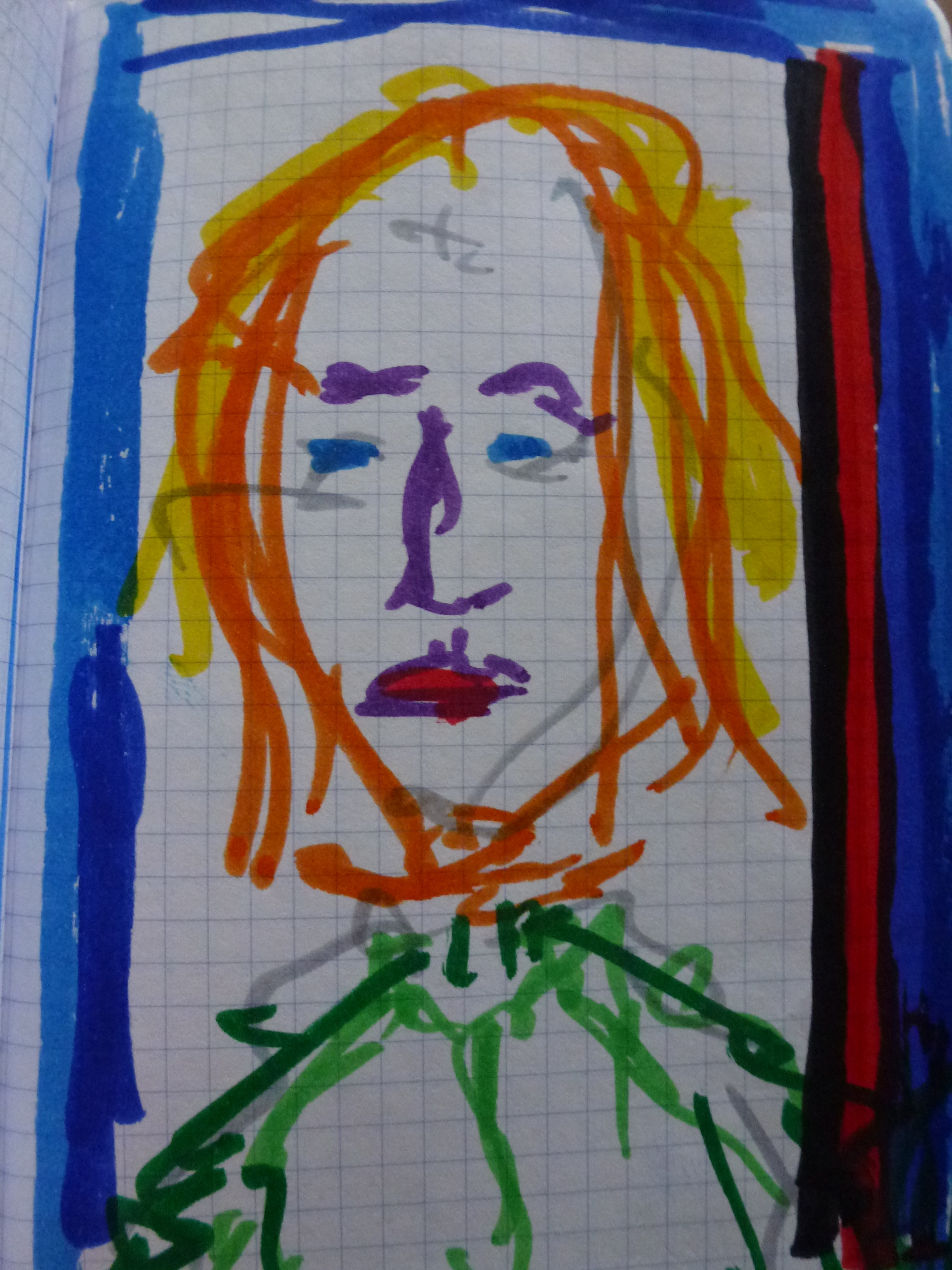
The other unique aspect of this little journal is that it contains twenty or so self-portraits. I know, I know, you’re thinking is there no end to this giant ego? But it’s not like that, honest, it was part of an exercise to begin each writing session with a quick self-portrait, just a quick line drawing by way of preparation. I heard that Leonard Cohen did this for a while and I thought that’s good enough for me.
I can’t really describe these properly in words so here are a few examples. I don’t normally share them so don’t be too critical, I have no illusions about my drawing skills. I’m posting them as thumbnails so they can be enlarged:
“because I forgot my glasses, I look perhaps like this . . .”
The halo is slipping . . .
Infected!
etc.
Well, you can see for yourself, they are good fun and not meant to be taken all that seriously. I’m not sure that going through the exercise of drawing the self-portrait changed the quality of my writing or not. It perhaps led to a little more abstraction and freedom, I suppose, from the tyranny of the written word.
And so, I will keep on writing in my various journals. When cellist Pablo Casals was in his ’90’s and still practicing for four hours a day, someone asked him why he bothered. “I think it’s started to help,” he said. And I guess I feel the same way.
Here’s a cool little number I found on YouTube to leave you with.
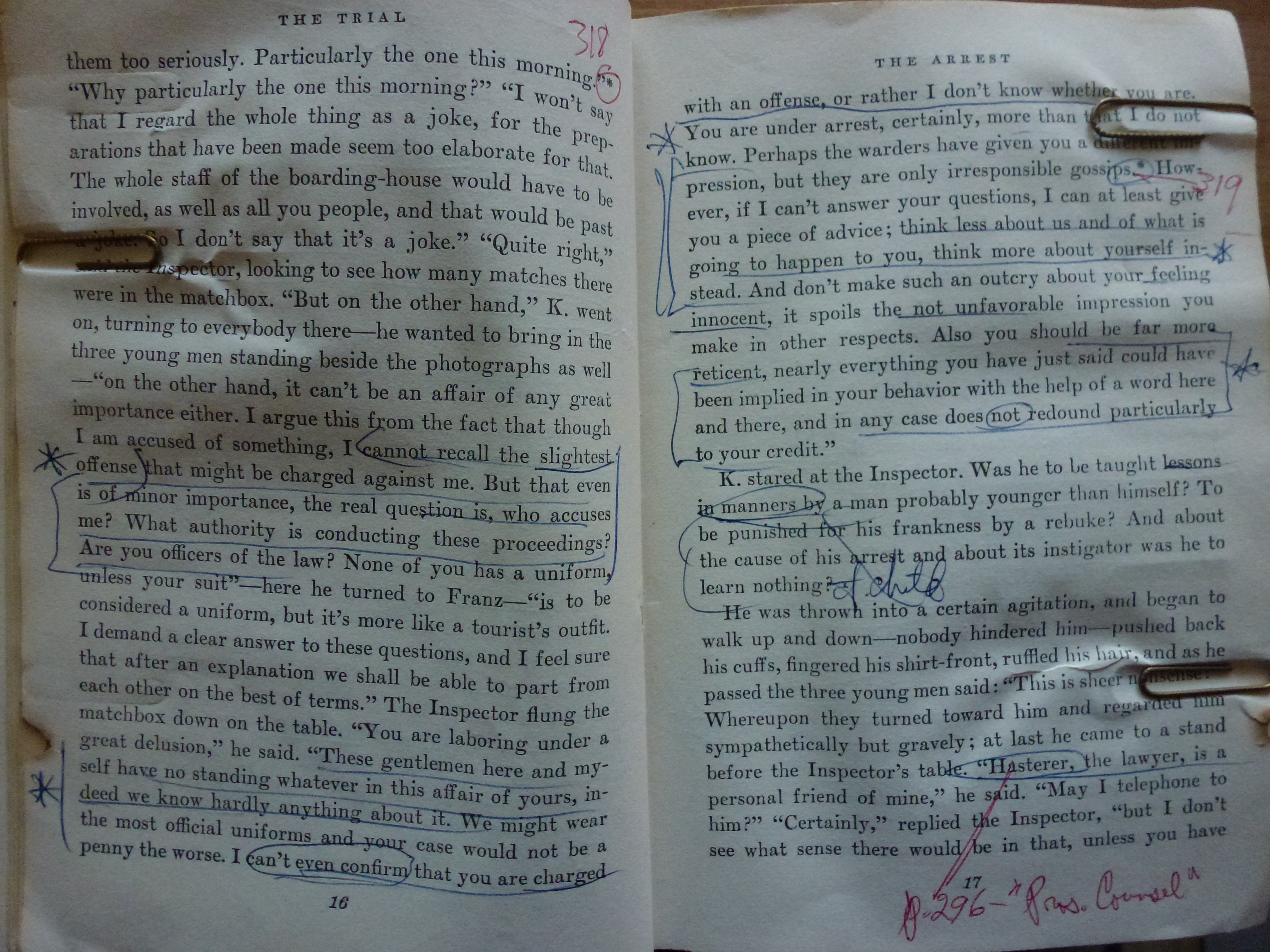
It’s so old you can hardly see the title which is embossed in gold on the green fabric.
This copy of The Trial belonged to one of my mentors, Gene Dawson, whom I wrote about, inadequately, I’m afraid, earlier on this blog. (Please see Mentors Series 2: Gene Dawson, September, 2012.)
When I began this series on the objects in my apartment that tell my life story, I asked the hypothetical (hopefully) question, “If your house was on fire and you could only take one object, what would it be?” One of my bookish friends asked me specifically which book would I take in the face of that same all-consuming fire; my answer would be this copy of Franz Kafka’s The Trial, the Modern Library edition from 1956, coincidentally the year I was born.
I have read this copy of the book once. I have also read, several times now, the Schocken Books edition of 1968, which you would think would be the same, but contains some subtle differences. Both editions use the Willa and Edwin Muir translation, but in this edition the text has been revised by E.M. Butler.
So I suppose it was Butler who changed the famous opening sentence from “Someone must have been telling lies about Joseph K., for without having done anything wrong he was arrested one fine morning,” to “Someone must have traduced Joseph K . . .”
Why would he do that? Did he think that was better? Traduced? Really?
As we all know, there are many different kinds of books and many different approaches to reading them. These days, for example, I am indulging in a bit of summer reading, a guilty pleasure, with Inferno by Dan Brown. I feel kind of cheap and sleazy reading this. I didn’t even buy the book, I didn’t want it in my place, so I put it on my Kobo instead. Still, he’s got me hooked and I am learning a lot about Dante and Florence and the Divine Comedy and all the rest of it.
So there’s summer reading, which is allowed. And there is skimming and there is analytical reading and there is devotional reading to name but a few. I would like to propose a new category of reading. Unlike most reading experiences which I would call reader-based reading, there is an entirely different way that some of us read, those of us who are writers, and I would call this writer-based reading.
This type of reading is not recreational or escapist, in fact it’s part of the work we do, and we do work, even though some people are convinced that we really don’t and the words just appear by magic in our word processors as we sleep at night.
Writer-based reading is actually hard work. What we’re looking for as we engage in this exercise is not so much ideas – hopefully we have those, although again, many people seem to be convinced that we don’t, so we often hear things like “Hey, I’ve got a great idea for you!” or “Here’s a really good idea for a play!” implying that all of our own ideas for plays thus far have not been very good at all.
In writer-based reading, one could say we are looking for examples of the very best technique to express things in a way that will resonate as deeply and hopefully universally as possible. And then these things we steal. By the time we actually employ them, no one would dream what the source was, because it’s not so much a source in terms of content as in form.
For example, is it possible that Bob Dylan had read The Trial, and when he began his song “The idiot Wind” with the line, “Someone’s got it in for me, they’re planting stories in the press?” it was actually a veiled and probably unconscious reference to the novel, even though he himself may not have been aware of it? We will probably never know unless Mr. Dylan happens to read this post and lets us know, if he even knows himself. (That’s the beauty of the internet, he could.)
The point of writer-based reading is that we engage in the exercise like kleptomaniacs in a dollar store. We take this, that and the other thing with no real sense of purpose other than the fact that we like it, it touches something inside us, we think it might be of use somewhere down the line. And yet, by the time we do use it, if we ever do, we have probably long forgotten where is came from in the first place. It’s not plagiarism, it’s literary recycling and it’s been happening forever, with its most famous practitioner being William Shakespeare.
The book, then, becomes a workbook. It shows evidence of having been read interactively. Coming back to this specific copy of The Trial, Dawson was the best I have ever seen at this. In this sense he taught me how to read as a writer reads. I can’t show you every page, obviously (unless you want to buy me a glass of wine) but here’s a sampling of a few pages, complete with Dawson’s complex method of using paper clips to mark – well, who know what he was marking, or why? (Of course, when I was a young student and in awe of my favourite professor, I too marked everything with paper clips, but I’m over that habit now. Mostly, I’m over it. Sometimes . . . Oh, never mind.)
Here’s a few sample pages. They are thumbnails so you can click on them to enlarge them.
The first page. I love the illustrations.
Note the cigarette burns towards the bottom of both pages.
Dawson was always trying to figure out the lapses in time precisely.
The last page.
So you can see that this book is bound up in my mind with my journey of becoming a writer, and in this regard it truly is one of the objects I have around my that helps tell my story. Beyond theories of how we read, I love the book. It helps me through hard times, through trials of my own. Joesph K. is probably my literary hero.
Finally, in my search for the lyrics to “The Idiot Wind” I found this song that begins with the same line by the band James. There’s also a great version on YouTube of them doing this same song live at the Albert Hall. They are thought to be one of the most underrated bands of all time, so I am pleased to do my part to change that and share this video with you here. Enjoy!
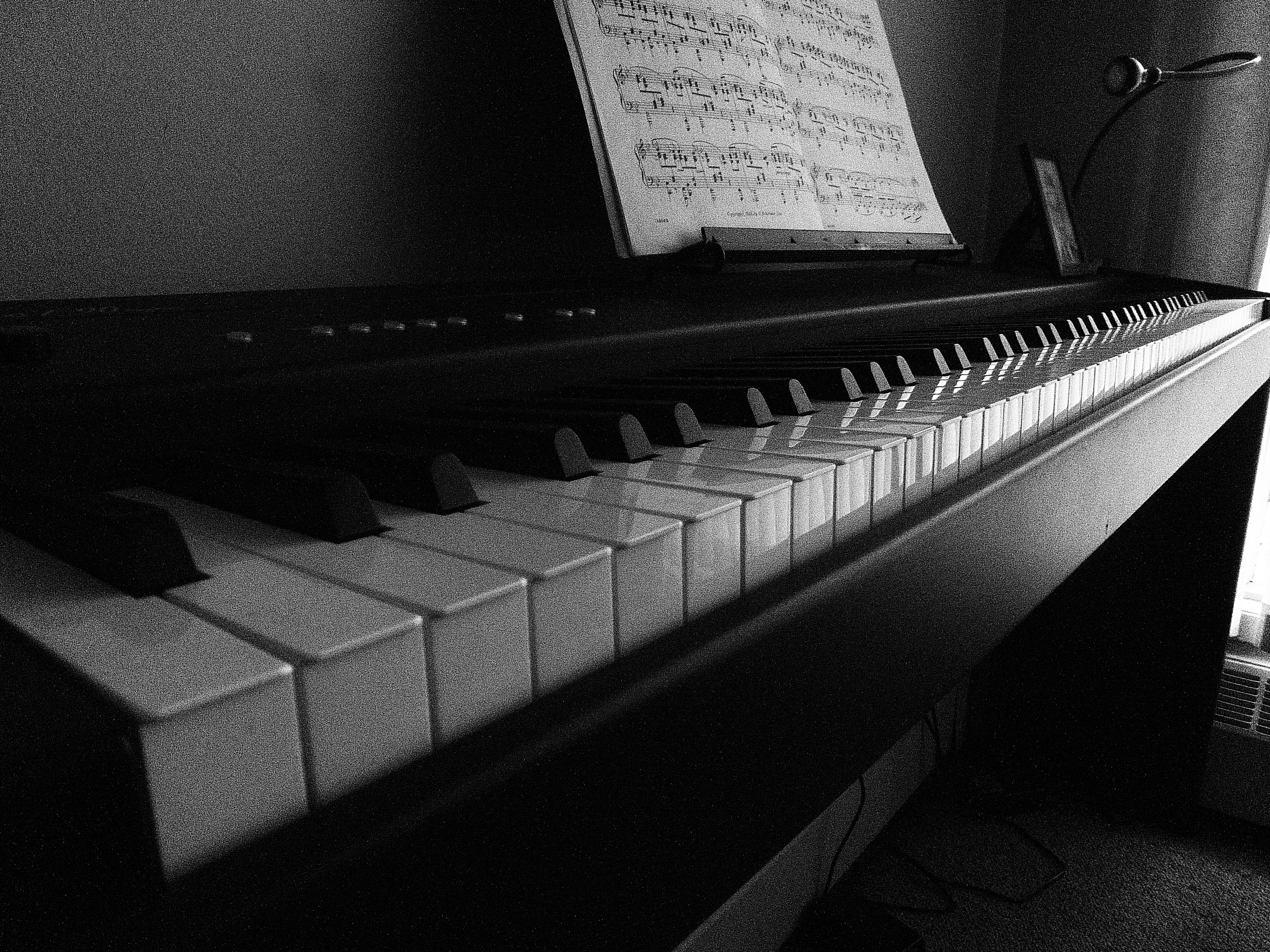
The music is the Brahms Op. 118 Piano Pieces, one or two of which I can kinda pretend to play, kinda.
PIANO
By D.H. Lawrence
Softly, in the dusk, a woman is singing to me;
Taking me back down the vista of years, till I see
A child sitting under the piano, in the boom of the tingling strings
And pressing the small, poised feet of a mother who smiles as she sings.
In spite of myself, the insidious mastery of song
Betrays me back, till the heart of me weeps to belong
To the old Sunday evenings at home, with winter outside
And hymns in the cosy parlour, the tinkling piano our guide.
So now it is vain for the singer to burst into clamour
With the great black piano appassionato. The glamour
Of childish days is upon me, my manhood is cast
Down in the flood of remembrance, I weep like a child for the past.
1918
_____________________
I’m sure this wonderful poem by Mr. Lawrence resonates deeply for any of us who grew up with a piano in the home. We had a huge old upright Mason and Rich in our dining room. My mom (born the same year that Lawrence wrote his poem) was a church organist and she loved to play. My brother Tom always played as well. Growing up, my life was filled with music.
I took lessons when I was young with the ubiquitous lady down the street, Mrs. Hanson. (With her twelve in ruler at the ready in case you got lazy with the position of your hands – and she wasn’t afraid to use it!) But I quit, who knows why, probably because it conflicted with baseball. How I got back to it is a cool little story and so here it is . . .
One night, it must have been in the early months of 1971, I was at a coffee shop in downtown Regina – the old Copper Kettle, for those who might know it. I’m sure I had a notebook with me, so you can see that my habit of writing in coffee shops goes back over four decades now.
A fellow I knew from school came in and joined me. I didn’t know him very well. He was a little older, and quite cosmopolitan, in my eyes. After all, he came from Edmonton which seemed exotic to me at the time.
As we left the Copper Kettle and walked towards Victoria Avenue, the Hotel Saskatchewan loomed into view. Graham grabbed my arm and before I knew it he was dragging me into the lobby of that beautiful old hotel.
“We can’t come in here!” I hissed. I probably did hiss it – after all, a couple of straggly rugrats can’t just waltz into the Hotel Saskatchewan.
“Relax,” he said. “I do it all the time.”
So we walked through the lobby, Graham in the lead as if he owned the place, with me following behind as if I was about to be arrested. We went into a sort of grand parlour, just before the dining room. It was a beautiful room with couches and overstuffed chairs and art on the walls and a huge chandelier suspended from the ornate ceiling throwing a golden light on everything. And in one corner, a grand piano.
Graham got a chair and opened the cover and began to play. I was astounded. I thought it was not only the most beautiful music I had ever heard, but really, it was so amazing that he could play like that. What a gift! And clearly, such a skill could get you anywhere in life – look where we were!
When he finished, he asked me if I wanted to play. I so desperately wanted to but I had to say I wasn’t able to. But I resolved then and there that I would go back to it, that I would take lessons again and learn to play. And I did. And I’ve been hacking and thrashing away ever since.
There have been times that I lived without a piano, but no more. That would no longer be possible. The piano I have in my apartment now, the one in the picture above, is a Roland F90 digital. It has a full keyboard with weighted keys and so feels and sounds like a “real” piano. The advantage is you can put in headphones and play all night without bothering anyone if you want to. The disadvantage is that if the power goes off, you can’t play the Moonlight Sonata by candlelight. Oh well, you can’t have everything.
I wonder for those of us who play a musical instrument if it isn’t some kind of life raft we crawl onto at some point in our lives when the waters are churning around us and everything seems particularly hazardous.
Some of us never crawl back off, I guess. And why would we want to, anyway?
I’m closing with this wonderful short film of the master, Vladimir Horowitz, reducing an audience in Moscow to tears. What a beautiful moment in time it captures!
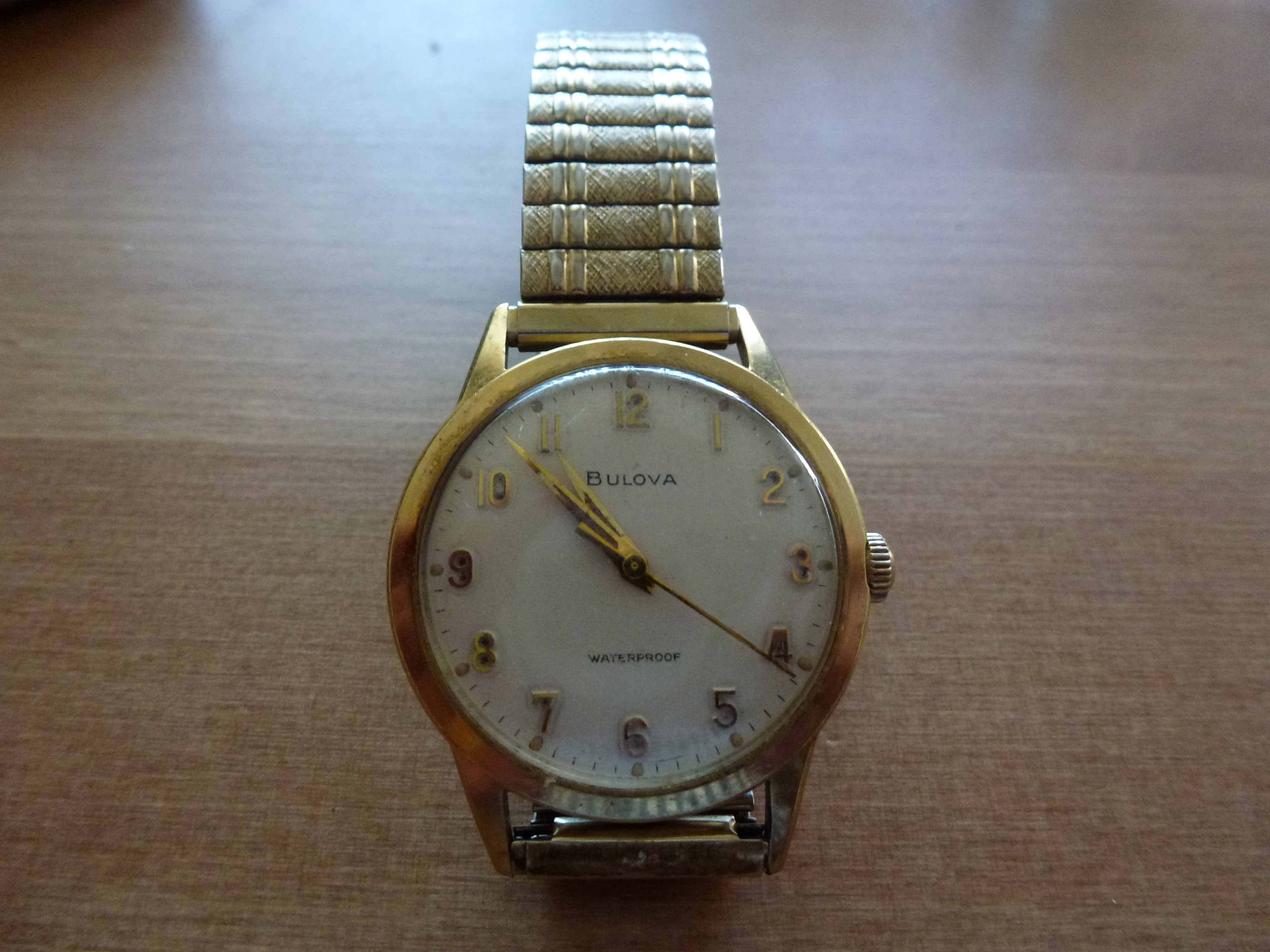
For all the years I’ve had this watch, I’ve never worn it.
This watch was given to my brother Gary Stickland in 1966 for, as is engraved on the back of it, “18 months of perfect service” by the Regina Leader-Post. He had a paper route back in our neighbourhood, and I sometimes was his helper.
I often present story structure to my writing students at a very basic, stripped-down level: Situation, Complication, Resolution. There, I just saved you the trouble of reading through countless lengthy tomes on story structure. The point is that in the story of our hero, there will always be hardship and obstacles to overcome before he can emerge, stronger and presumably successful in his quest, whatever that might be.
The complication in my own life story came in 1968 when Gary died in a car accident. He was 16, I was 11. Suddenly, the sweet serenity of my youth was shattered and the hard ragged edge of reality intruded.
It was a calamitous event for my family, one which in many ways my parents never recovered from. It’s true what they say, that parents should never have to bury their children. It’s the hardest thing of all. In my own case, it certainly put me on perilous footing as I was about to enter into my adolescent years.
I have no doubt that all discernible aspects of my character, good and bad, can be traced to this event. For example, I don’t like reality all that much, I really don’t. So I retreated into my own little world and surprise, surprise, I became first a musician and then a playwright.
A character in one of my plays (Dotty in Sitting on Paradise) says, rather famously in Calgary at least: “Change is never good. Nothing good ever comes of it.” People thought I was joking about that, but I really don’t think I was.
I can control things in the world on stage. Out in the real world I can’t. It’s probably as simple as that.
My brother was everything I was not. We were a study in contrasts. He was dark, and brooding, with my father’s deep brown, almost black eyes. I was a dreamy kid, with my mother’s fair complexion and blue eyes.
Gary was a doer, I was a thinker. He was a fighter, I was a lover. Or if not a lover at 11, I sure as hell wasn’t a fighter. He was about the body, I was about the imagination. While I played the piano, he played football and baseball, at a level that was so high and so far above anyone else that no one doubted for a minute that he could have made it to the pros in either baseball or football.
Sadly, I don’t remember much about him all these years later, but here’s one story I do remember and you’ll have to take my word for it that it actually happened.
I was playing Little League baseball for the old Senators team coached by Regina legend (and father to Chico) Joe Resch. I was not playing well, not well at all. I think Joe only tolerated me because I was Gary’s younger brother.
One evening after our game, I rode my bike over to the field where the Pony League played their games. I knew Gary had a game that night. As I pulled up to the screen, Gary was in the on deck circle taking some practice swings. He saw me and walked over to the fence so we could talk.
I felt so special that he did that, you have no idea. He asked me how my game went. I can’t really remember now how it went or what I said to that, but it probably hadn’t been all that good, at least on a personal level.
The batter went out or got a hit and so it was Gary’s turn to bat. He said, “I’ll hit a home run for you.” I said, “OK.” “Which field?” he asked. “Right,” I said. He winked at me and went up to home plate to bat. Three pitches later, he hit a home run over the right field fence. He rounded the bases and then waved at me as he went back to the dugout.
And that was that.
That was my brother Gary, as I remember him at his best.
What even to say about it? Maybe it brings back memories for some?
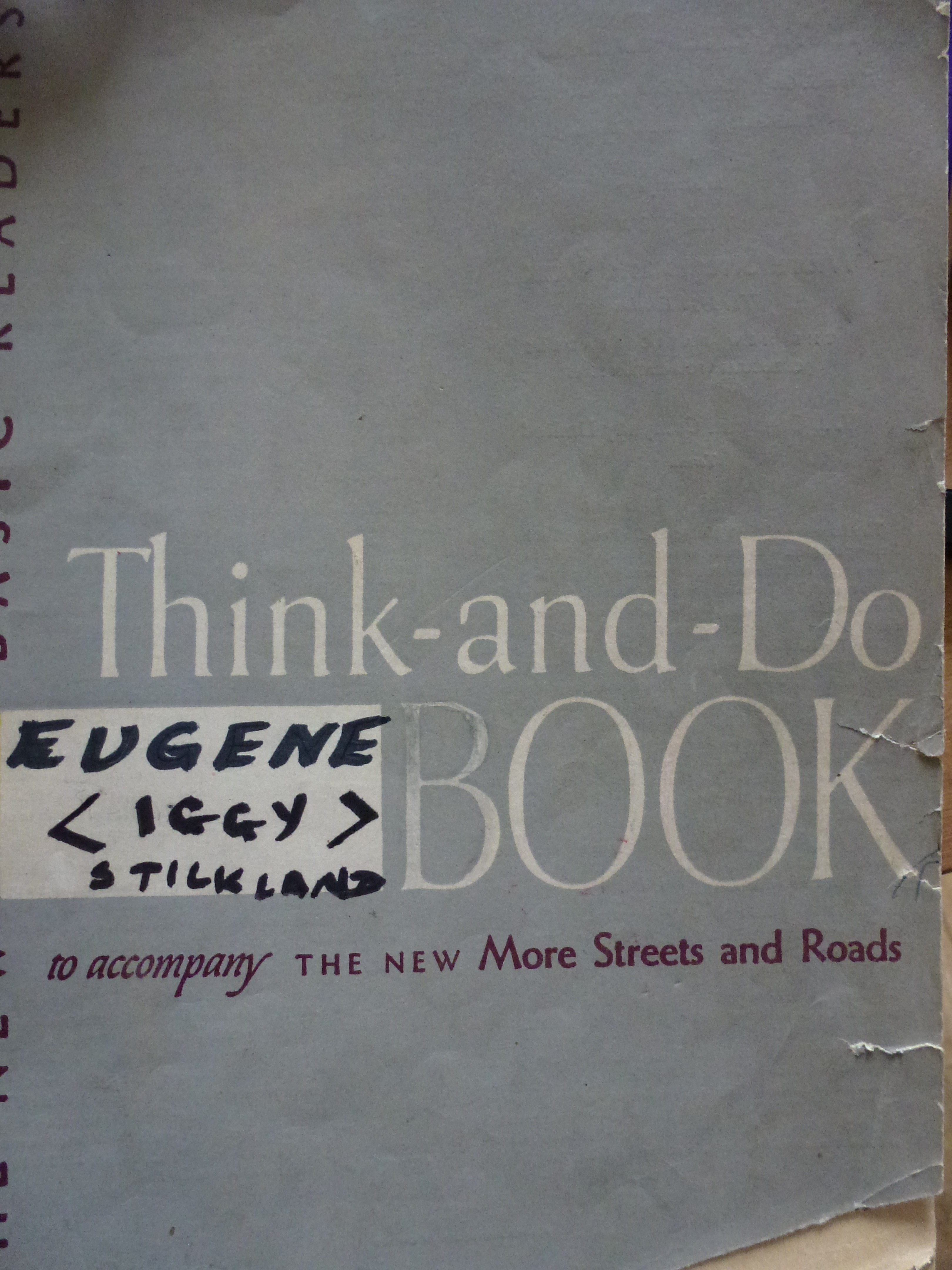
I don’t have many other things from this time in my life. For some reason, this book has always followed me around. It documents some of my early explorations in reading and writing. Although I was never the greatest or most disciplined student, all the exercises in this book have been completed and by and large I did quite well.
My name on the cover strikes me as being very unusual. Back in those days, I was known as Gene, not Eugene. My first wife (I know that sounds bad; it reminds me of Robert Browning’s “My Last Duchess”) Marguerite is solely responsible for the Gene to Eugene transformation but that didn’t happen until I was in university.
As for . . . Hmmm. Another mystery. The only person ever to call me that – and I’m sincerely hoping it stays this way – is my sister, Sharon. She still does, in birthday cards and Christmas cards and occasionally on the phone. But no one else has ever called me Iggy.
I can only conclude that my name was written on the cover long after the time that I was actually working in this book, which according to extensive research (Wikipedia) would have been in Grade 3, which I believe was in 1963.
This Think-and-Do Book, it tells us on the cover, was meant to accompany The New More Streets and Roads, which was a reader we had back then, putting us firmly into Dick and Jane land. I would reckon that most people in Canada around my age learned to read and write thanks to Dick and Jane.
And of course Spot, who, my research tells me, began his literary existence back in the 1930’s as a cat, but morphed into a dog sometime in the ‘50’s. The things you learn!
Those of you who are up on your pedagogical theory will know that by the late 60’s, Dick and Jane and their tight, white little world came under very serious scrutiny by educators who were worried that such books served the white middle class patriarchy, and what we were really being taught was how to be good tight white little citizens who could presumably read and write well enough to keep the whole thing going for another generation.
I’m not sure that I totally agree with that. I can’t remember the content of those readers back then beyond the famous “See Dick run” and all that nonsense. But I have to admit that the books would not exactly have captured the imagination of anyone from a different culture, with other than white skin, or any of the little girls with aspirations beyond growing up to be decorative.
Looking at this book today, I am reminded of what a different time it was and just how different things were back then. In grade 3, we would come a little early to play on the playground which was segregated with the boys on the boy’s side, the girls on the girl’s side. And ne’er the twain shall meet. Until we got inside, go figure.
Once inside the classroom, our day began by saying the Lord’s Prayer followed by the singing of God Save the Queen. Thus purified in the eyes of God and the Queen we were ready to get down and tackle the 3 R’s and all the rest of it. But God (or the Queen) help you if you were caught whispering to a friend or if you needed to pee. Things really were strict back then. The principal was armed with a strap and he wasn’t afraid to use it.
The school I am referring to here specifically is Albert School in the old north end of Regina, Saskatchewan. The beautiful old brick building that I went to was torn down a number of years ago and they put up an ugly modern thing in its place.
Beyond that, the neighbourhood underwent a profound change in character when our First Nations people moved in, and just as quickly the white working class people moved out.
It has since been described by Maclean’s Magazine as the worst neighbourhood in Canada, which is no small accomplishment. Very little is said about this. Regina and other prairie cities continue to have huge racial issues that never seem to be resolved.
When I returned to Regina in the late 80’s after living and going to school in Toronto, I taught for a while at what was then the Saskatchewan Indian Federated College, now the First Nations University of Canada. Some of my friends from the old north end didn’t understand. They felt, some of them, that I had betrayed them. The lines here are drawn very deep. It’s obviously a very complex situation.
But when I look back at the old neighbourhood now, it all seems rather dreamy and bucolic.
In many ways, it was a good place to come from, but I don’t know that I’d want to go back now.
Looking back to 1963, I amazed at all the great music that came out that year. Here’s a sampling . . .












 eugene stickland