Ian Leslie has an interesting article in this month’s Intelligent Life titled “In Search of Serendipity.” Appropriately enough, I came across it accidentally when I was wandering around another aggregate site, The Browser.
I wrote a few weeks ago about how the Internet is changing the shape and scope of our minds, making us better at skimming information but less likely to engage in deep thought on any one subject. (“Life With No Computer” published here in early December, 2011.)
Leslie’s argument is that with the “democratization” of information, true serendipity (which he simply defines at one point as a happy coincidence) is becoming a rarer phenomenon. This got me thinking about the role of serendipity in my own life and career, and the fact that the early years were pre-internet, in fact pre-computer. (My first play was written on a typewriter!)
Artists are frequently asked about our careers, as if we somehow planned them to work out the way they did. I would suspect that with most of us, and maybe not just artists, maybe it’s true of doctors and lawyers and such, serendipity plays a huge role in our lives. So this is part of my story, and this blog is a rough sketch for a public lecture I will deliver at St. Mary’s University College later this year.
When I was a young man just starting out, I went to the University of Regina as a music major in piano performance. I finally realized with some pain and regret that I wasn’t good enough and so after a while slid over into English, but I had a few delusional years there when I though I might have a chance. During this time I became passionately interested in the work of Johannes Brahms, and in those days before the Internet, I did what we all used to do to find out more about him: I went to the library.
The fine arts library at the University of Regina had a good selection of books on Brahms. The trouble was, they were all written in German, some of them old enough to be in Gothic Script. So what to do? Serendipitous moment #1: I enrolled in a German class. I am of English heritage and I spoke not a word of it, but I survived German 100 and so enrolled in German 101 for the winter semester.
Half way through that class, my instructor, Frau Holle. a lovely woman of Austrian extraction, invited me up to her office for a late afternoon drop of sherry. (Imagine having a student of the opposite sex up to your office for a drink these days!)
“Herr Schtickland,” she said, “We have a very grave problem. I was hoping you could help.”
Each year the university was awarded a very generous scholarship by the Goethe Institut for one of its students to study in Germany for six months. No one from the upper years was free to take it, and they basically needed a warm body to fill the position so the scholarship wouldn’t be lost in future years.Was I free to go?
Serendipitous moment #2. I was, and I did.
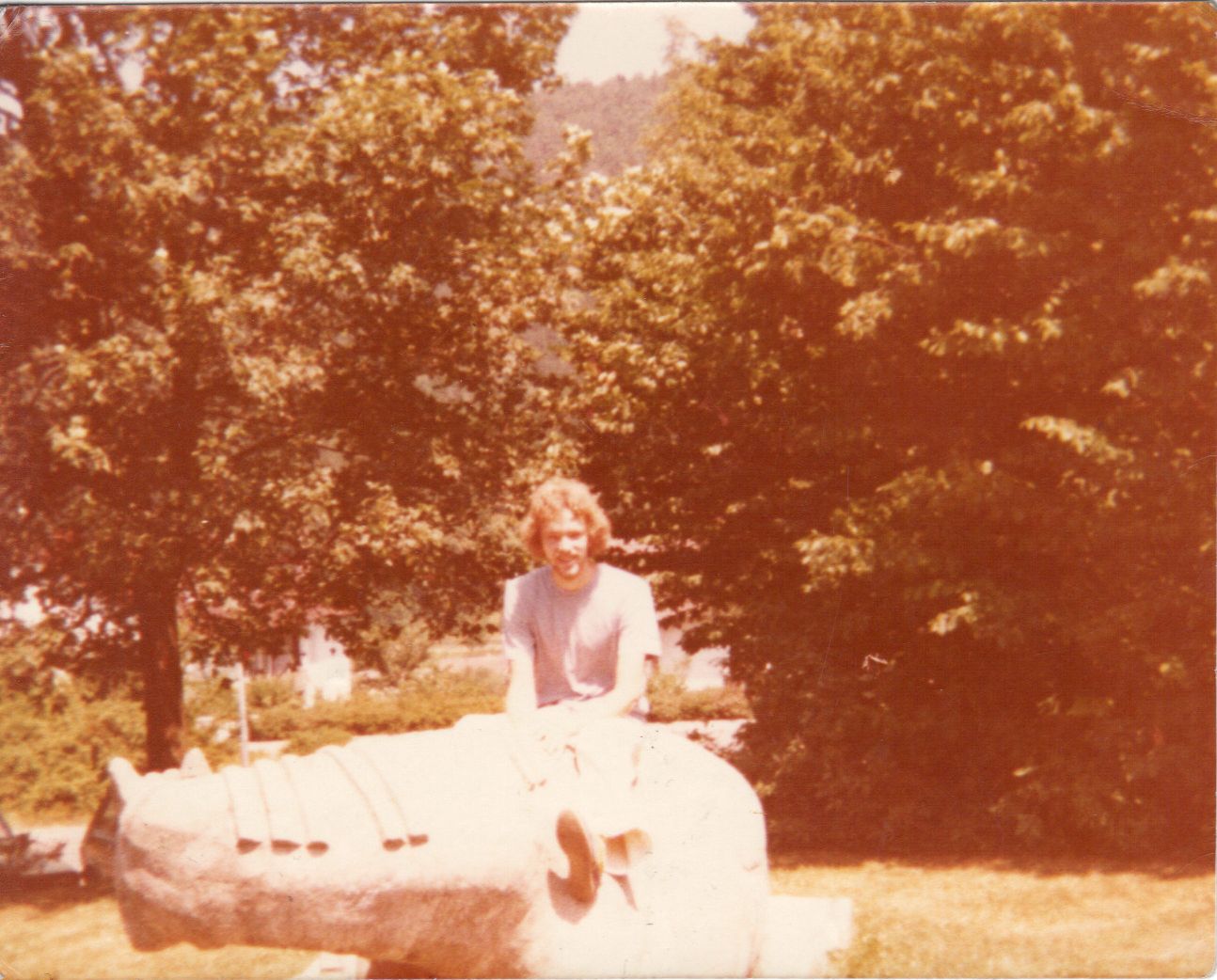
This is what I looked like back then. This is what photographs looked like back then:
1977, the year Elvis died. With a mustache sitting on some kind of ancient German beast. A typical mid-70's photo.
So off to Deutschland. Before the course started, I had a few weeks to kill so I went up to England to visit my Aunt Deirdre. While I was there, she suggested I go to Stratford and see some plays. Having grown up in Regina when I did, I hadn’t had the chance to see much theatre, because there wasn’t much theatre to be seen.
Serendipitous moment #3: I went to Stratford and saw a few plays by the old boy. Serendipitous moment #4: A brilliant production of A Midsummer Night’s Dream must have put the idea in my head that writing comedies would be a good thing to try.
And so back to Germany where I learned German well enough that people I met couldn’t tell I wasn’t from Germany. I loved my time there but I began to miss the English language, and so I bought a number of journals and began writing in them, which could well be Serendipitous moment #5. Certainly by the time I returned home, I realized I would never be a great concert pianist and began to think of myself as a writer and not as a musician.
And so I became a writer. I don’t believe I would have ever lived the life I have, if I had not ventured into a library some 35 years ago and become frustrated at not being able to read anything about my favourite composer. Part of the program in Germany was to study Gothic script and I got good enough that I could read a little. When I got back home to Regina, I went back to those books at the fine arts library and hacked through them, but I can’t pretend I gave them a good reading.
Still. what an interesting journey I went on, just to read a few books!
There is a postscript, which happened only a few years ago. There was a man who used to come to Caffe Beano, whose name I cannot remember and who passed away a year or so ago. I didn’t know him very well. He was a collector and seller of antiques, curios and rarities. One summer’s day as I was sitting outside the cafe writing in my journal, this man showed up with a rare find. It was a book published in the early 1500’s, I believe, that he had acquired at a Hutterite colony. It was a real beauty, with wooden covers and a richly decorated cover. Such antiquities are rare on the prairies.
He was showing it around (carefully) to some of the assembled. He opened it up and looked at the title page. “The trouble is,” he said, “I can’t read it. Can anyone here read Gothic script?”
Serendipitous moment #6.
I could, and I did.
Thanks for reading! Stay warm.
PS. I was in Caffe Beano this morning and asked around and found out that the man’s name was Udo. My friend Bob McDonald (aka Bob Loblaw because it sounds like blah blah blah) once bought an accordion from him. Who else are you going to get a good used accordion from? Apparently Udo had garages full of junk, but apparently it was all oxymoronic high quality junk. May he rest in peace. Bob remembers the Gothic Script incident, and told me that his estimation of me increased significantly that day.
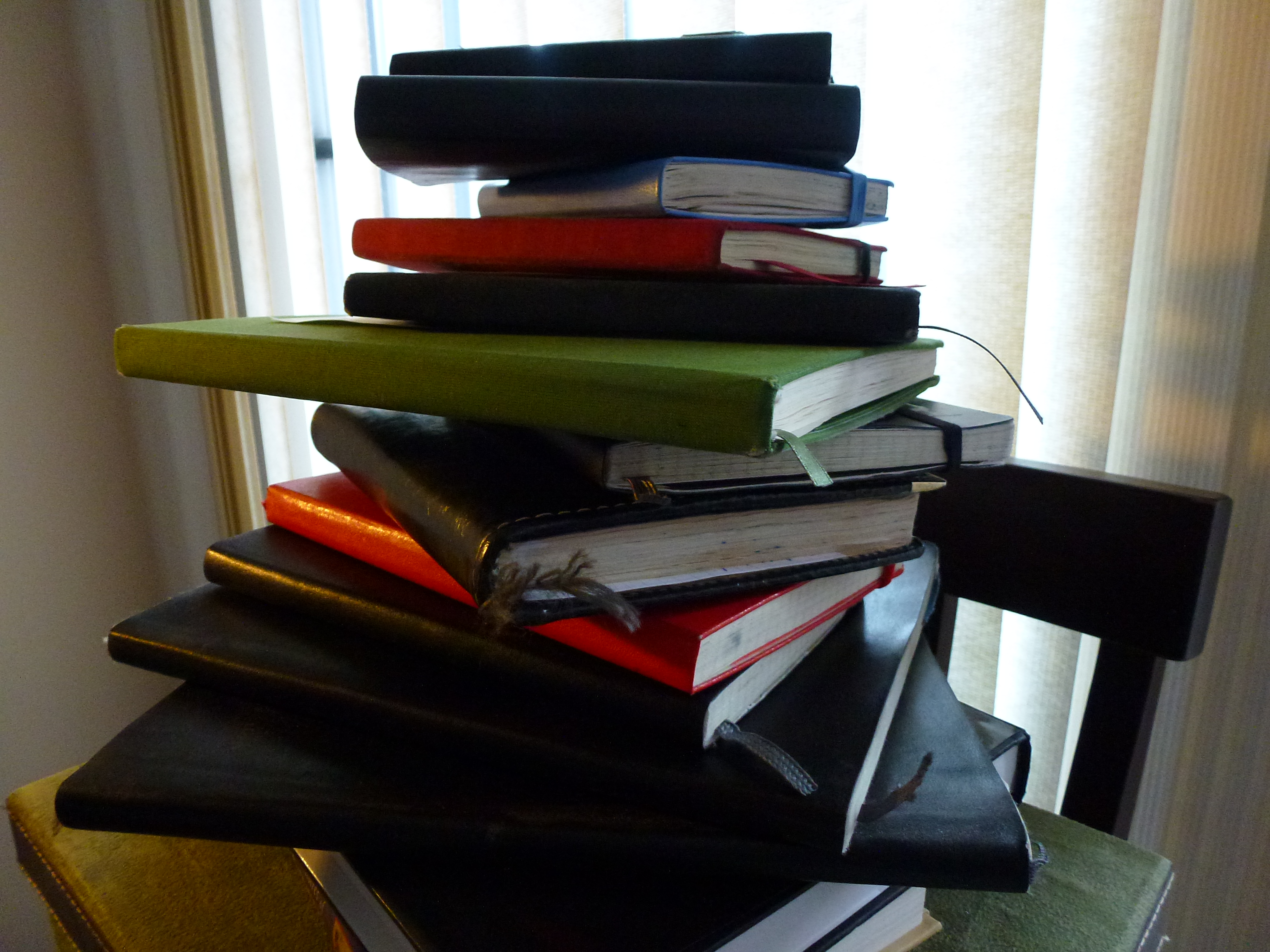
Some of my journals from the last two years. These are just a few of the hundreds I have filled over the years.
I have been an inveterate diarist since I was in high school, and that’s going back a few years now, let me tell you. I actually have one of my journals from 1974, when I was in Grade 12. It records among other things a trip my friend Richard Campbell and I took from Regina to Banff. Anytime I lose my mind and think about camping as a possible activity, I only have to go back and read that record of those cold soggy nights on the side of a mountain and I quickly come to my senses.
With a few holes, a few missing years, alas, I have a fairly complete record of my life that spans some 40 years recorded in hundreds of notebooks, containing probably close to 3,000,000 words.
Blake Brooker of One Yellow Rabbit Performance Theatre and I have talked about doing something with all these journals, some kind of interactive performance piece with them. I think all we’re lacking is any sense of urgency. Since we last talked about it, I’ve probably filled half a dozen more books. The possibilities would seem to be endless for such a piece. Want to know what I was doing on the day you were born? I could probably tell you. (Unless you’re older than me, but you’re probably not!)
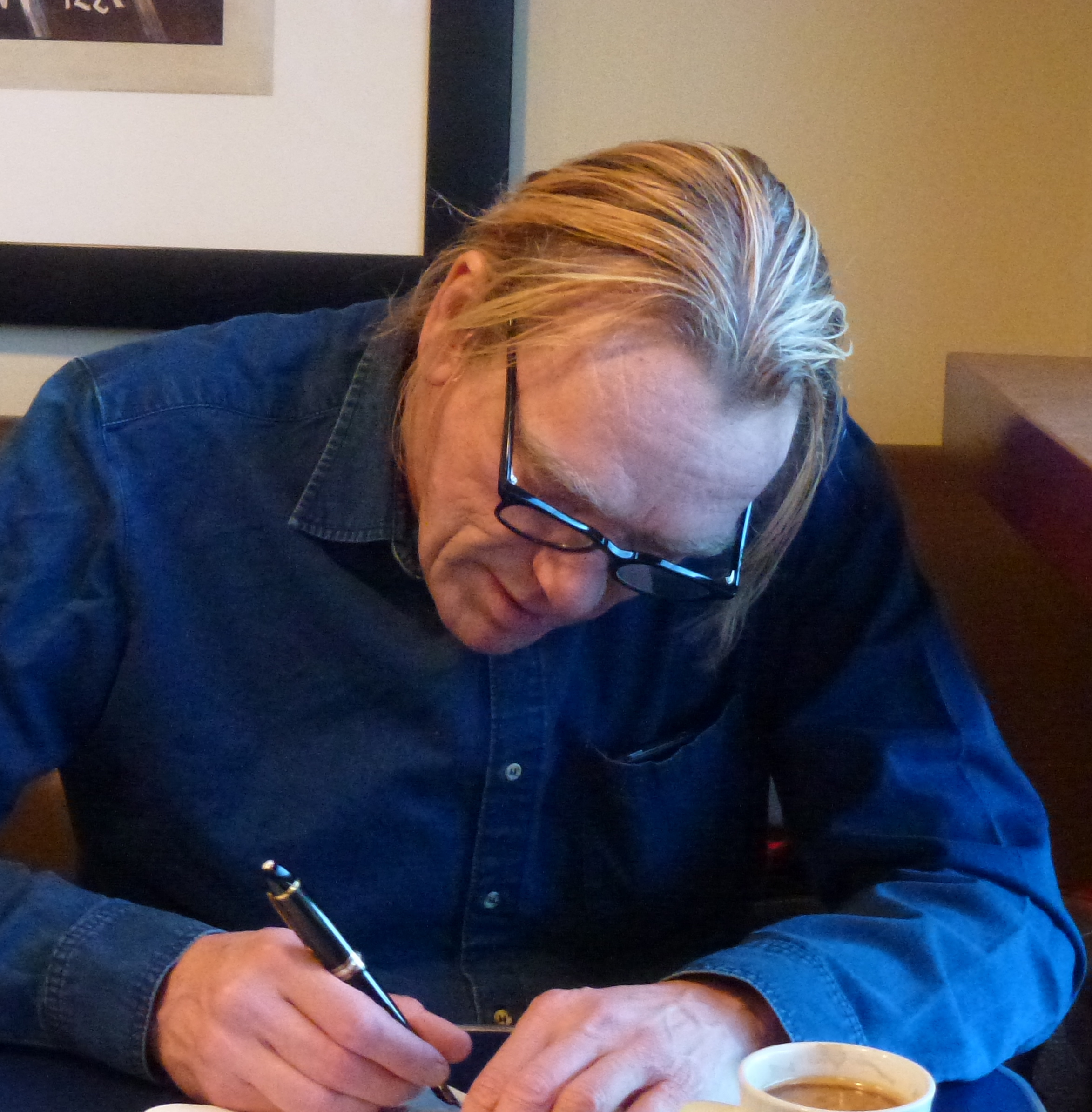
These days, I am a regular fixture at Caffe Beano just off 17th Avenue SW in Calgary. I write in my journal there almost every day. When I am traveling, I look for new coffee shops that are conducive to the writing process. Last fall in Statford, I discovered Balzac’s on my first day there and wrote there every day for three weeks. I guess I’m a creature of habit, which is no small trick when you don’t really have a daily schedule.
David Mamet once wrote a great essay, “Writing in Restaurants,” which gave the title for a collection of essays. There’s something interesting about engaging in a very personal act in a public place, especially one you won’t get arrested for. I don’t pretend to understand the reasons why I am able to be so productive in a coffee shop, so much more so than if I stay at home to do the same thing. You can’t argue with results, and my coffee shop and restaurant output has been consistently prodigious.
Yet, in a way, that’s the easy part. The hard part is having the discipline to go back through them and mine them, as it were, for the gold they may or may not contain. In doing this, one is confronted with one’s past, which at times can be uplifting, while at other times and more often than not, simply deary, I’ve often noticed that we don’t tend to sit down and write anything when our favourite team wins a big game. But, get our hearts broken and that’s a different story. Unhappy events in our lives tend to send us scurrying back to the comfort of the written word, and so my journals, at any rate, tend to be a little on the dark side.
(If I had never had my heart broken, I might have 3,000 words instead of 3,000,000. That’s just how it goes.)
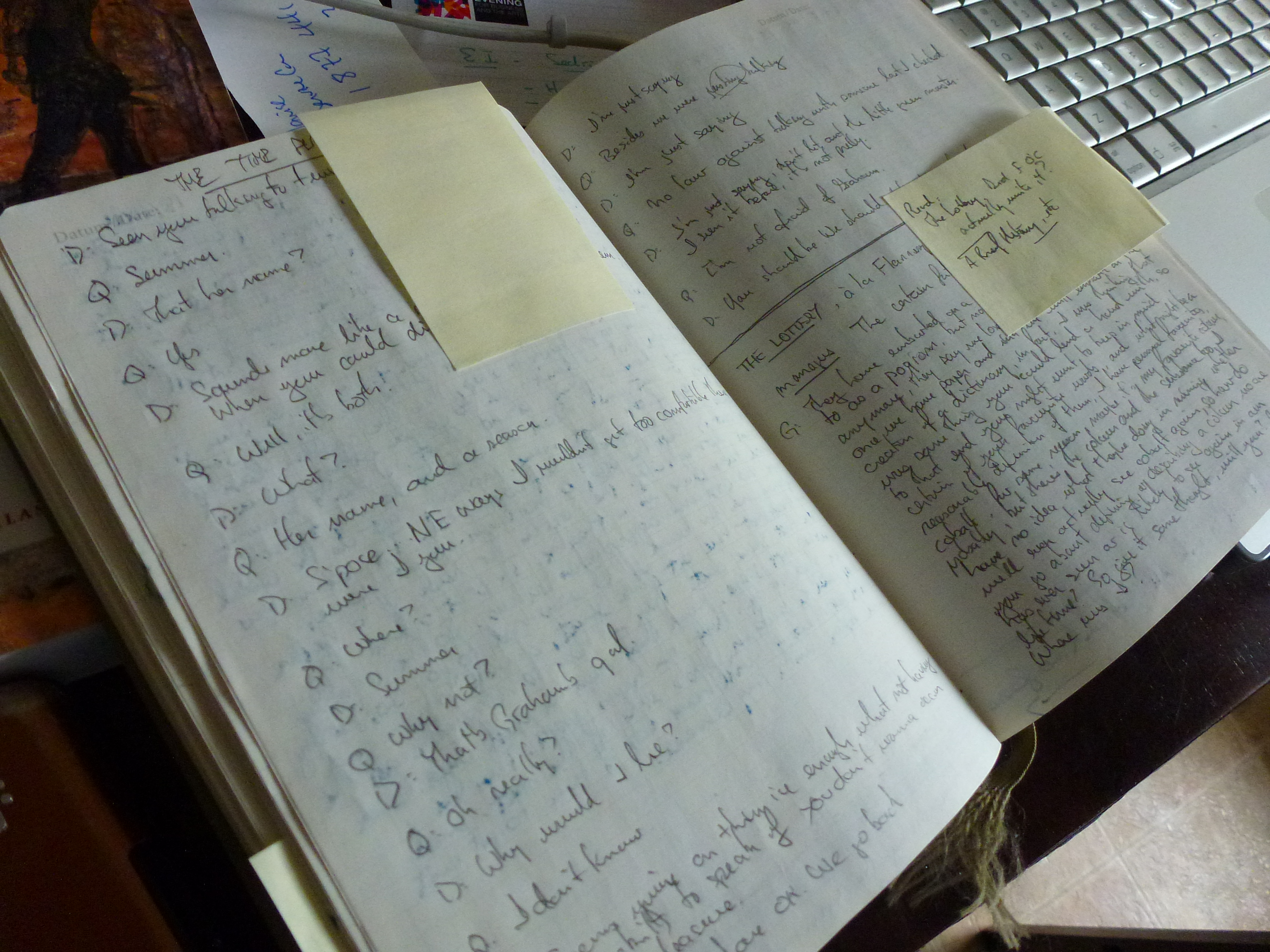
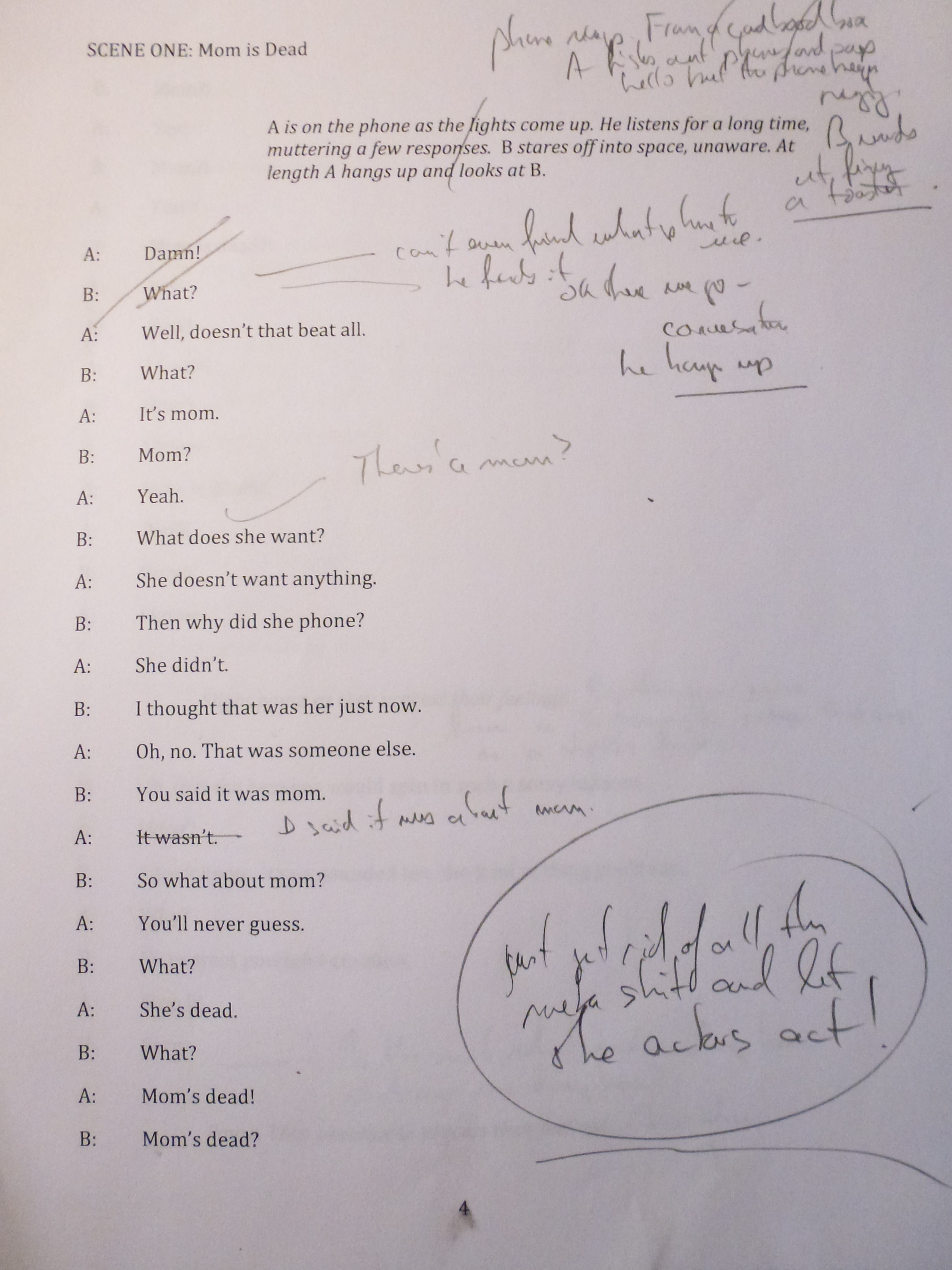
Along with the minutiae, the quotidian, as it were, we mine these journals for the poems and scenes of plays we may have written down on a rainy Tuesday afternoon, say, or late at night when we simply couldn’t fall asleep. These are a few pages from the notebook I kept in Stratford and wrote mostly while at Balzac’s:
It's a scene from a play someone wrote. Oh yeah! It was me!!
Obviously by now, writing down my deep thoughts on a daily basis is second nature. It’s habitual and probably very therapeutic. But as I say, the hard part is going back through it to see if there’s anything there of interest.
This scene I’ve been looking at today seems like it might have some potential. There are about ten such scenes in this unnamed play that I called at one point “an epic fantasy,” yet there’s no actual title at this point So these days, cold days in Calgary when one looks for reasons to stay indoors, I am transcribing this raw material into my computer, with a wait and see attitude about what’s there. Is it gold, or fool’s gold? Too early to tell and no way to tell but to go through the process, hoping for the best.
Even though such scenes are written in full sobriety (for some reason I can’t write in bars) there are times when I go back and read them and have little or no recollection of having written them in the first place. What that’s all about, I’m not really sure, other than to say we clearly go into a very different frame of mind when creating, the results of which can be at some level unrecognizable even to ourselves.
And so now, it’s -30 degrees outside, yet I’ve been at this computer far too long. So even on a wretched day like this, I am to Beano to see what words are waiting on the page of my journal for me to draw out.
Writing stuff down in my new day timer in Caffe Beano.
Once upon a time in New York City, a wandered into a bar somewhere I guess in Midtown but leaning a little over to the Gramercy Park part of town. It was a quiet little place, but “authentic” on some level, so I stopped in for a beer on my way home. (Home was a grotesque yet “desirable” apartment in a tenement in the Lower East Side, but that’s another story.)
There was a game on the tv and a juke box in the corner and a couple of suits who had stayed too long after work and an amorous couple and a very large book-reading African-American man who, with me, was the only other person on our side of the bar, although on the other side of the bar there was a disaffected bartender working a tooth pick and reading the paper. He was at least kind enough to pour me a beer.
Suddenly, and for no apparent reason, my fellow bar-dweller slammed down his paper back novel, arose and announced in a booming voice to those of us thus assembled: I AM AN ANALOGUE MAN LIVING IN A DIGITAL WORLD!!!
There was a slight pause, a momentary silence as I suppose we all took in his message. And then he sat down and went back to his reading and life in the bar continued as before.
Yet I’ve never forgotten it, because it was like he had done that for my benefit. I, too, am an analogue man living in a digital world, which I proved to myself last week, this time vis a vis the question of daytimers.
You see, I have an iPhone and a MacBookPro with all the scheduling and calendar functions and the supposed automatic syncing by virtue of the Cloud. One would think I would be so organized and efficient as I entered this new year that I wouldn’t have a worry in the world. That I would, in fact, be all over it.
Well, after missing two appointments last week and only making a third because I happened to be in the place where it was supposedly happening. I realized that unless I write it down, I don’t don’t know it’s happening. I can push the buttons and rig the alerts and all the rest of it, but for some reason, unless I can see, in my mind’s eye, that page in my calendar on which I’ve notated the event — and when I do that I can see it so clearly it’s uncanny, right down to the colour of the ink — then I’m doomed to miss the event, blissfully unaware that it was ever meant to happen in the first place.
This has gone on for years. Every year, I think I can get by without one. Every year, at some point early in January, I find myself in Ried’s Stationers looking for the book I can live with for the next 50 weeks or so.
I should never schedule anything for the first few weeks in January, at least until I realize I have no sense of my schedule, of the demands being put on my time, unless I have written it down somewhere.
So, I now have a day timer and if you want to meet me sometime this year, the odds are now much greater that I will actually show up.
My favourite gift this Christmas was a Kobo reader from my sister, Sharon. Like any avid reader, I have looked at them for some time now, but as a true lover and collector of books, I had put off buying one. But now, one had come into my house and so I was able to see for myself just what I thought of it, and of the experience of reading a book in an entirely new way.
I had been reading a discarded library copy of Hitch – 22, and not really enjoying the experience of reading an old and battered copy. So I thought this would be a good place to start. The process of buying the book on line on my computer, and then syncing with my reader was effortless, and before you knew it, I was reading a worthwhile book on my Kobo.
It surprises me to say that I actually loved the experience. The display is very even and easy on the eyes. I like tapping the screen to turn the page. And I absolutely love the reading stats it gives you, such as % of the book read and average length of reading sessions. I finished Hitch – 22 much faster, I believe, than I would have had I kept on in the book. I then downloaded a few others, including Major Pettigrew’s Last Stand (recommended by my friend Joyce Doolittle) as well as a number of free, public domain books including The Adventures of Sherlock Holmes, Three Short Works by Gustave Flaubert and The Mystery of a Turkish Bath by E.M. Gollan — a quirky little number, to put it mildly.
And so it came to pass, the other evening I was extolling the virtues of my new toy to some friends, when I was reminded of an image I posted on Facebook not so long ago. This one:
And so I was asked if, in fact, I am no longer keeping it real, motherfucker.What could I say? I had been caught red-handed, guilty as charged. Busted.
I don’t like hypocrisy, especially when I am guilty of it myself. But I have to admit that having had the Kobo for a few weeks now, I am of two minds about the whole reader vs. books question.
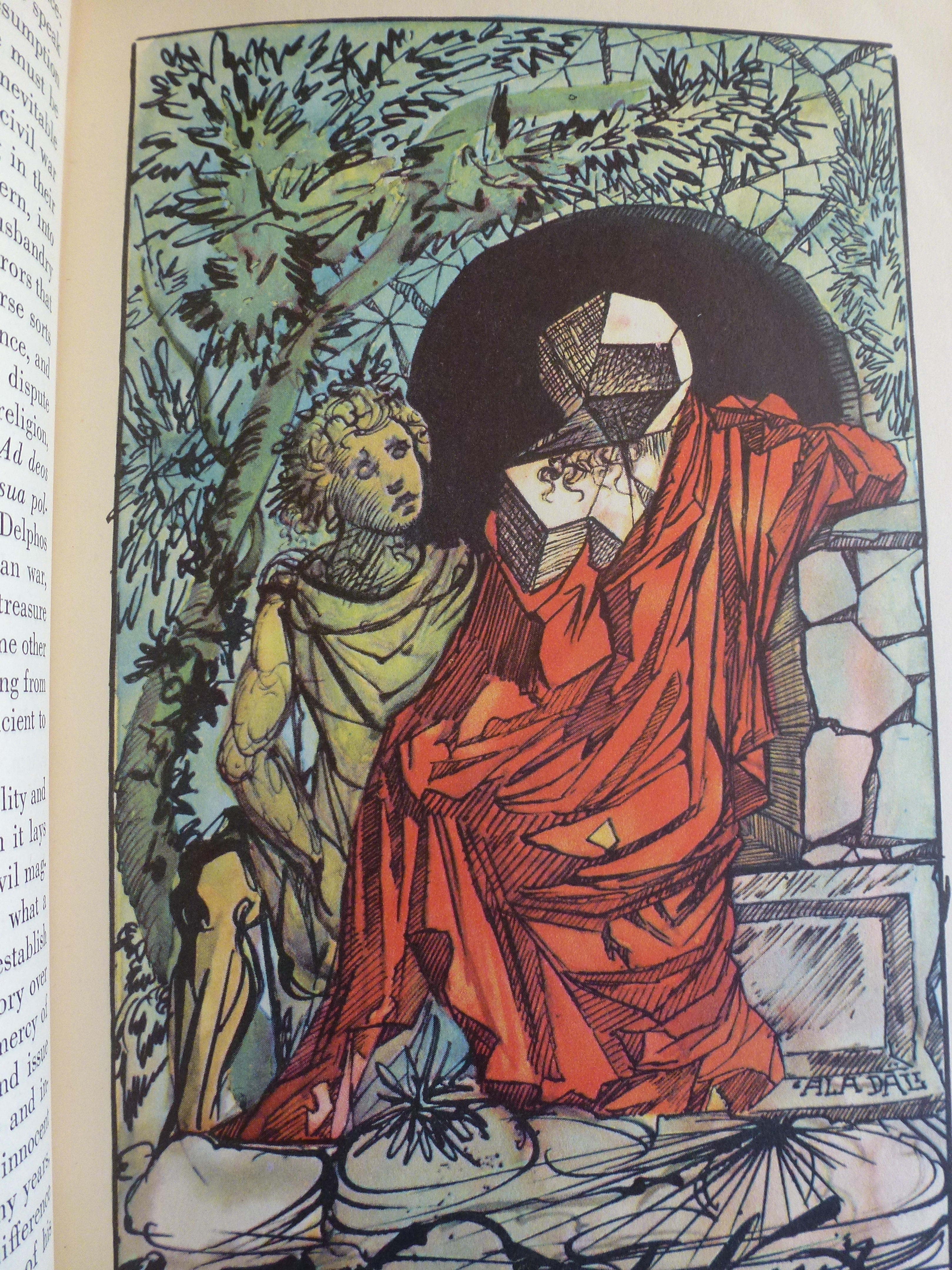
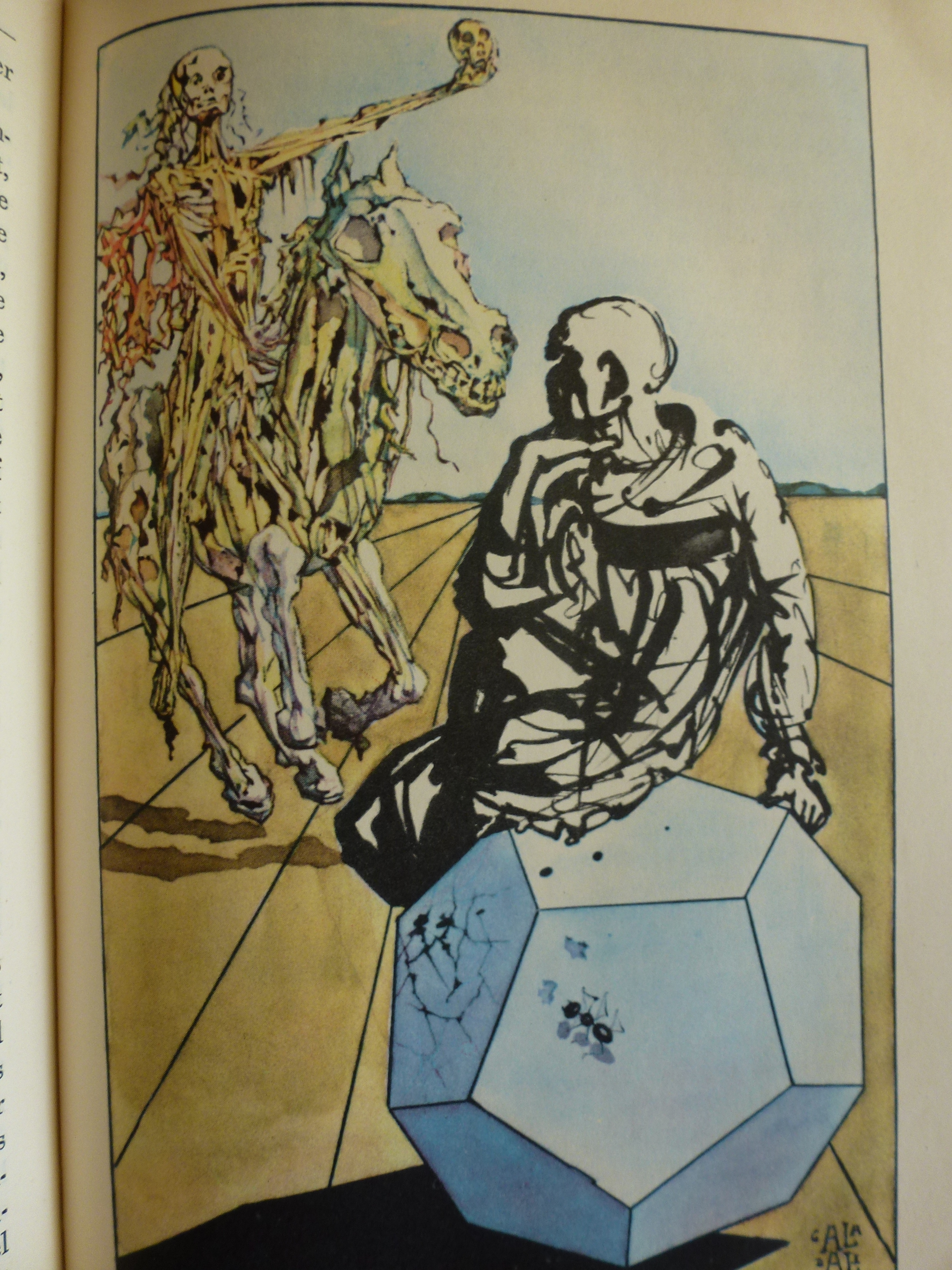
As I say, I love books. My most treasured acquisition of 2011 was a first edition of Michel de Montaigne’s Essays, edited and illustrated by Salvador Dali (Doubleday & Co., 1947). It’s such a great find! I paid too much for it, probably, although only a fraction of what it’s actually worth. My knees were shaking (more or less) when I was going through the negotiations for it at Fair’s Faie Book store on 17th Avenue.
It occurs to me as I write this that most of you will never have the opportunity to see these images, so here are three of them pretty much at random to give you a feel for the quality and beauty of this book, and the artistry of Dali’s illustrations:
Obviously, nothing electronic can compete with a beautiful book.
Not only do I love books, I love bookstores, especially independent ones owned and operated by my friends and neighbours. My current favourite is shelf Life books on 4th St. SW in Calgary. I’ve read there a few times now and have attended the readings of other authors. It’s quickly become a vital place for Calgary’s writing community. Whereas electronic gadgetry has all but destroyed our sense of community. places like Shelf Life, and others such as Pages in Kensington, help to foster it.
I’ve done my best over the years to help such establishments keep their doors open.
Some books invite a certain amount of underlining and scribbling in the margins. One such book for me was Stephen Greenblatt’s Will in the World, one of my best reads from last year. I saw on the Kobo website that he has a new book, The Swerve, and thought about ordering it, but decided I should wait and buy the actual book as I know there will be lots of underlining to do, and many marginal notes to make.Unfortunately, it’s still only available in hardcovers so I will have to wait a little. Well, I’ve got lots to keep me going in the meanwhile.
Obviously, the Kobo is not going to replace real books for me. And yet. there’s something about it that’s really quite lovely. I like the fact that it doesn’t tell me if I have a new email and that it doesn’t allow me to connect to Facebook. I love it’s portability. I can hardly wait till I travel again so I can load a bunch of books on it. (Knowing only too well that I will acquire far too many real books on my travels. My first stop in a new city is always its leading independent book store. Followed by a local coffee shop. Followed, in turn, by a decent bar . . . )
I guess I come out on this question sitting firmly on the fence. It’s the best of both worlds, when you think about it. Maybe the most important thing about it is that it’s another excuse to keep on reading, which is one of my resolutions for 2012:
Read more. Read better. Be smarter.
Thanks for reading!
__________
Post Script: I went into Shelf Life Books today and told them I had mentioned them in this blog and added them as an external link. While there. we talked about The Swerve, what a great book it promises to be, and when would it be available in paperback? They had it in hardcovers, and then made me an offer I couldn’t refuse, so I am in possession of a beautiful copy of Stephen Greenblatt’s The Swerve: How the World Became Modern.
I guess I won’t be looking at my Kobo for a little while.
Holding this copy of The Swerve in my hands, I have to say there’s nothing in the world I find more beautiful than a good book!
As you may know, I spent five odd years, very odd years, perhaps, writing a column for the Calgary Herald. It was a very rewarding experience and allowed me to think, at least, that I had a kind of dialogue going on with the entire city.
I toyed with the idea of collecting some of the almost 300 columns I wrote for the Herald into a book. That still may happen someday. But for now, because I have this blog, I at least have the opportunity to share some of the columns with anyone who might be interested.
One of the advantages of this format is that I can include files from other media, so at the end of this column, I have (hopefully) provided a link to hear a lovely rendition of this song by Loreena McKennitt.
This column was originally published in the Calgary Herald around Christmas Day, 2007. I think the idea of lighting candles this time of year still holds true.
Some things hold true, I guess, while others change. I shall miss my daughter, Hanna, this year who is in far away Portugal, and yet I know she’s safe and happy so what more could I ask for?
But as we like to say, it’s all good. We shall muddle on through, somehow.
Merry Christmas!
The Bleak Mid-Winter
December 23, 2007
_______
I ran into an old friend earlier this week in the produce section of the down town Coop. Where else do I ever run into my old friends? I seem to spend a lot of time there. Well, I don’t bowl, so where else would I rather be?
I was there because I was in need of some carrots. I have a some kind of rabbit-like creature living in my back yard. At first I thought it was a big deal, and that maybe Santa Claus and the Easter Bunny had got their wires crossed. I’ve since learned that almost everyone has a rabbit in their yard.
It’s an infestation, they say. They’re a nuisance, I’m told. Still, I kind of like my bunny rabbit and though he’s obviously managed to grow into a rather large adult rabbit without my help, now that he’s come into my life, I feel a sense if responsibility toward his well- being. It’s cold out there, the ground is frozen. It’s amazing he’s managed to survive at all.
My only experience with rabbits comes from countless viewings of The Bugs Bunny Show, so I was in the produce section at Coop buying some carrots. I’ve given my rabbit the very unimaginative name of Jack. Every time I see him I ask, “What’s up, Doc?” I assume that carrots are his favourite food.
I was anxious to get home with my carrots for Jack when I ran into my friend. What a year she’s had! She came home from work one day a few months ago, looking forward to a quiet evening at home, a nice meal, a little TV perhaps, and her husband told her he was leaving. Just like that. Out of the blue.
She hadn’t seen it coming. None of us who knew them had seen it coming. It just goes to show you that you never know for sure what another person is thinking.
I probably don’t need to say (but I will anyway) that this is just the very worst time of year to be dealing with something like a divorce. Or the loss of a loved one. Or anything of a serious nature. The expectations of the season to be happy, to be jolly, to be merry and bright are so great that any deviation from out and out glassy-eyed ecstacy seems almost sinful.
“It’s the hap-happiest time of the year.”
Or at least we try to make it so.
In fact, it is the deepest darkest morning of the year as I write this. Out of a sense of desire to kindle some Christmas spirit I light a few candles on my mantle. There is something about this simple ritual that must hearken me back to my ancient ancestors toughing it out in the bleak mid-winter. When light was scarce to the point of being sacred.
This need for light was tied in with the winter solstice and became a pagan ritual marking the winter solstice. The miracle of light, and of warmth, “While the earth stood hard as iron, Water like a stone, Snow had fallen, snow on snow . . .”
This same light, embodied in these flickering flames, was of course integrated in Christian rituals as it had been in Jewish ones.
This light that comes at the darkest time of the year, symbolizing the fragile hope that the darkness, internal and external, will not last forever.
We see these little flickering lights everywhere this time of year. I have mine on my mantle and will wrap stylized ones around my Christmas tree if I ever manage to get the blessed thing up.
Each of us sees different things in the same flame, I suppose.
Even living in a prosperous place as we do, with the boom holding for another year anyway, human existence – being human – is not an easy proposition.
Husbands will always leave wives. And wives will leave husbands. Hearts will be broken and plans dashed. Fortunes lost and bills called in.
All we can look for in those little flames is some glimmer of hope that our hearts will heal and we will find joy and peace again, even in the darkest hours.
As the old saying goes, it’s better to light one little flame than to curse the darkness.
And as it says in my favourite carol, “Truth and love and hope abide, this Christmastide.”
I hope that Santa or the Easter Bunny or whoever is responsible for it finds your house and leaves something lovely under your tree this year.
My computer went down, so to speak, on Friday and so I had to endure life without one. I felt rather like a Benedictine monk from the 15th Century. I felt an incredible sense of loss and lack of focus. Without easy access to Facebook, I began to feel I was losing my identity. Rendering this even more pathetic, I have access to everything on my iPhone. But it just wasn’t the same.
Clearly, I learned that my habits and proclivities vis a vis the computer amount to nothing short of an addiction.
$740.00 later, I’m back.
Coincidentally to all this — some might say ironically, as no one seems to know the difference anymore — during this time I have been reading Nicholas Carr’s excellent book, The Shallows: What the Internet is Doing to our Brains. He didn’t have to convince me. From my own experience, I am reasonably convinced my Internet usage is turning my own brain to mush.
It first hit home this summer when I decided I simply couldn’t go another year without reading The Brothers Karamazov by Dostoevsky. This is, obviously, what we call a “big Russian novel.” So I found it, bought it, lugged it home, bought a case of vodka and settled in to read the great tome.
Halfway through the first page, my eyes were burning, my head was aching, I was wondering what was going on AT THAT MOMENT on Facebook, I had to check, I put the book down and logged on and I felt so much better, you have no idea.
Two hours later, I got back to the Brothers made it most of the way through the first page before falling into a profound sleep.
A month later, after a sustained effort at reading the book, I was 11 pages in. Clearly. something was happening to my brain, something not so good.
In his book, Carr is very thorough and relentless in his examination of this situation, which isn’t just happening to me. To a certain extent, it’s happening to all of us. Through our use of the Internet, we are rewiring our brains to become proficient at skimming and increasingly unlikely to engage in and deep analytical thinking.And what we’re doing to our long term memories is positively chilling.
I’m trying to mitigate against this. I’m testing and stretching my feeble memory by memorizing poems. Now there’s a quaint pastime in the digital age: memorizing a Shakespearean sonnet. I’m working on #60, “Like as the waves make toward the pebbled shore . . . ” (I wrote that from memory!) After a month or so, I’m about halfway through. Still, it’s a start.
And I’m reading books, such as The Shallows, like my life depended on it. But the best way to fight it is probably exactly what happened to me. To be denied access, or to deny yourself access, and to simply walk away from the computer and reading, or going for a walk, or playing with your kid or your dog or whatever — I think it’s critical to do such things.
Such a break was forced on me, but I think it was a good thing, a blessing in disguise, as it were.
And now, rather than post this and check compulsively to see how many hits I’ve generated, I’m going to post it and get back to a very good book. I suggest if you’re concerned about this as it relates to your own brain, you read this book. To say the least, it’s a cautionary tale.
Here I am with my new haircut and Movember mustache -- I hardly recognize myself! -- standing in the Auburn Saloon which looks vaguely like a Mexican bordello, not that I've ever been to Mexico.
Wow, what an odd photo. Maybe it’s because there’s Salsa dancing at the Auburn Saloon on Thursday nights I feel this has a surreal Latino look to it. And it seems that I have a surreal and rather low rent Latino look to me. The machismo of the mustache, perhaps. I’ll be happy when November is over and I can shave it off and I can get back to my clean-shaved self!
On any account, it was the Poetry Slam at the Auburn Saloon this evening. After running the thing for six years, the venerable, the indefatiguable (if that’s a word, I thought it was?), the amazing and magnificent Sheri-D Wilson stepped down as the Slammer of Slammers (although she’s still surely the Momma of Dada) and has passed the torch to a consortium of poets who are going to keep the thing running, under the name of The Ink Spot Collective, comprised of poets Tyler Perry, Jen Kunlire, Erin Dingle and others.
Sadly, Sheri-D could not attend this momentous passing of the torch as she is in hospital, having had her appendix removed. But she was still in the room, and the recipient of all of our awe and appreciation for all she has done for poetry in Calgary over the last few decades. And obviously our thoughts are still with her, wishing her a speedy recovery. (I too am an Appendicitus survivor!)
On any account, the Slam must go on and it did and there was some good poetry and some not so good poetry and then it was all over and then it was Salsa night and it was like it had never happened. But it will carry on, pre-salsa, at the Auburn Saloon under the Calgary Tower on the last Thursday of every month. If you want a snap shot of what’s coming out of the pens and mouths of local poets, there’s no better opportunity.
I read some poems — being decidedly old school, I read, I don’t recite. There’s one that I am quite fond of, and am happy to share it here with you.Thanks for reading . . .
After almost 40 years of driving a car, I am trying an experiment. I am seeing if I can get by without one.
Growing up on the prairies, in cities that are meant to be driven, not walked, I have always assumed I needed a car. When you’re a young man in the cities and towns out here, there’s a right of passage into manhood, I suppose: you turn 16, you get a car. No questions asked.
For me, it was something I did quite without thinking. I have been leasing a car for 7 years now, kidding myself that this made sense economically. But then on November 1, suddenly my plates, my insurance and my car had all expired. For once in my life, I crunched the numbers and realized how much I pay just for the, well, for the habit of driving.
For the first time in my adult life, I asked myself, “Do I really need a car? And can I really afford it?”
My answers, which surprised me, were, “No,” and “No.”
Part of my way of thinking came as a result of reading Chris Hedges’ book, “Death of the Liberal Class.” I think it’s one of the most impotant books of our time, and should be required reading for all of us who care what’s happening in the world today. I have deep appreciation of the people in the “Occupy” movements all around the world, but I don’t see being an occupier myself. But believe me, I am part of the 99%, and spent a lot of ink and newsprint talking about that in the Calgary Herald, long before it was fashionable.
Suddenly, not to drive seemed a good way not to buy in. I’m not buying into General Motors anymore, or the oil companies from whom I bought my gas. I am doing a tiny little thing to help save the environment which according to Mr. Hedges is probably doomed anyway. It’s a tiny insignificant action, not to drive, but in an odd way it is done for political reasons.
Normally, I don’t have to be anywhere at any given time. Normally, I am not in a rush. I walk more now, which is good for me. I get to observe humanity up close and personal, which as a writer I can only think is a good thing.
I’m surprised that I really don’t miss my car or the act of solitary driving at all. In fact, I feel a strange and wonderful sense of freedom.
And the money I save, I can put into the odd great bottle of wine, and some funky walking shoes.
From what I can tell after 8 days, there is no down side.
A few days ago I wrote a post about writing a play, reflecting on my time working with my friend and dramaturg and director Bob White at the Stratford Shakespeare Festival on my new play, Those White Things in the Ocean. I was pleasantly surprised that through Twitter and Facebook, the post seemed to be of interest to my friends in the dramaturgical community. That being the case, I thought why not expand my thoughts on the activity of dramaturgy from the perspective of a playwright?At least this playwright . . .
I am, in fact, a dramaturg myself although I have never really practiced the craft. My MFA from York University clearly states that I hold that degree in both dramaturgy and playwriting. Back then, my god, 27 years ago, a dramaturg might likely have been the person who knew the answers about an existing script. While at York, for example, we did a production of “The Caucasian Chalk Circle” by Bertolt Brecht. As company dramaturg, I was expected to answer any and all questions from the director and actors about the play, its origins, its production history, Brecht himself, his theatre company The Berliner Ensemble, how being a theatre company in East Berlin might influence his work, what was the nature of epic theatre, what was the nature of communism, the modern history of eastern Europe, the relationship between the German language and the English language — you get the idea. I would think that dramaturgs who work in such an academic way are most often employed by companies such as the one I am currently a guest of, the Stratford Shakespeare festival. One can imagine how exhaustive this activity is for the works of William Shakespeare, for example. Or the Earl of Oxford. Or whomever. Whatever.
One of the most astonishing and gratifying developments in the Canadian Theatre since I have been involved with it, say in the last thirty years or so, is the process that is now in place to help us playwrights write plays that are ultimately produced in theatres across the country. If you are under 30 years old, you may take this for granted, but it wasn’t always so. Arguably, playwriting as an activity that is encouraged in Canada is less that 50 years old, and common practice for less than 35 or so.
Significantly during that time something else happened: the personal computer was invented and everyone got one. Hence, word processing as opposed to typing. I’m old enough that my first ever play, “The Family,” was written on a typewriter. It’s a hell of a lot of hard work to type anything on a typewriter, compared to word processing, let me tell you. (If you don’t believe me, find one and type a letter on it. Imagine 100 pages of that!)
Suddenly there was a legitimate art form in our country and a new way of creating it, which together helped give rise to the place of the dramaturg in our theatre. In this particular guise, the role of the dramaturg shifted from what I had studied, to being more like an editor for a novelist. Another set of eyes, someone to bounce ideas off of. Playwriting is a lonely occupation and suddenly there was another person on the scene to give the playwright support, encouragement and advice. This advice, thanks to word processing, could easily be acted upon, and creating a new draft of a play wasn’t a week of finger crunching work. It’s still work, don’t get me wrong, but of a different and ultimately more satisfying nature.
Do you think that in saying this, I am implying that without word processing there would be no dramaturgy? Well, many of my plays, by the time they hit the stage, go through on average ten drafts. Would I type that same play ten times on a typewriter, from beginning to end? Not bloody likely. I’m not saying it’s an absolute. Let’s put it this way: being able to word process must have made playwrights less resistant to changing their work and more open to the suggestions of the dramaturg. The question that then arises is, and I’ve heard it many a time, Are the plays any better for all that rewriting? Personally, I think so. I know so. I hear of playwrights who believe they are taking dictation from god or something and their first drafts are masterpieces not to be tampered with by mere mortals. But I believe in my heart that my own plays have only gotten better with each new pass at them.
If you want my honest opinion, I think writers who don’t or won’t rewrite are egoistical or lazy or maybe even both, a dangerous combination!
I’ve heard it said best that the dramaturg doesn’t serve the playwright, or the producing company. The dramaturg serves the play.
Nowadays, the person to see a new play first is the dramaturg. This could be based on a personal/professional relationship, which it is in my case with Bob White who functions both as my dramaturg and director (not to mention psycho-therapist). Playwrights’ service organizations, such as the Saskatchewan Playwrights’ Centre or the Alberta Playwrights’ Network, provide dramaturgical support for writers. In some cases a producing theatre will assign a dramaturg to a production. I’ve heard of playwrights who resent this scenario, but I never have. I’ve never encountered a dramaturg who wasn’t well-intended or who was doing anything other than helping the playwright make the play as good as he or she possibly could.
It’s a fluid, dynamic relationship and process, never the same twice. I remember once at the playRites Colony in Banff, ATP’s dramaturg Vicki Stroich was assigned to me and my play, I think it was “Midlife.” We went for a coffee together and she came stationery shopping with me, which is a big part of my process. And then she left me alone which was exactly the right thing to do at that point of that particular process. That’s not to say she didn’t help me in a more textual manner later on, she did. But at that point, she had the sensitivity to figure out how to best support me, how best to facilitate the writing of the play.
That was a process that went quite smoothly, but there have been others. Oh my god, yes, there have been others. When we were getting down to the short strokes with my play “Sitting on Paradise,” I didn’t know what the fuck I was doing anymore. I was a gibbering idiot lying in the fetal position under the table in the rehearsal hall. Bob White bailed me out on that one, to the point that when the play was published, I considered wording it like this: Sitting on Paradise by Eugene Stickland, as dictated to the playwright by Bob White.
I can’t speak for all playwrights, but personally I feel a tremendous debt of gratitude to the dramaturgs in my life, including Don Kugler, the late Larry Lewis, Bob White, Vicki Stroich, James Defelice, Bradley Moss, Johanne Deleeuw and Vanessa Porteous. They have all made me and my plays better than I could have done on my own.
Finally, a couple little jokes about it:
Q: How many dramaturgs does it take to change a light bulb?
A: Does it have to be a light bulb?
Q: How many playwrights does it take to change a light bulb.
You never know when you’re writing a new play exactly what your process will be. I think this new play of mine, Those White Things in the Ocean, is my 19th play. Yet every time out, the process has been different. I’ve had to work a lot the last few years. Also, I got hit by a car almost two years ago now which resulted in a bit of Post Traumatic Stress Disorder, which I don’t recommend to anyone. So, while I’m usually pretty quick when it comes to writing, and have rarely been plagued with writer’s block, this play was a little slow in coming. It took a few years, writing sporadically when I had the time and energy.
I got a hurry up call when I was invited to take part in this year’s retreat at the Stratford Festival. I had to show up at Stratford with something completed. And so I finished the play, finally, before I came here, about a year later than I had originally intended. I got the best part of the play written at a self-directed residency at the Banff Centre in February, but didn’t actually manage to finish writing the first draft until August.
And then the various places in my life that employ me and pay me were kind enough to allow me these three weeks, and so I find myself in Stratford with nothing to do but concentrate on my play. Earlier today, after two weeks, I completed the second draft. Two years for the first draft, two weeks for the second. There’s no better way to point out the value of retreats like this. For those of us who have to work, these residencies give us the opportunity to keep our real careers moving forward.They allow us to write our plays.
It’s been a lovely two weeks. I learned to write in Balzac’s coffee shop, as well as in the beautiful place they provided me to stay in while I’m down here. We have had convivial meals with the folks from the festival and my playwriting brothers and sisters from across the country. All in all, a magical time.
Some of my students and young writers in general ask me about the value of doing an MFA in creative writing. I always say it’s a good idea because it allows you time to keep writing. I got my MFA years ago (York University, class of ’84) but I am still always on the look out for opportunities to have the time to write. They seem to get more and more rare and therefore more valued as one gets older. These three weeks have been so important to me. They have reminded me what I’m all about, what I’m meant to be doing in this short time I have on this planet.
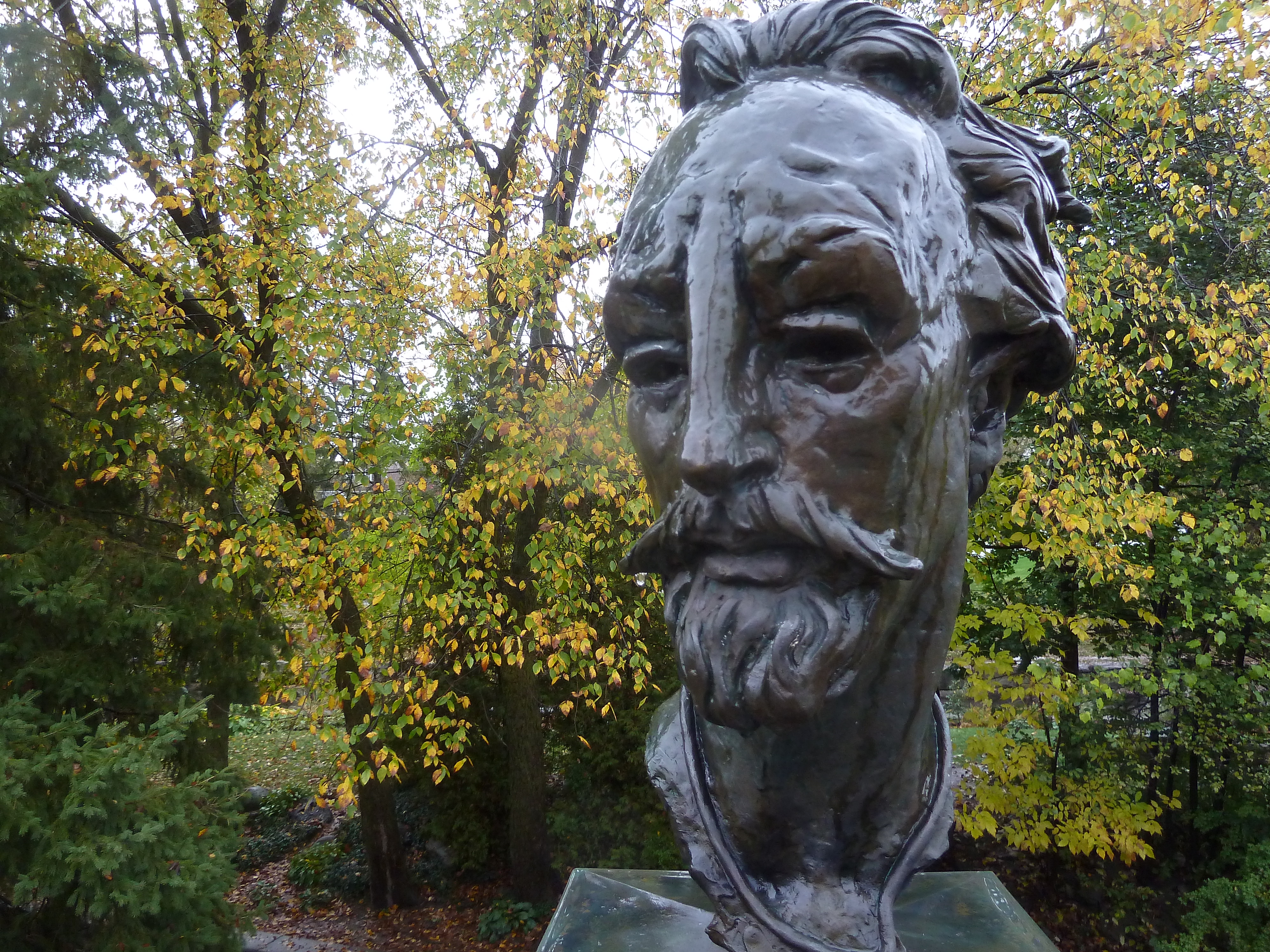
Here’s a guy you’re constantly thinking of in this town, a constant source of inspiration. We were caught in the rain together . . . .

 Ian Leslie has an interesting article in this month’s Intelligent Life titled “In Search of Serendipity.” Appropriately enough, I came across it accidentally when I was wandering around another aggregate site, The Browser.