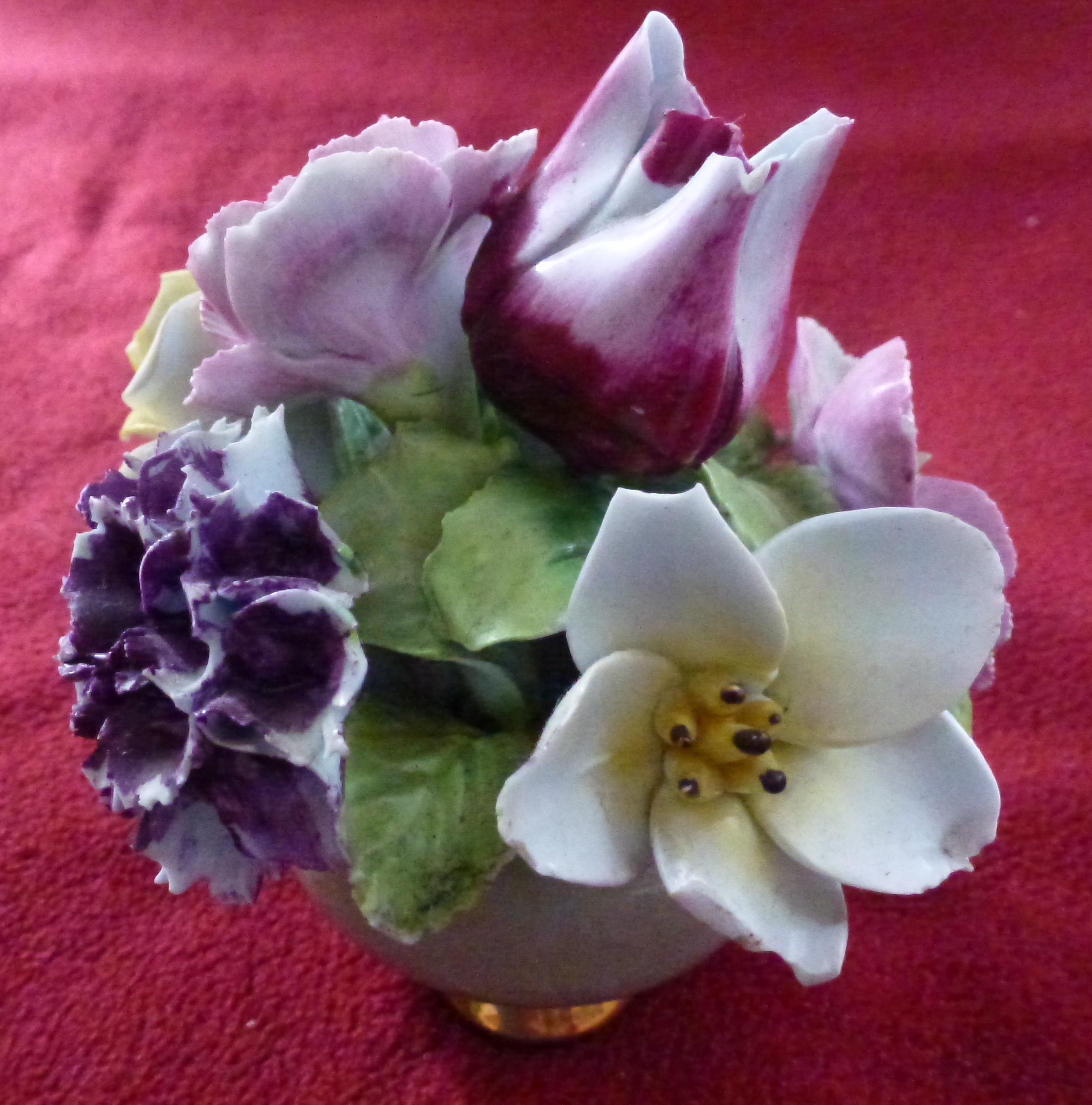
This thing belonged to my grandma and when she passed away, my mom took it and when she passed away, I ended up with it. It’s about 4 inches high and it’s rather heavy. Also, the flower petals have very sharp edges – you can almost cut yourself on them if you’re not careful. This is a standard old lady knick knack if ever there was one. I don’t like it, aesthetically, but as it reminds me of my grandmother, Edith Hunter (neé Arthur), what can I do but hold onto it, maybe even cherish it at some level?
I have written before on this blog about my relationship with my grandmother, so I won’t go over that same ground again. (Please see “A Visit to Grandma’s House” posted in February of this year.) But in that post, I refrained from telling what I think is a very interesting story about her and how the family ended up on the prairies, so here it is now.
Early in the last Century, around 1907 I believe, grandma’s father and brothers took advantage of the Homestead Act and went out to Saskatchewan to farm a quarter section of land. (This was in the Alsask area, for those of you familiar with the great metropolises of the Canadian prairies.)
Grandma and her mother stayed home back in Ontario, in the town of Ancaster, which I believe is now a part of Hamilton but was then its own dreamy little village. Both were school teachers, and very fine ladies from what I understand. Teetotalers, even. (I know it’s hard to imagine that I come from such pure and virtuous stock, but I do.)
To give you an idea of the two of them in action, grandma told me that one day around this time she and her mother went out to make their calls on a fine Sunday afternoon, but then were forced to hurry back home when they realized they had left home without their white gloves. Scandalous behaviour!
Grandma’s mother was very suspicious of this western movement of the family. She had hoped her husband would come to his senses and return to Ontario after a summer, but he and the boys seemed to be staying put. And then one fateful day, there came a letter in the mail from the wilds of the western hinterland requesting that the girls pack up the house and come out and join them.
Great-grandma was having none of this, and so she dispatched my grandma on a recognizance mission to find out first hand just what it was like out there. At the time, this meant traveling down through the United States to St. Paul, Minnesota and then taking a spur line up into Canada.
It’s hard to imagine a young Edwardian lady heading out on a journey like that, with her envelope of money pinned up inside her petticoat, but she did it. The train dropped her off at a very lonely crossroads in the middle of the vast prairie, not a building in sight. And there were her dad and brothers waiting for her on a buckboard pulled by one gigantic horse.
Grandma loved it. She had the time of her life, and soon enough returned home to her mother singing the praises of the prairies. This was the promised land, Shangri-La, Valhalla, Eden . . . take your pick. She convinced her mother to make the move, and her mother – against her better judgement – acquiesced.
And so the next summer, as my grandma presented it to me when I was a wee lad, she and her mother packed up the fine china and crystal and linens and the piano and everything else and took that same train down through Minnesota and then up into Saskatchewan.
They were dropped off at the same lonely empty crossroads, along with all of their earthly possessions. There on the buckboard were my great-grandfather and my great uncles.
Can’t you just hear the drone of the mosquitoes and the buzz of the grasshoppers and feel the heat of the sun beating down on them . . . and sense the deep endless silence beyond . . . that relentlessly vast and empty space, the big bowl of the sky, high white clouds drifting by, thousands of miles from civilization?
Grandma’s mother took it all in, ever so slowly slumping to her knees on the dirt road, in her white dress and her white lace gloves. She began to sob, pounding her white-gloved fist on the dirt road moaning, “No . . . . no . . . no . . .”
Grandma said you could see little puffs of dirt rise up each time she hit the road with her fist.
I guess great-grandma didn’t like it out west so much. As far as I know, she never really did come around.
I don’t know . . . maybe this little vase once lived on a shelf in that stately old home in Ancaster. Maybe it made the journey out west with my grandma and her mother.
Honestly, it’s one of my least favourite objects, but as it reminds me of one of my favourite people of all time, my dear grandma Edith Hunter, here it will stay as long as I have a shelf to put it on.
Thanks for reading!
Here’s a little gem I found looking for something from this era to share with you . . .
Not the greatest photograph, sorry. But you get the idea.
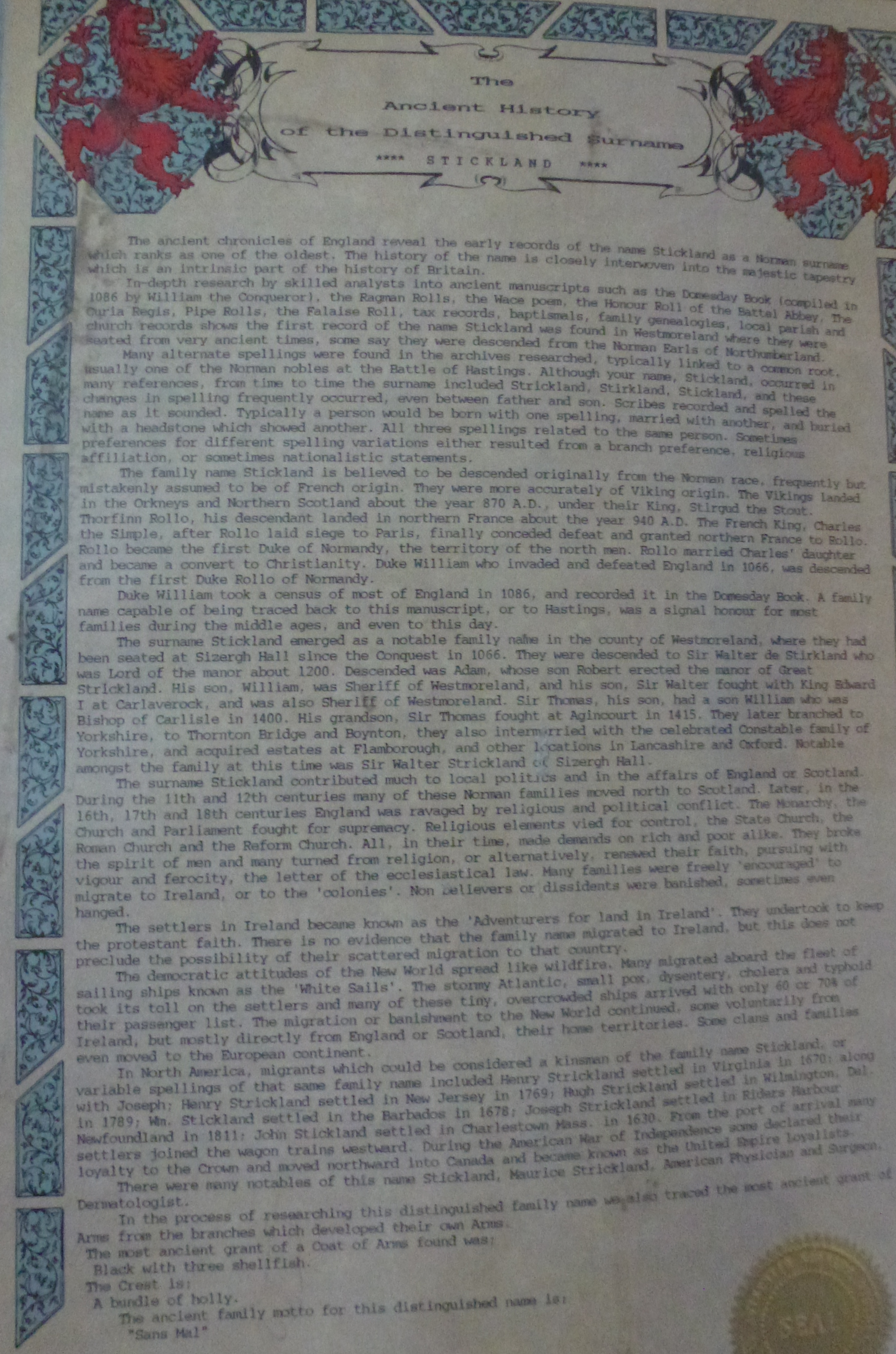
This object is one of those things that I simply can’t bear to throw away. My father ordered it, probably because he saw an add on television and imagined that with its authority, he could put the whole Stickland – Strickland debate to rest once and for all. (As I type these words in Word on my MacBook Pro, I notice that Stickland gets the red underline, Strickland does not. Clearly, like my father before me, I am fighting a losing battle.)
It is 11” x 17” and looks credible at first glance. But the fact that the word “SEAL” is embossed into the gold seal makes me a tad suspicious. Isn’t that a tad redundant? But this was created in the days before the internet, and so the amount of research that went into it, evidenced by a copious bibliography printed on the book, makes it seem fairly credible. It would take you five minutes to find this out in the internet nowadays. This document was created on just the other side of the digital revolution.
What the scroll tells us is that the name of Stickland, and its derivatives such as Strickland, goes back to very ancient times –it’s actually a Norman name, so puts my daddy’s family way back to the time and possibly in the company of William the Conqueror when he roared into England, back in 1066 and all that.
My mom’s side, the Arthurs, go back even further. They were the ones waiting for the Conqueror in Hastings almost 1,000 years ago saying “Welcome to England.” While I have some Scottish blood in there as well, and even a dram of Irish, my pedigree is quite secure on the English side.
My paternal grandfather immigrated to Canada in the early part of the last century. He was a blacksmith in the small community of Maryfield. Saskatchewan. My mom grew up on a farm near Broadview, just up the road. Somehow, improbably, proving once and for all that opposites attract, they met and married and hence the writer of this blog was brought into the world.
My mom and dad grew up in a Canada that was very much a British colony. We had a photo of the Queen of England on the wall in our dining room when I was growing up. A typical Sunday dinner would have been roast beef and Yorkshire pudding on Royal Albert china. Dad dressed for these meals and we children were allowed to be seen and not heard, elbows on the table was considered a serious crime, the tv was nowhere in sight, and one didn’t leave the table without first asking to be excused. Etc.
While a Brit at heart, my dad was a fierce Canadian. He loved this country with all his heart and soul. Well, I should qualify that. He loved the English version of this country. He didn’t care for the French, but this animosity was directed mostly into hockey: the beloved Maple Leafs vs. the damned Montreal Canadiens.
I know it’s easy to castigate the English, but I am proud of my English ancestry. I love my Arthurian cousins still living in England, although born here, on Vancouver Island. The history of imperialist Britain I know can be brutal and arrogant, but I can tell you that my dad was one of the kindest and most principled men I have ever known.
I’ll give you an example. (I think this also happened to my brother, Tom.) When I was twelve or thirteen or so, my dad came into my bedroom, which he never did, smoking his pipe, which he always did. He sat on the side of my bed, looking around like he was, as they say, an anthropologist on Mars, with great plumes of blue smoke emanating from his pipe.
Dad was laconic, to say the least. A man of very few words. There was an extremely long and awkward silence as he composed himself and chose his words.
Finally, he said: “You know what a gentleman is.”
I said I did.
“When you’re around girls, which you will be now, always try to be one.”
That was all. And that was my facts of life speech, I guess.
I’ve tried to live up to my dad’s advice. I think I’m getting better at it the older I get. I hope I am.
Finally, I would say about this parchment that I will never be able to throw away — the implication that the Sticklands were Normans and may well have originated in France could not have been welcome knowledge to my dad. Be that as it may, it would seem to be so.
He didn’t exactly brag about the contents of this document, but I guess in my own way I am doing it for him now.
Thanks for reading.
Here’s my favourite English song I could think of . . .
I have just finished reading Neil MacGregor’s excellent book, A History of the World in 100 Objects. MacGregor is the director of the British Museum, where all of his 100 objects can be found. The book is beautifully illustrated with photos of each of the objects and then some. It is based on a series originally done on BBC Radio 4.
If you have any interest at all in the history of mankind from 2,000,000 years ago (Olduvai stone chopping tool) to the present (solar-powered lamp and charger), this is a good book for you to lay your hands on. There’s a paperback version, but it doesn’t seem to have all of the illustrations in it so I recommend getting the hard cover version, which is published by Penguin (2010, $42.00).
For those interested generally in the subject of anthropology, this book is very, shall we say, digestible. It is written in bite-sized bits, I suppose to fit the original radio format. It offers a small but lucid glimpse into different times and places. One feels a whole lot smarter after reading this book, if I do say so myself.
The idea of using objects to talk about history, I find, is very effective. It seems to objectify a time and place in a very efficient manner, reminding the reader always that we are all part of the great human family that stretches back in time over 2,00,000 years.
I’ve been thinking about objects, the things we have, for a the past few weeks as I’ve watched the people in Calgary who were hit by the flood having to divest themselves of most of their possessions. I have heard it said before that we consumers are only intermediaries between the store and the landfill, and that we even pay for the privilege of being so. Never has this seemed so apparent as now.
A lot of people choose to surround themselves of a lot of things, a lot of objects. Looking at it when it’s all piled up, wet and soggy and smelly and misshapen, covered in river silt, house after house, street after street, it really does beg the question, “How much stuff do we really need?”
Be that as it may, I’m not criticizing anyone who has just survived a flood. It’s realy a very horrible experience and my heart goes out to all my neighbours who have had to endure this catastrophe. And yet, it’s probably safe to say that many of us in North America tend to have a lot of stuff, to the point where one could legitimately ask, “Do we possess our possessions or do our possessions posses us?”
I almost wonder if there’s a sense of liberation that comes from losing a lot of it, and whether people who have weathered this storm will choose to live in a more austere fashion in the future. Hell, maybe they’ll go back at it with renewed vigour and zeal, I guess we’ll find out. Time will tell.
On any account, between the book and the flood, I looked around my own apartment and asked myself what is really important here, and what isn’t. There’s an old after-dinner question that goes, “If your house was on fire and you could only take one thing with you, what would it be?” It is very telling about a person’s true nature as to how he or she answers that question.
And so, I wondered if it would be a useful exercise for me to look for not one but 10 (but not 100!) objects in my apartment that I could use to tell my own personal history, in the same manner in which MacGregor tells the history of the world with his 100 objects. So to that end I’ve been looking around my apartment the last couple of days, for the first time in my life taking a long, cold look at the things I surround myself with, asking myself what they have to do with me and my story, if anything at all.
The list I have come up with is quite surprising, even to me. So, what exactly is this list, you might ask? Well, dear reader, you have to wait for it. Because it’s my blog and I can do what I want to, tomorrow I will begin a series of ten pieces on ten objects in my apartment that I feel tell the story of my life. I plan on doing this in ten days. We’ll see if I manage to pull that off or not, given that I have no one other than myself to give me a hard time about deadlines.
I think this is an interesting project — I hope to others besides myself — and I hope you will check in and see what things I have on my list and what I have to say about them.
In the meanwhile, I encourage you to look around your place, at your stuff, and figure out for yourself how your own stuff reflects or even defines who you are.
Thanks for reading. Happy Canada Day! See you back here tomorrow.
Here’s Oscar Peterson with my favourite Canadian song of all time, eh . . .
The Bow River under Crowchild Trail just west of downtown.
I am writing this post partly for the sake of my readers who don’t live in Calgary, but I hope it will be of interest to those who live here as well . . .
As you may know, I live in Calgary which is a largish city (for Canada at least) located at the western end of the Canadian prairies, in the foothills of the Rocky Mountains. It is the centre of the oil and gas industry in Canada and so it’s one of Canada’s wealthiest cities.
The residual wealth that trickles down from oil and gas has actually helped to create a thriving arts and culture scene here, which I like to refer to as the art patch as opposed to the oil patch. As you can probably guess, I identify more with the latter than the former of these patches.
Generally speaking, the people in the two patches don’t always get along so well. They (oil) seem to think that we (art) don’t work and we (art) often think that they (oil) operate without any evidence of a soul.
This dirty roiling mess is usually quite placid beautiful blue-green water from the mountains, some of the nest trout fishing anywhere.
But, we do share the same geographical area, one of the features of which is the proximity to the mountains. Banff, for example, is just over an hour’s drive west of here.
Two rivers (in particular) originate in the mountains and flow down through Calgary, the Elbow and the Bow. The Elbow flows into the Glenmore Reservoir in the south part of town and it is from here we get our drinking water. It then flows north and east from the reservoir up through some of the finest neighbourhoods in the country and meets up with the larger Bow River just east of downtown, which is the site of Fort Calgary.
A few days ago a number of forces came together to cause these two rivers to flood in a way no one here can ever remember happening before, not like this. Those forces included the melting snow pack in the mountains along with a record rainfall in the mountains, the foothills and in Calgary. All that water has to go somewhere and it all went into the two rivers which soon flooded their respective banks, leaving large areas of the city underwater, causing the evacuation of tens of thousands of people.
Although I live nowhere near either river, people in the block east of me were evacuated yesterday (Friday) not so much because of the water but because there were problems with the power grid and so the power was lost for a number of apartment buildings downtown, hence the evacuations.
It’s like it’s boiling.
Obviously, the situation wasn’t as dire here as for people living along the rivers. Some of them lost everything, and all of them have a horrible mess to return home to.
All of which brings me to my point about the amazing spirit of generosity that flowed through our city as a result of this situation.
I first became aware of it on Thursday evening when the shit really hit the fan and we all began to realize how serious the situation was becoming.
I was following events as they unfolded on Facebook. The updates on there turned out to be more comprehensive and current than anything I could find on television. I watched in disbelief as news spread of neighbourhood after neighbourhood being evacuated. Some of them were only a few blocks from my apartment, and all of them were places where friends of mine live.
What followed was truly extraordinary. Friends on Facebook, those on higher and drier ground, began offering a place to stay for those who were facing evacuation. I wish I had counted how many offers I saw on Thursday night and Friday, honestly it was in the hundreds.
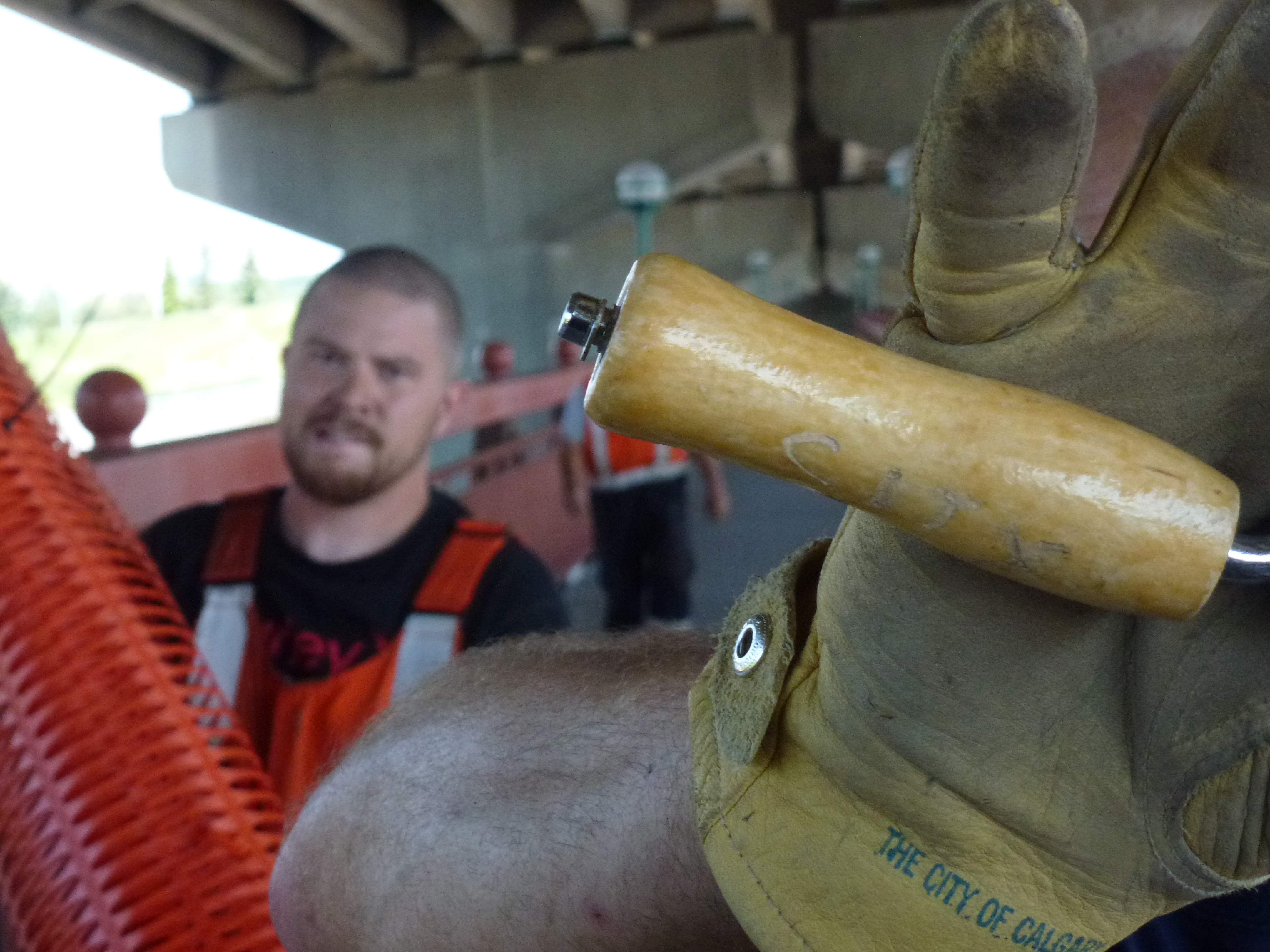
Then the city workers arrived and bade me to desist.
Not only that . . . people were offering to drive and pick up the evacuees. And not only that! Many were sweetening the pot with offers of food, wine, beer, you name it! People with yards were even billing themselves as “animal friendly” for those with pets.
This generosity was so spontaneous and overwhelming that in a few cases I seriously contemplated pretending I’d been evacuated just to have a little free vacation at someone else’s house. Of course, getting busted on something like that is something you would never live down so I rode the storm out on my own. I even offered a room at my place for anyone who needed it.
After all, I had beer and vodka, coffee and smokes, and a little water. I knew I’d be OK.
And in the end, you know, it didn’t matter much which of the patches you came from or which side of the river you lived on, the people of this fine city came together in a truly inspirational expression of community that for some of us – certainly for me – reminded us why we live here in the first place.
Reminding us, ultimately, that’s there no place else in the world where we would rather live.
The rains have subsided but the rivers are still high. These photos of the Bow River were taken today (Saturday).
There’s a hell of a mess left to clean up, but we’ll get through it, and maybe even be a little richer of a community for it.
In closing, a little number from one of my favourite Calgary-based musicians, Tim Williams, who had a health scare during the flood and had everyone worried but it looks like he’s going to be fine. This is Harrison Lake in BC you’re seeing in this vid, the flooding’s not that bad here . . . not yet . . .
This photograph came to the Eugenius archives today thanks to the little boy you see on the right, my oldest friend in the world, Roy Lyster. Since that photograph was taken in the early 1960’s, Roy and I have gone our separate ways, but in the true manner of old friends, we check up and check in every now and then. Roy was in Calgary last week and we had a lovely evening together.
And now, looking at this photograph that Roy sent out of the blue today, I am in awe that I have been blessed to have such a truly wonderful friend in my life all these years.
I mean, look at us! Could we be more happy!? Is there any place we would rather be than in each other’s company?! I think not.
A few comments on the photo, some 50 years after it was taken . . .
I believe the photo was taken near Roy’s house on the 16 block of Athol Street in Regina. This area has since become, according to Macleans Magazine, the worst neighbourhood in Canada, but it seems pretty damned leafy and safe in this photo. And it was. It was a good place to grow up.
I’m not sure what Roy is doing wearing those high-waisted jeans, but he was always a little ahead of the rest of us fashion-wise. I can’t help but notice that I am wearing a cardigan, which I still do, and am wearing what appears to be Chuck Taylors, which I still wear, and I’m obviously riding a bike, which I still do. Have I not come anywhere in over 50 years on this planet? Have I not evolved? It would seem not.
But as they say, if it ain’t broke, don’t fix it.
Further to my wardrobe, you notice I am not wearing jeans, like Roy is. My mom was wont to dress me up a little bit. Legend has it that she insisted my hair be kept long and she liked to dress me in little outfits, pinafores and such. One day my dad was out with me and someone asked him how old his little girl was and that was that. Dad took me to a barber and cut off all my curls. Mom took to her bed and cried for days. I still have an envelope with those curls in it. So I notice I have on dress pants in this photo, which doesn’t really surprise me.
Notice too that I am on a girl’s bike, and with a basket, yet. And notice how gigantic Roy’s bike is in comparison. Roy’s bike even has one of those old school generator and light gizmos. Talk about high tech! I can’t believe he could ride that thing without damaging himself! But why would I have a girlie bike with a basket like that?
The simple answer to that is that I at least had a bike, and, I’m sure, was glad to have it. My parents were hardly wealthy. Neither were Roy’s. But they provided us with what we needed, and we were obviously happy little boys.
Today, the little boy on the right in an immensely talented and successful man, you can read up on him here: http://people.mcgill.ca/roy.lyster/. And elsewhere. And you know about the other boy in the photo. Whatever was going on in our young minds that day almost half a century ago when we set out for a bike ride together, it must have all been good, and our little minds were free and clear to dream big dreams.
One night, a few years after this photo was taken, when we were thirteen or so, we were at a party and Roy had the Old Friends album by Simon and Garfunkel. I remember we wondered that night so long ago if we would be friends like Simon and Garfunkel so beautifully sang about. Well, we’re not 70 – yet – and we’re not sitting on a park bench – yet – but it seems we are destined to be friends to the end. I hope so.
I found the song and share it with you here.
So, here’s to old friends, my friends. Remember the old saying:
Well, well, well. Would you look at that! Just when you thought our streets were safe, who should come skulking around here again but Mr. Grumpypants with another first world atrocity to share with us all. Take it away, Your Grumpiness . . .
Thank you, Eugenius.
Meine Dame und Herren. Mesdames et Messieurs. Ladies and Gentlemen, thank you for taking the time to read my guest column on the Eugenius blog here. Though I don’t mind telling you that I am still awaiting payment from the first post I wrote which was months ago. Does the administration of this blog think I live on air or something? What the hell’s wrong with people, Krisake . . .
On any account, there I was in Safeway. Minding my own business as usual. I was in the eggs and dairy aisle, lovingly fondling the various tubs of yoghurt. A woman of indeterminate age and, I might add, rare beauty, was beside me, so to speak, likewise engaged.
I was caressing a big firm tub of OLYMPIC CREAMA while she was going back and forth from tub to tub of inferior yoghurts, clearly befuddled and unable to make a final decision. She seemed particularly interested in a blue tub of Greek stuff that I had tried myself and found to be wretched. And so what could I do, what choice did I have, I intervened.
“My lady,” I crooned, in dulcet tones, “Do yourself a favour. Forget that stuff, I’ve tried it, it’s no good. Get yourself a tub of the OLYMPIC CREAMA. It’s simply the best. It will change your entire notion of what yoghurt really is.”
“Is it really that good?” she asked?
“It is, it is, it just makes everything else taste like puppy doo doo.”
“Well,” she said, “That’s good enough for me. Thank you.” And she took a tub of CREAMA and put it in her cart. Decisively, if I do say so myself. She gave me a meaningful look, and then shopped on, as did I: she to eggs, and me to cheese.
End of story, you would think. But no. Oh no. Oh no no no. A few minutes later, as I was looking to take my place at one of the checkouts, there she was, hauling a tub of the blue shit I had warned her about onto the conveyor belt. She had obviously slunk back to the yoghurt section when I was out of sight and put back her tub of CREAMA and taken a tub of this inferior blue goo instead.
WTF?!
What can you even say to this type of underhanded skuzzy behaviour? We had a pact, an agreement. We had had a moment. For no personal profit or gain of any kind, other than the satisfaction of helping a fellow human being, I had GONE OUT OF MY WAY to help this thankless hussy and what does she do??? She sneaks back around and makes the old switcheroo.
A low point, a black day, in the history of cooperative shopping, to say the least.
In my mind, I made my way through the lineup behind here and I picked up that blue tub of rancid yoghurt and held it up to her face and screamed: “AH ha! Caught you! You heartless thankless JEZEBEL! You low and vile worse than crawling THING! How could you?!?! How could you do this to US???????”
And then triumphantly made my way to the fruits and vegetables aisle to compose myself. In my mind, at least, that’s what I did.
Ahh, but dear reader, perhaps in another place, at another time, I would have done just that, and then some. But sadly – and herein lies the seat of my grumpiness – I am a Canadian man, bred and trained by my parents to be polite and obsequious at all costs, especially in the presence of women of indeterminate age, and so what did I do?
I averted my eyes, dear reader, pretending I hadn’t noticed this atrocity, and meekly took my place in another line up.
So sad, when I think of what might have been. So sad, so sad.
No wonder they call me Mr. Grumpypants.
I live it my friend Gladys and her Pips to convey the depths of my despair . . .
A number of years ago my friend Michael Finner and I started up a small publishing house in Calgary called B House. It has gone through good times and bad, happy and sad. It’s obviously interesting times in the publishing world. Everything is up in the air. Everything is topsy-turvy. The old rules no longer apply and no one really knows what the new rules are.
In this regard, we are certainly living in interesting times.
While we have been down, we have never really been out. And now, amazingly, we are having an omnibus launch of 5 new books this spring.
Here is the press release I wrote about the launch:
B House Publications is pleased to announce an Omnibus launch of 5 new B House publications featuring the work of some of Calgary’s finest writers. The books will be launched in one evening at Calgary’s Shelf Books, at the corner of 4th Street and 13th Avenue SW on Thursday, June 6 beginning at 7:00 PM.
The evening will be hosted by B House editor in chief, Eugene Stickland. There will be readings by our authors from their books, in the following order.
1. Neil Fleming will read from his play, “Last Christmas.”
2. Eugene Stickland will read from “Cartwheels,” a collections of letters written by Amy Doolittle chronicling her experience with ALS.
3. Virginia Nemitz will read from her volume of poetry, “Swans I have Known.”
4. Jude Dillon will read from his volume of poetry, “The Fractured Garden.”
5. Kirk Miles will read from his volume of poetry, his second with B House, “Hotel on the Cliffs of the Heart.”
There will be an intermission so our friends can look around this beautiful book store and mingle with the authors. There will be a reasonably-priced cash bar and some nibblies. All in all, it will be a rare experience to launch so many books by so many great writers at the same event. Please share this with as many people as you can.
All of these books will also be (or have also been) launched individually by their author, so please check with them to see if there will be other events to celebrate these books.
See you at Shelf Life June 6.
-30-
On the night, I will speak on the ever-changing mandate of B House and offer some insight into what I think is going on in the publishing world. I certainly invite friends in Calgary to take in this event and support our local writers.
There is a link to Shelf Life on the left side of this screen.
According to recent statistics – some of which I read and some of which I am making up, though I think the ones I read can be found in a New Yorker magazine which unfortunately was subjected to water abuse in my bathroom where I tend to read the New Yorker and so had to be thrown out, this having taken place about six months ago, although it may only have been four months ago and could have been as long ago as a year ago, all complicated by the fact that it may not have been a current issue when I was reading it, so you’ll have to take my word for it. “What kind of scholarship is this?” you might well ask. “Shoddy,” you might well reply and you would be right. Further, you might ask, or even demand, what kind of interjection is this that goes on for 150 words, only four words into the sentence? And to that I would say, if you’re even still reading, to paraphrase who was it, Lesley Gore, who had the hit song “It’s my party and I’ll cry if I want to, cry if I want to, etc.” in the early ‘60’s (ha ha, I was able to check this one out, it was Lesley Gore and the year was 1963!) that “It’s my blog and I’ll ramble if I want to, ramble if I want to, etc.” Damn, this seemed like such a good idea when I started out. Does that ever happen to you? On any account, I felt terribly guilty about my lack of fact-checking and so spent a laborious three minutes in the Googlean labyrinth and was able to verify that at least in some parts of England what I am talking about here, or what I am about to be talking about, if I would just get on with it, is true – more and more people are choosing to live alone these days.
We might infer from this startling statistic that this means that more and more people are in fact single, but this is where things get a tad murky, because it would seem to me from my experience that, to quote the Gershwins, “It ain’t necessarily so.”
And this is where my research into the I/we shift comes into play. As far as I know, I am the pioneer in this field, the trailblazer, the visionary on the vanguard, as it were, but while I have identified this phenomenon, preliminary research would indicate that it has, in the parlance of the day, traction. (At least it does with my friend Pete, who like me is a single man, and who is so vitally interested in the I/we shift, having encountered it a few times in his own life, so that nothing would do but I write this blog post sharing my findings with a larger public. Speaking of Pete, I might add that he actually has some experience with the we/I shift, but to say more would be to tell tales out of school, as they say, and so discretion would dictate that I say no more, and leave it at that.)
Essentially, the I/we shift occurs when one is talking to someone who is presumed to be single – first person singular, or I – but who soon reveals, linguistically, that he or she is in fact part a couple – first person plural, the dreaded we.
Consider, if you would, the following conversation which is quite a bit like a conversation I had just the other day. I was standing on a street corner winding my watch, when I was approached by a lovely young woman who was either walking her dog or was being walked by her dog, depending on which one of them you talked to.
ME: My, what a lovely hound you have there!
SHE: Thank you.
ME: Is it a short-haired-near-sighted-snorfling-Belgian-water-mutt?
SHE: No, it’s a French bulldog.
ME: Ahhhh, sorry, I tend to get them confused. It’s a handsome dog on any account.
SHE: Thank you. I’m so glad I got her.
ME: I guess you get lots of exercise walking her?
SHE: Oh yes, I walk her three times a day. I’m actually getting into shape!
ME: I can see that. Do you not have a yard, then?
SHE: No, we live in an apartment.
Let me interject here. At this point of the conversation, having encountered the first I/we shift, I was on uncertain footing, as I didn’t know if the we referred to by the young lady meant herself and the dog, or herself, the dog and some hulking, brooding geologist with his head shaved, you know the type. The kind of man of whom one and all might ask, “What the hell is she doing with him??” Oh, the imprecision of the English language. Although I knew we were heading into choppy waters, I none the less sailed on.
ME: Yes, I too live in an apartment, I guess most of us down here, do.
SHE: Well, I’m hoping to get a house some day.
ME: A noble aspiration.
SHE: (dreamily) I love having a yard so can putz about and sunbathe.
ME: (swooningly) A lovely image.
SHE: We’ll have it soon enough. Just as soon as my boyfriend finishes his engineering degree.
There you have it, gentle reader. Not only the completion of the I/we shift, but the added insult of inclusion of the dreaded “B” word. I should have known.
This was a rather slow-developing I/we shift, and of course the longer it is prolonged the more painful it becomes. But I often hear it in one or two sentences, to wit:
I went to Banff yesterday, I love it there. We love hiking, I love my boyfriend.
Not quite so drastic as that, perhaps, but alarmingly close.
It all makes me wonder, are there any single people left out there, or are we always taken somehow, by someone, to some extent?
On any account, there you have it: the I/we shift. Check it out for yourself, tell your friends, remember where you saw it first.
I’ll leave it for my old friend Tom Waits to mop things up.
It’s Mother’s Day and so our thoughts turn to our mothers and all they have done for us. My mother, Stella, was a real beauty, a true child of the prairie, she could run across a field and jump on a horse and ride it bare back, when she was a girl.
It wasn’t always easy to see that bright athletic girl in her when she grew older, when she grew old. Her final days were not easy ones, she was in physical agony on account of osteoarthritis, and then her mind was ravaged by Alzheimer’s Disease. When she died, of course I was sad, but I was relieved as well. It really was a tough go for her at the end.
I’ve been watching the progress of my friend Michael Finner’s mother as she, now, enters into the endgame. It’s not easy for Michael or his brother Frank and sadly it sounds all too familiar to me.
After his visit with his mother today, Michael shared the following on Facebook, and kindly agreed to share it here on my blog. So here’s my best friend and publisher Michael J. Finner talking about visiting his mother on mother’s day:
To Whom It May Concern :
I went up to the extended care unit to see my Mother today. She was quietly sleeping and after I put a bouquet of flowers by her bed I sat down and watched her for a while. Like a dream within a dream, pushing well into her 90’s now, she reminds me of a little bird. And it seems like she grows smaller every day. No doubt, one of these days, she will just up and disappear.
I am very thankful that at this time of her life she is very peaceful as well as comfortable as she is. Oh, yeah, once and awhile she lets go with a verbal blast aimed at no one in particular. But I think that’s just to let you know she’s still very much alive. And although there’s always the pretended outraged expression of ” Oh, …. Mother! ” it is very hard to keep from laughing. In truth, sometimes we laugh together. Howl might be a better description. I think this is probably just her way of getting a rise out us and anyone else who happens to be in the vicinity. Her sense of humour, if nothing else, is completely, or at least for the most part, intact.
Yes, there are days when she wonders who I am. Where she is. Who the nurse is. The one she was calling by name only a moment ago. She usually confuses me with my brother Frank. And vice versa. Her cognition and her eyesight are going but not yet completely. Finding out dementia was come on followed by the news she was going blind really took it out of me and I must say I sadly lacked in the stiff upper lip category when I learned the same. My Mother always was, and is, a far, far braver person than I. We usually close each visit with a little kiss. Then she tells me that she loves me and of course, just like some kind of prayer, I tell her the same. Dementia or no. It is as it always was and always will be. Unconditional love.
So here is to Mothers everywhere. The ones I know personally . The ones I don’t know at all. May God’s love (whichever one you believe in) shine down upon You and Yours. Each and every day of your lives. As for my previous mention of the disappearing act that comes to us all – in closing let me leave you with this thought that crossed my mind as I was leaving my Dear Mama today.
This observation was made by Chief Crowfoot of the Blackfeet Nation some time ago. Somehow it always leaves me at peace.
What is life?It is the flash of a firefly in the night.It is the breath of a buffalo in the wintertime. It is the little shadow which runs across the grass and loses itself in the sunset.
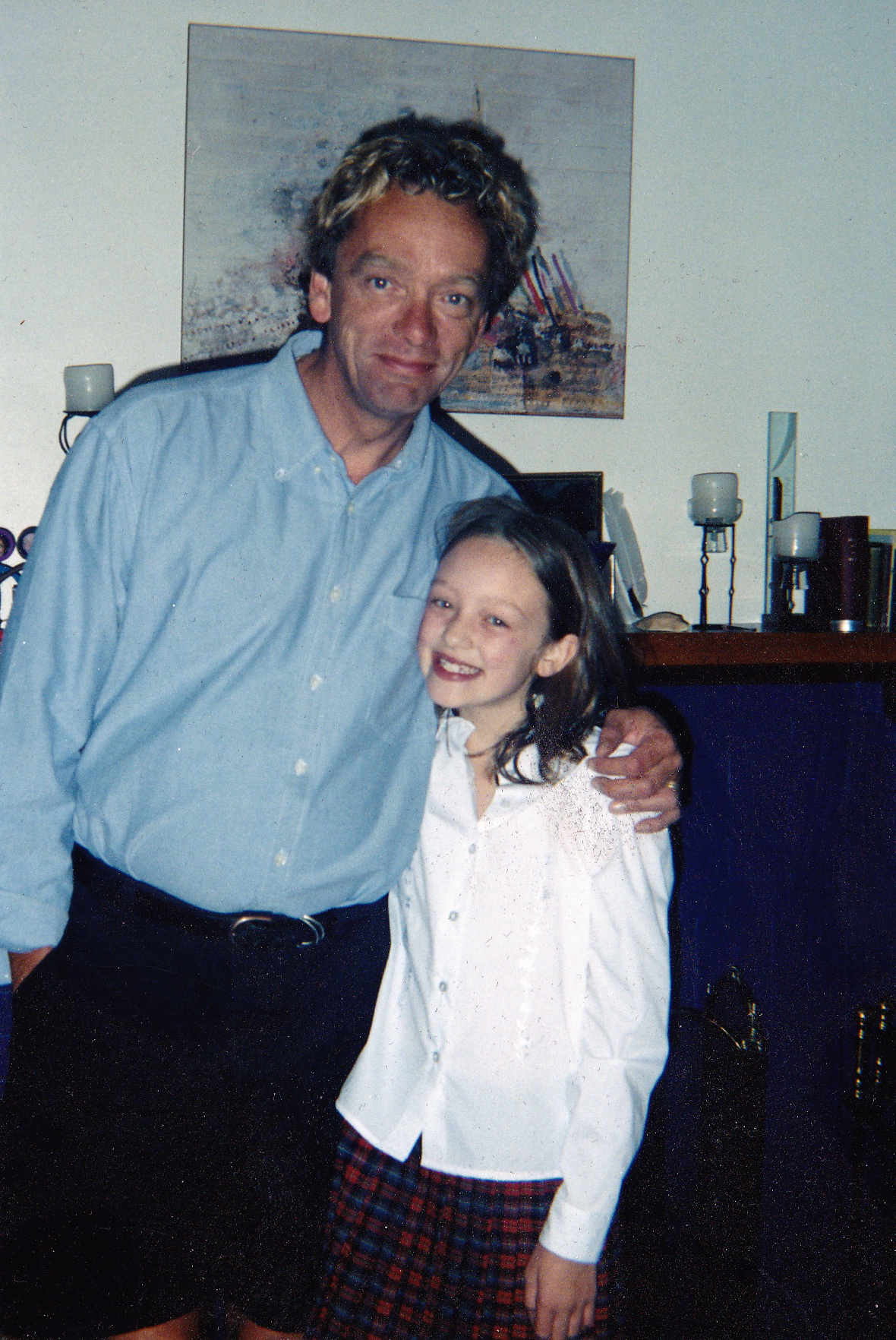
Dad and daughter back in the day, looking a tad preppy!
My daughter Hanna, aka to some of you as Johanna, was recently turned down in her application to study photography at one of our universities. Rejection is always hard, I know. I reminded her that I was rejected by UBC but then was accepted at York for my MFA.
So I know it’s not easy, no matter how much you have going for you. It’s a hit to the ego and it hurts.
The people at the university in question, trying to be competitive and fair, looked at Hanna’s high school grades which they felt were a little low.
What they didn’t know was that she had given up a promising and potentially lucrative modeling career which was taking place mostly in New York (and London and Paris) to return to Calgary to finish school in the first place.
That she finished high school at all was a bit of a miracle, and I know that when her mother and I watched her graduate we felt especially proud of the very mature decisions she made as a young teenager to get her to that point.
But now, the chickens have come home to roost, I suppose. She is disappointed, but I gently reminded her that she is currently working in the real world of photography, in some cases with artists whom her (not to be) professors have only read about, and so to keep moving forward and to never stop making her own way in the world.
And I shared with her my little metaphor about how a career in the arts is like riding on a train, and I as I know many artists read this blog, I wanted to share it here with you, with Hanna’s blessing.
I end up with her some of her thoughts on modeling along with some of her photos from a recent issue of INTERRUPT Magazine.
THE TRAIN
The train metaphor is about having a career as an artist. When you are young, you see the train going by and think, that looks cool, I think I’d like to be on that train. So you run after it a bit and catch up to the last car but it is totally packed and instead of people helping you up they seem to be pushing you away. There are even people hanging off the edges but you finally grab onto a piece of the railing or a ladder, you grab on and hang on for dear life and away you go.
Finally you get yourself pulled up into the back of the last car. It’s crowded and smelly and there’s hardly enough food and sometimes not even a clear space on the floor to sleep on and many times you think of jumping off because you see others jumping off, but you hang in there and the good thing about others jumping off is that it clears a little room for yourself and so gradually you are able to move forward in the car and even dream of what’s waiting in those cars ahead of you on the train.
And those others jump off at very nice places like law schools and accounting firms and marriages with lovely suburban houses and puppies and such, it’s all so tempting. Have a good look, because either you have that, or you stay on the train, it seems you can’t have it both ways.
So you stay on. At times the trip is tedious and monotonous and you wonder why you bother as do others, and they keep jumping off at the oddest places and yet there is more and more room, to the point it can get quite lonely at times. But you stay on the train and eventually make your way up to those cars ahead of you, where it gets a little better, a little easier.
After all your work and sacrifice, you might pass by those who jumped off and they will look at you with a mixture of admiration and loathing and think to themselves, “I was on that train once myself, I could still be on there too, but I jumped off . . .”
Well, say hello and wave good bye, you’re either on or off.
And the way is never easy or predictable. You say you should frame your rejection letters . . . Hemingway wallpapered his living room with rejection letters before he ever got published. I have a stack of them, and even at my age and with some reputation, I know that stack is growing.
That’s no reason to quit, though. All the more reason to carry on. It’s not easy, but you might find as the train continues on its course, eventually you will make it up to the front cars where you can actually get a seat and maybe they’ll bring you a drink and you can look out at the passing scenery and know there’s no place else on earth you would rather be.
And that’s my little metaphor of the train that has sustained me all these years and I hope it will you, too.
Here’s Hanna with the final word. Thanks for reading!










 eugene stickland