Imagine two somewhat soggy rugrats entering this grand establishment!
To end this reminiscence of early days in Regina . . .
At some point, I had to travel further south than Taylor Field.
It was on a late autumn evening in 1970 (possibly spring of ’71, on any account, long long ago!) which means I was 14 years old. I was sitting in the Copper Kettle coffee shop on Scarth Street smoking cigarettes and drinking coffee and writing in my journal.
That used to be the real reason for going into a coffee shop on a rainy evening way back then, to have a comfortable and dry place to have a cigarette. How the world has changed during my brief time in it. Well, we have to adapt, I guess. Within reason.
(Christ almighty! That was 55 years ago! And here I sit in Caffe Beano, sans cigarette, still writing in my journal. Have I not evolved at all?!) (And more to the point, what was I doing in a downtown cafe all alone on a Friday night, smoking cigarettes of all things! At 14!!)
Anyway, tt was a dark and stormy night when into the Copper Kettle came a boy from my school. He was a grade ahead of me. He was from Edmonton, much more glamorous and interesting than I could ever hope to be. He spotted me and came directly over to my table which surprised me mightily — I didn’t even know that he knew who I was, or that I even existed.
He sat down at my table, ordered a coffee and we sat and smoked a couple of cigarettes. Then he asked me, “What are you doing tonight?” (As if sitting in a coffee shop downtown smoking cigarettes wasn’t enough! Could there be more?!)
I’d like to think I was worldly and erudite enough to say something like “You’re looking at it,” but probably not.
“You want to go on an adventure?” he asked.
“Sure, I guess,” I said, not sure at all.
We left the coffee shop and went out into the rain. In front of us, there was Victoria Park, and to the left, across Victoria Avenue, the beautiful Hotel Saskatchewan. I followed my new friend as we walked up to Victoria, then crossed Scarth until we were standing at the bottom of the small stairway leading into the hotel.
“Come on,” he said.
“We can’t go in there,” I said.
“Why not?” he asked.
“We’re not allowed,” I said.
He looked at me like I was insane. “Of course we’re allowed,” he said. “It’s a hotel.”
Seeing my hesitation, he said the words that would stay with me the rest of my life: “Just act like you belong and you’ll be ok. ”
And so I did. And I’ve been doing it ever since.
We passed the elegantly-dressed doorman into the lobby then went down the main corridor past the elevators, my friend walking ahead of me, me tagging along behind. Finally he turned off into a small. ornate salon: in the salon, a grant piano and a couple upholstered chairs.
He took his wet coat off and threw it over one of the chairs and then sat at the piano. I sat on anther chair with my soggy coat still on and listened in mute disbelief as he began to play. Although I’d grown up in a house with a piano and had taken lessons when I was younger, it was like I was hearing the instrument for the first time.
For the life of me, I can’t remember what he played but I do remember it was what is known as classical music. It may have been some Mozart, maybe some early Beethoven, maybe a little Bach. It hardly mattered. I sat enthralled.
He played for twenty minutes or so, lost in his own little world. He transported me somewhere I had never been before. I never wanted that moment to end. But of course it did. Finally he stood up abruptly and put on his coat and said, “We better get out of here before they kick us out.”
I recall that I basically ran home that night, down Victoria to Albert, under the subway to Dewdney, over to Cameron and then the last half block to my house. My mom and dad were in the living room, probably watching TV.
“Did you have a nice evening, dear?” my mom must have asked. How could she have known my world had been shaken, that everything had changed for me in the brief time I’d been away?
“It was fine,” I said, then asked, “Mom, would it be possible for me to take piano lessons again?”
My mom was a church organist and a fine musician. I think she stared to cry when I asked her that. The answer was never in doubt.
And so I began piano lessons a few weeks later at the Conservatory on College Avenue.
My world had changed.
“Act like you belong.”
Words to live by.
Thanks for reading.
PS. For anyone interested in learning more about the venerable Hotel Saskatchewan, my friend Jeff Itcush has a short video on Youtube titled Jeff Returns Home — to the hidden world of the Hotel Saskatchewan.
There was a sculptural quality to my bicycle today, I thought.
I live in western Canada and we don’t really expect to still be riding our bikes in mid November but the weather is still mild this year so I’m still out there.
You’ll notice my bike has no gears. If I flip the back wheel around I can ride it fixie but my old knees wouldn’t stand the strain, I’m afraid. Still, riding it as it is garners no small degree of admiration from the hipsters and bike couriers in my neighbourhood.
Have you ever read Henry Miller’s My Bicycle and Other Friends? It’s a lovely read if you can find it. There’s also a great photo of Miller on his bicycle which I found and am happy to share with you here.
Sometimes when I am riding my bike, I feel like I am 12 years old again, and that’s not a bad way to feel.
Sometime in the dark and mist-shrouded vistas of time past — 1946 rings a distant bell — my parents moved into a fine old house on the 1400 block of Cameron Street. It was a good working class neighborhood at the time, maybe even with respectable middle class pretenses.
With the horrors of the Great Depression and then World War ll behind them, they must have had a lot of hope and big dreams, if not a lot of money, at that time. If they had a little extra money left over at the end of the month, they might walk down the half block to Dewdney Avenue to the Utopia Cafe. At that time, it was a good family restaurant run by a Greek chap named George. I think my dad told me once that at that time they could both dine there for about a quarter but I may be making that up.
But then things got a little weird. George sold the place to a rather eccentric chap named Roger Ing, originally from Canton. At first, that was all we knew about him. He ran the place — featuring the above menu — throughout the ’70s and beyond. In the early days, most of his clientele were people from the neighborhood, like me. If Scott Collegiate, located a few blocks north and a few blocks west, had an official clubhouse, it was the Utopia, or U-Ball as it was sometimes referred to. There was a corner table at the front of the place that you could only sit at if you belonged. I was allowed to sit there, in certain circumstances. It was one of those unspoken things.
Roger’s English was never all that great, although it was rumoured he understood more than he let on. He wandered around the place in his own little world delivering cheeseburgers and orders of chips and gravy and topping up cups of coffee. Nothing out of the ordinary, I suppose, but for one day when I stopped in for a coffee en route to my piano lesson. I had my music books with me. Roger sat down at my table, transfixed by a Beethoven sonata I was working on. He opened the cover and looked at the music carefully. Then he took out a ball point pen and drew a perfect caricature of a bust of Beethoven on the cover. Under it he drew a staff of music and “Ludwig van Beethoven, 1770-1827.”
Beethoven, by Roger. I probably bought this along with a grilled cheese and coffee for ten bucks or so circa 1990.
Well, you could have knocked me over with a feather. What on earth did Roger know about Beethoven? How did he know how to draw like that? I’d known him for years but never suspected he knew anything about art or music. After that little episode, Roger treated me a little differently, I thought. If I had books with me, which I usually did, he would sit with me for a minute and leaf through them muttering to himself. If I bothered to ask him about his interest in these books, or his knowledge of Beethoven, I don’t remember now. Or if I did, maybe he didn’t answer me. As I say, his grasp of English was never all that strong.
Enter Art McKay — literally. Art was an artist of great renown in Regina and beyond, a member of the “Regina Five,” on faculty at the University of Regina’s Fine Art Department. As I was told the story, he just happened to wander into the Utopia early one evening for a cup of coffee. He immediately recognized Roger as a former student, a foreign student from Canton who had come to Regina to study art at the college (University of Saskatchewan, Regina Campus at that time) in the 1950s. Roger obviously recognized his former professor. Soon enough a sketch pad materialized and they began trading drawings, just the two of them in the dim lights of the Utopia with the door locked to the outside world.
From that point on, things began to change rapidly at the Utopia. Roger transformed the unused banquet room (from the days of George) at the back of the place into his studio. Paintings began to emerge from the studio — strange, wild, crazy, intelligent, ironic, weird and wonderful paintings that were grouped around a number of motifs, including UFOs, flying hamburgers, tigers, as in William Blake’s tygers, the Mona Lisa, the rodeo and bulls, delicate little birds on a branch and of special interest to me, portraits of Beethoven and Shakespeare and other artists of note from days gone by.
Roger scoured the second hand stores for paintings and prints and painted over top of these, spilling onto the frame, retaining and revealing some of the original work underneath. (Also, his friends and fellow artists brought him prints and paint-by-numbers they found at garage sales, frames and all.) His output was astonishing. The quality of the work was insanely uneven. So many experiments, some that worked, some that didn’t. It didn’t seem to matter to him. The paintings kept streaming out from the banquet room at a prodigious rate. (We regulars would peak in when we were at the back feeding our dimes into the pinball machines, The Queen of Hearts and Buckaroo!)
For all of this, Roger certainly had his time in the sun, his late in life more than fifteen minutes of fame, and deservedly so. There is a wealth of information about him and his art and the Utopia on the internet, including a very good documentary by Regina author and artist Judith Silverthorne, titled Roger Ing’s Utopia, among others.
My story ends on a personal note. I returned to Regina for a few years in the early 1990s after Roger had begun his ascent to fame and adulation. (From Regina, I moved to Calgary where my playwriting career took flight.) One day before I left, I went into the Utopia in the late morning and sat at the old corner table. It was a quiet morning and Roger brought me a coffee and sat down with me, just as he had twenty years earlier when he drew his little portrait of Beethoven on the cover of my sonata.
I explained to him that I was moving to Calgary, that it was a good opportunity at a good theatre. After a moment he looked at me and said, “You show them. Show them what the boys at the corner table can do.”
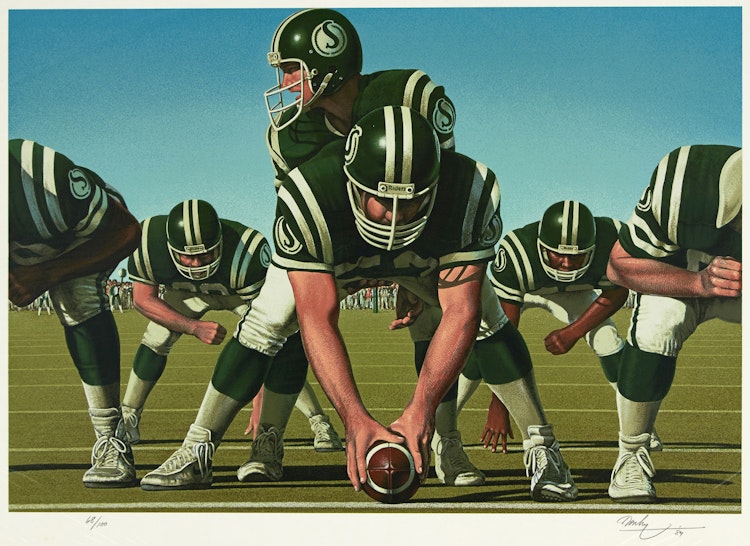
Ken Danby’s great painting, Roughriders. Everything has changed, yet the feeling remains. Timeless.
More nonsense, this time about football, as we try to erase the memory of the World Series from our Canadian minds!
I grew up only a few short blocks away from the setting of this painting, which was old Taylor Field. If the Riders are going towards the south end zone, then you could almost see my house between the QB and the running back on the left.
Growing up so close to the action, it was impossible not to become a life-long fan, which at times is both a blessing and a curse. We’ll see what happens this year!
Thanks for reading more stream-of-consciousness whatever it is!
we had a pee wee football and some nights we would play catch on dewdney avenue on the sidewalk in front of dewdney drugs and the doctor’s office on the corner and paramount cleaners and johnny the barber and the utopia cafe and gondola pizza and the little co-op store on the corner but this was a long time ago and I may be forgetting something anyway if you got good at it you could throw those little balls a long way and with any luck catch one that had been thrown a long way which is a good feeling maybe you know it and maybe it’s not all that surprising that we played with a football because taylor field where the roughriders played was only a block south of us so naturally football was very important to us sometimes we would cross elphinstone and walk over to the exhibition grounds and run around on the infield in front of the grandstand where they practiced and they had a machine that was a bright yellow frame with black arms of stiff rubber protruding from the inside of the frame which you had to run through if you could make it i guess those black rubber arms emulated the arms of the defensive linemen and linebackers and what made it special and even magical in a way to run through that thing was knowing that george reed himself would have been running through it a few hours earlier a brush with greatness unlike any other and we probably had the pee wee with us when we went there or maybe even a real football




 eugene stickland