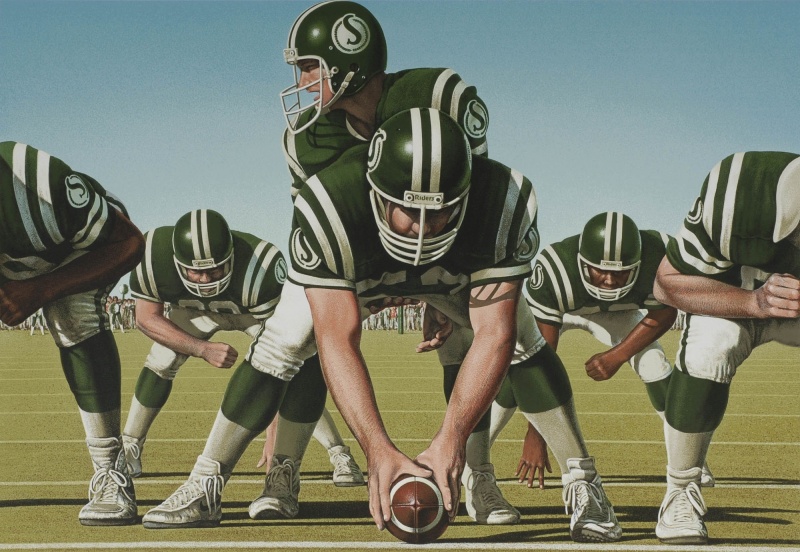
Roughriders by one of my favourite artists, Ken Danby
If you live in Western Canada, at least on the prairies where we still care about such things, you would know that on Sunday the Saskatchewan Roughriders will be playing in the Grey Cup, which this year is being held in that province’s capital city, my hometown, Regina.
I actually grew up in the old north end of Regina, two blocks from Mosaic Stadium, or as it was known back in the day, Taylor Field. (Who was Taylor anyway? I’m not sure that I ever knew. Quick edit at this point: please see Aydon Charlton’s comment on this blog for some interesting notes on Mr. Taylor and other Roughrider lore and legend.)
Growing up as close to the Elysian field as I did, it obviously played a big part in my life and in the life of my friends. On game days, my dad would park his car in the garage so I could park cars alongside and in back of the garage. When I was ten years old or so, this constituted the biggest part of my annual income. I would stand on the street with a cardboard sign, hoping to attract some generous fans from the wealthier south end of town. It was a real bonus if they’d had a few drinks because that usually meant they would be more generous.
My friends and I could actually get into the games in a few different ways. One was by hopping the fence which was a little tricky as it was topped with barbed wire and you had to go quickly to avoid being caught by one of the staff (especially the old geezer we dubbed “sausage fingers”), or by the air cadets who patrolled the inside perimeter, ever vigilant for us miscreants.
The other way, which was safer and actually paid something, was to become a hustler for a man known as Spud Leggett. There was no beer at the games in those days, so you were effectively selling mix to the fans who, generally speaking, may have been a lot of things, but sober was not one of them. I preferred selling pop corn or peanuts because they weren’t as messy as pop. Spud’s pre-game pep talk to the motley assembly of rugrat hustlers should have been taped for the ages, but I remember the bottom line was in fact the bottom line, with Spud saying, “The better yous guys do, the better I do, so get out there and sell, sell, sell.” Or words to that effect.
As I grew older, I became more aware of the players in our community. When I got to grad 8 at old Albert School, we had an actual Rider for our phys ed coach. His name was Dale West and he had been an all star defensive back. Not only that, he was a really good guy. It was a big deal for us to have him as a teacher, a real brush with greatness at that young and impressionable age.
In high school at Scott Collegiate, a knee injury prevented me from playing football, so my dream of actually playing for the Riders some day died early. But I did play basketball. The coach at Thom Collegiate (north end rivals) was Al Ford, probably one of the last players in the league to play both defence and offence. He was a punter as well. It was a big deal to shake his hand at the end of the day.
Over at Central Collegiate, Ron Lancaster was the head coach, and again it was a big deal to play a good game against Central and somehow earn his respect. I also shared a few cigarettes with Ronnie in the waiting room of the old Grey Nuns Hospital emergency ward on one occasion. With were both in for some kind of procedure – you know how it is for us athletes. I think I was having an infected blister on the ball of my foot treated (ouch), but I can’t remember why he was there.
(And yes it’s true, I am old enough to remember smoking in a hospital. It seems like a million years ago.)
Bill Baker, a defensive lineman for the Riders who came to be known as Baker the Undertaker for his penchant to try to decapitate opposing quarterbacks had gone to my high school. He gave a speech at my grade 12 grad.
And so it was in my part of Regina, at least, the team was involved in the day to day life of the community and they were loved, we lived and died with them. When they won the Grey Cup for the first time in 1966, I was 10 years old and I assumed my life would be full of many Grey Cup victories, but such was not the case. The next one didn’t come until 23 years later (Lancaster’s number had been 23, for those who believe in such things) in 1989.
I had been living in Toronto prior to that where the CFL hardly registers, but got back to Regina in time for that Grey Cup. I watched the game at my brother’s house and then as it was a fairly mild night (only -20 or so) I walked home to my apartment downtown. To get home I had to cross Albert Street, which was a steady slow-moving stream of pick up trucks by the time I got there.
Most of the trucks had some good old boys in the back of them, probably sitting on hay bails. One of these guys saw me and said, “Hey! Where’s your beer?” I shrugged my shoulders, showed my empty hands, and he reached down and came up with a Pilsner tall boy for me.
What the hell? The Riders had just won the Grey Cup!
I don’t know what the team means to people in other parts of the province, or in the far-flung region of Rider Nation that literally spans the globe, and I don’t know what they mean to fans in Regina and Saskatchewan today, but they sure meant a lot to me growing up in the shadow of Taylor Field, and they still do to this day.
What can I say? Cut me, I bleed green.
Go Riders Go!
Thanks for reading. Here’s a song by one of my favourite Saskatchewan bands.
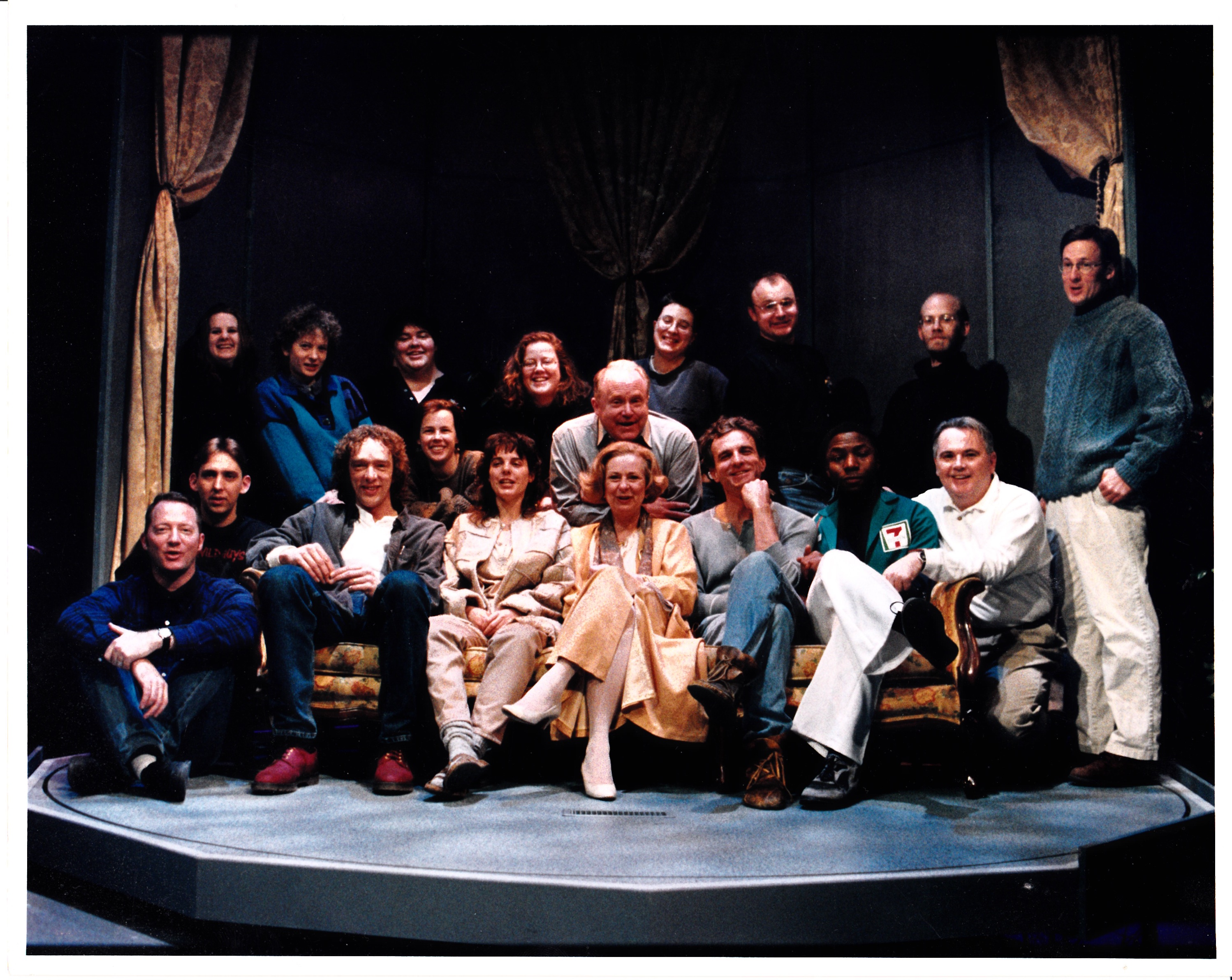
The way we were: cast and crew of Sitting on Paradise, playRites ’96/ Photo by Trudi Lee (I think).
There’s word in Canada’s national newspaper, The Globe & Mail, that Alberta Theatre Projects’ playRites Festival will end after this season’s installment.
The reputation I made for myself in the theatre and the body of work I’ve been able to create can largely be attributed to Alberta Theatre Projects and the playRites Festival.
Back in 1993 when I arrived on the scene, the Festival (which began in 1987) was really gathering momentum. The model at the time was to offer main stage productions, in rep, of four new plays, with full production values, which was and probably still is unheard of, even unthinkable. At the same time there were three or four plays in development that were workshopped and then given readings in the rehearsal hall, known as Platform Plays. This is where I, and my play “No Moving Parts,” could be found at playRites ’93.
Other ancillary events included Brief New Works, which consisted of readings of short plays throughout the community; Celebrity Hors d’Oeuvres; TheatreBlitz!, a mini festival for high school students; the announcement of the Harry and Martha Cohen Award; Blitz Weekend, for theatre artists and journalists from out of town to come and check out the work; the 24 hour playwriting competition; later, Plays on the Plaza in the Shackter Theatre (holding an audience of ten) on Olympic Plaza, etc. etc. etc. It really was a festival in the true sense of the word.
In 1993, before the advent of the Auburn Saloon (which closed its doors earlier this year, alas), there was even an after-show bar in the lobby of the theatre called Martha’s Bar. In 1993, I read a piece at a literary event there hosted by Brad Fraser, whose play Unidentified Human Remains had received its first production at playRites a few years earlier and gone on to tour the world.
They called it at the time “The hottest six weeks in winter,” and that was an apt description. Masterminded by then Artistic Director Michael Dobbin and run by the indefatigable and exacting Bob White, it was an event unlike any other we are likely to see in this lifetime. It was also tremendously expensive and to pay for it, Dobbin had the moxie to prize some big bucks out of the not-always-so-supportive-of-the-art-thing oil companies. In fact, early on in my tenure there, Michael told me, confidentially, even conspiringly, that if oil ever reached 20 bucks a barrel, we’d all be dancing in the streets.
It did; we’re not. End of story.
At the same time, Bob White had the respect of playwrights from across the country, bringing the best available new work to the stage – in Calgary, no less. This included not only original plays written in English, but works from Quebec and even Mexico in translation which seemed quite daring at the time. Bob was (and still is, now at the Stratford Festival) a very intelligent and sensitive, at times ruthless, dramaturg, and in my experience, one of the country’s best directors. With him running the show, artistically, you could rest assured that the quality of the work was as good as it could possibly be.
It’s hard to explain just what a magical event it was at that time. You almost had to have been there to know how exciting playRites was in its day.
That first year I was there for my platform play reading, one evening after our rehearsal I sat in the Martha Cohen Theatre and watched one of the main stage plays. Actually, it didn’t matter that the play wasn’t so great (notice I’m kind enough not to name it), because I was blown away by the beauty of the theatre, the physical space, and offered up one of those silent prayers we all offer up from time to time, bargaining to sell my soul to god or the devil or whomever if I could just have my work produced in that theatre once. Just once!
1993, following playRites, I went back to my home town of Regina. It was a tense year for me, waiting to hear whether my little play, which I had since renamed “Some Assembly Required,” would be produced on the main stage at playRites ’94, or if I would sink back into relative obscurity, the beautiful dream over before it had really begun.
As it turns out, they did have me back. My play did well enough for me to become playwright in residence for ATP (a one year contract that went on for ten years). I wrote five more plays for the company, all of them premiering at the playRites Festival. Three of them received second productions in subsequent seasons at ATP, and so I ended up having nine productions in total in the elegant Martha Cohen Theatre. (I think my soul is still intact, although that may be up for debate.)
Some of these plays have gone on to having many other productions in other cities and countries, but there was something about the playRites production that was, for lack of a better word, magical. And that didn’t just happen, magically, it was the result of a lot of hard work. I was fortunate enough to have Bob White directing my work. The plays were cast with some of the finest actors in the country, with great designers (including now Calgary City Councilor Brian Pincott) and with Diane Goodman and the big ATP machine steadily behind it all.
I was really very fortunate to have been there at that time, and obviously I have very fond memories of the Festival. Because of all that ancillary programming, there was so much work for the theatre staff during those hot six weeks that it almost killed us, though I guess we tend to remember the good more than the bad. But make no mistake, it was hard, and relentless. There was pressure to be not just good but amazing. It was a great place to open a play, but it was hard on the nerves, not for the faint of heart.
For playwrights, the Festival was important for a number of reasons. It offered sensible and intelligent dramaturgy (or play development, if you like), so the work produced would be as complete, as good, as the playwright et al could possibly make it. It offered the best production values a play, new or otherwise, is likely to see, anywhere. It provided an audience, a big one in fact, as the Martha Cohen Theatre holds around 400 people. Finally, it brought the work exposure in the media (remember the media?) and to artistic directors from all over, making second (and beyond) productions of playRites-premiered plays commonplace.
And now it’s gone. I find it hard even to try to put a good spin on that. I’m sure it’s been a very difficult decision for the current staff. It will certainly leave a gigantic hole in the Calgary theatre season, and in the Canadian theatre scene as well. It’s a tough loss not only for playwrights but for actors and others for whom it represented at one time one of the best and longest gigs in the country.
And yet, the playRites Festival as I have described it here, the way it was 20 years ago or so, has been gone for some time and for the last few years, there just didn’t seem to be the same buzz, the same excitement about it. It felt like the magic was gone, like a little of the air had seeped out of the balloon. I wondered if maybe this was just my own personal perception, as I’m not involved anymore, with nothing at stake. But it would seem, clearly, that wasn’t just my own perception. And now, the great idea, the noble initiative, has run its course, and it’s time for the company to move on.
Move on to what? That’s not for me to answer. I’m sad to see playRites end, it will be sorely missed in Calgary by many. (By people like Joyce Doolittle, for example, who has seen each and every main stage play at the Festival, well over 100.) But I hope something new and wonderful will emerge from this resilient and important theatre company.
Thanks for reading.
Here’s the curtain call music Bob White chose for the playRites production of my play Sitting on Paradise in 1996.
A few days of steady snow and it doesn’t take long to switch from summer mode to winter. You hear things out here like “Well, at least we made it through October.” It’s true, we mostly did. But now only three days into November, October seems like a long time ago, and the world suddenly looks different, the colors have been drained from the landscape and the world now appears in black and white.
Just last week, I heard the old refrain, the old wishful thinking: “Maybe this year it won’t snow. Maybe this will be a warm winter. Maybe this year it won’t happen. Maybe global warming isn’t such a bad thing after all . . .”
But of course, it did snow. It needs to snow. Have a look at some of the photos of the depression from out here and you’ll see for yourself what happens when it doesn’t snow. My mother used to say that the thing that near drove her mad in the ‘30’s was the dust. Dust and fine dirt everywhere, no avoiding it, impossible to keep anything clean, it would even get in your mouth. No water and everyone thirsty all the time, a mouthful of dirt, well, sorry to inconvenience you but we need the snow.
As for the cold, I don’t know that we need it but we’ll get it. It’s only adults who mind the cold. Kids don’t notice it. When I was a kid my mom’s biggest worry was getting us to do up our coats and put on our mittens, even on the coldest days. In high school we shunned boots and wore Converse, the only concession to winter that we would put on an extra pair of socks. This at 40 below, where the Fahrenheit and Celsius concur that it’s fucking freezing.
In Saskatchewan when I was a kid it would go on for weeks like that. Cars developed square tires, if cars would start at all. Remember the sound of someone trying to start their car on a cold dark morning. The hacking sound of the ignition, the whine, the silence. Again and again and again, until the thing turned over, and then you’d have to listen to the person rev the shit out of their motor for ten minutes before the car could crawl away, spewing huge flumes of white steam out the tale pipe. Either that or the sound of the car door slamming when the person finally gave up and went back in to call someone for a boost.
The sound of your footfalls squeaking into the thin dark air. The cold made audible but the air too thin and brittle to hold the sound for long. It’s a sickly sound, the sound of ice, the sound of the deep cold. You might want to do up your coat if it gets that cold and you have to walk a ways, but by and large you don’t think too much of it, it’s just how it is.
And so many ways to express it. It’s cold. It’s chilly. Breezy. Or the interrogative form: Cold enough for you out there? Sure, it’s a tad frosty out there. Colder than a hooker’s heart. Colder than a well digger’s ass. It’ll freeze the balls off a brass monkey. Exposed human flesh will freeze in less than 60 seconds. And it did, and it still does, but apparently human flesh thaws out again.
And everything now rendered in black and white. The white snow and the dark endless night of winter. White breath pluming out against the black sky, remote white stars above twinkling cold and eternal as if you have been caught and fixed in space along with the constellations. And even the sun when it bothers to shine, and shine coldly, radiating cold, shines almost as white as the moon and about as warm.
Every year it comes as a bit of surprise, no matter how many years you’ve had in the cold, you manage to forget, the summer effectively erases all memory of the long hard winter so that every winter becomes the first winter.
More than the cold and the snow, though, it’s the darkness that pervades everything. If summer is one long endless day, winter is an even longer more interminable night. It presses in from without. It works its way inside, seeping in, leaching all color leaving only the black and white outline of things: trees, fences, brown-black grasses poking up through a blanket of white snow, shadows of things under stark street lights, outlines of buildings, white swirling snow passing through the feeble white cone of a street light.
And yet for all that, life carries on. We lash wooden boards to our feet and head once again to the mountains, even more beautiful in winter than in summer. And there is beauty to it too, but not the lush, plentiful and easy beauty of the tropics. It’s austere and even barren. We have no choice to fill it up with something, and so we create art. Into the void, we feel we must offer something, from Shakespeare and his Hamlet to Beethoven and his 9th Symphony to the Group of Seven and their sublime and timeless images of the land and the climate. To this little effort of mine. We do try to fill the void.
In this way we carry on, and maybe even prevail.
And if nothing else, it only lasts for six months.
Thanks for reading.
Here’s a wonderful Gordon Lightfoot song from Sarah McLachlan.



 eugene stickland