It’s beautiful weather here in the Bovine City. The flood waters have receded for another year at least and the spirit of cooperation and, well, let’s just say it, LOVE, that washed over the city (so to speak) earlier this summer still prevails. Yes, it really was the summer of love here, and if anyone is feeling a bit of Nenshi-fatigue, no one is admitting to it. (We have the best mayor; Toronto has the worst mayor. It doesn’t get any better than that. Surely.)
You’d have to wonder how anyone could find anything to be grumpy about in this Shangri-La but true to form, here he is again, Mr. Grumpypants, reminding us once again that no matter where you go, there will always be someone who is unhappy about something. Take it away, your grumpiness . . . .
Yeah. OK. Exhibit A. Take a look at this photo:
Hardly an award-winning photo but it will give you an idea.
It looks like a war zone, right? It looks like it was taken in some kind of post-industrial wasteland in a third world country. In fact, it was taken in the Connaught neighbourhood of Calgary.
A year ago, this was a happy, friendly little park. It was a well-populated park. There are many people in this neighbourhood who live in apartments with no balconies, or perhaps north-facing balconies bereft of sunshine, who need and utilize this park. It was a busy place.
To this park, that was really nothing more than a grassy glade in the midst of the concrete jungle, the people would happily flock. Here you would find a person leaning against a tree, perhaps reading a book. You would see people playing a game of catch with a Frisbee. Or a football. You had the lovers sharing a blanket, arguing about fixed mortgage rates, and cheeses, etc. Yet others with dogs, happily, willingly bagging the shit of these senseless violent creatures. Go figure!
There was one guy who had one of those remote control helicopters and I took a certain delight in watching him, over the course of the summer (last year), learn to fly the thing. (Rumours that he was planning on affixing a video cam to the helicopter in order to spy on his ex-girlfriend who lived on the third floor of a nearby apartment are to date unsubstantiated.)
My point is that a year ago, on any given day, that park was a thriving oasis in the middle of a very urban neighbourhood.
And then a year ago, last August, the green fence that you can see in this photo was placed around the park, in effect locking out anyone who wanted to use it. I remember thinking at the time, why do that in August? Why not wait till after Labour Day? The days we can actually sit out in a park in this city are numbered. Why now? Why August?
Putting a fence around the park and locking everyone out of it might have been excused had anything happened, but nothing did. The empty, fenced park sat there for at least the next four or five or six weeks with nothing being done to it. And soon enough, winter came and we switched to survival mode so then who was even thinking about parks and such?
Over the course of the winter and early spring, the only thing that became clear was that the newly envisioned, improved park would feature a running track. The outline of the thing has been visible through the fence for some time now. Along with some holes that look like they might have to do with lighting. And there’s a huge pile of dirt in the middle of the thing that’s been there so long, untouched, that by early summer it sprouted grass, resembling an iron age burial ground.
All work, all progress, meager as it was, stopped at the time of the flood, and so I guess we all thought fair enough, the park renovating people are probably doing emergency flood relief.
But now, months after that, over a year in, all told, this once happy and well-utilized park looks like it does in my sad little photo.
To put it in some kind of perspective, that high rise apartment in the background has been totally constructed in less time than it has taken to render this park into its current state. A whole fucking entire building has been erected and they can’t do a half a block of grass and a running track.
I don’t suppose any of the users of that park have had a chance to voice their displeasure, but I certainly am, here and now. WTF?! What kind of morons would put a fence around a perfectly fine park for over a year only to have it look like this? What is wrong with people? Whose idea was this? Why aren’t heads rolling? Who is responsible? And who was the genius who decided that a park largely populated by readers and slackers and lovers and dope smokers needed a fucking running track in the middle of it in the first place?!?!?!?! (To voice my feelings on joggers is well beyond the scope of the current post.)
And finally, because they obviously won’t make it this year, when might we expect this unwanted improvement finally to be completed? How many years will slide by?
Huh?
They should have just left well enough alone, fucking assholes, if you can’t do any better than that. It’s as I always say, change is never good. Nothing good ever comes of it.
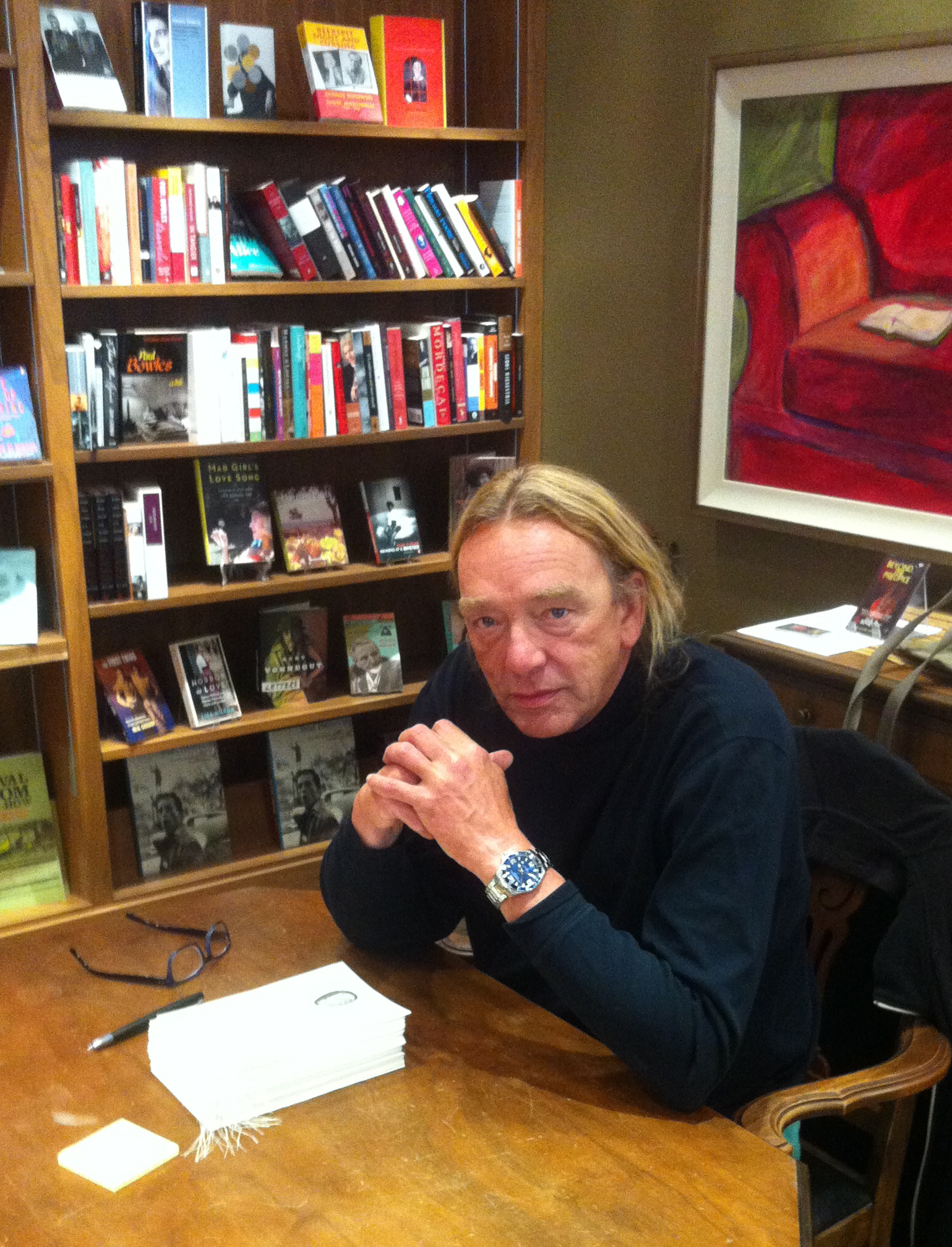
Hard at work, signing and numbering the books. I’m actually much better looking than this in real life.
If you should happen to meet someone who claims they know what’s going on these days with publishing, run the other way. No one knows. If anyone might know, it might be me, but I’m telling you I don’t know. Therefore, no one really knows. And there certainly is no secret.
When first there were computers and clumsy dot-matrix printers back in the early 80’s, it didn’t seem to change much, and so it was business as usual for writers for a few more decades. We carried on the same as we did when we were typing.
It seems to me (another way of saying I have no idea what I’m talking about but I’m going to say it anyway) that not a lot of attention was paid to printers in the early days of computers because the theory was that we would soon become a “paperless society.” That’s what they told us and we believed them.
I don’t know how many trees I’m personally responsible for slaughtering since then, but probably a small forest.
And yet, at the same time, they weren’t entirely wrong, these experts. The fact that you are reading this post electronically, as we say, is proof of that.
The one area of printing that befuddled the experts from the beginning was the book industry. Rather than roll over and die, it seemed to flourish in the electronic and later digital age. It seems to me (again, no idea, just saying) there were two (at least) reasons for this. For one, those of us in the literary community supported the industry as well as we could in the best way we could, by buying books. I know so many people like myself who own a Kobo or Kindle and an iPad or other tablet who still (and always will) prefer the “real thing” as it were. And the book industry responded by creating nicer books. It’s true. Books, as physical entities, as artifacts, are much nicer now than when I was a student of literature in the 70’s and 80’s.
Being in the publishing business myself, I know that it is possible to create beautiful books. Especially with a small press like B House, where we do very small runs of our books, it’s possible to create books that are beautiful inside and out, as it were. (We like to think that not only do they look nice, but that what’s inside them is worth reading as well.)
While I’ve been hard at work (not really, but you get my drift) publishing the work of others, I was recently rewarded with a publication of my own by an even smaller press than B House called 100 têtes Press, run by Calgary poet Paul Zits. 100 têtes is somewhat oxymoronically (I love that word) a chapbook press. All the books are created by Paul himself. The care he takes with typesetting and selection of papers results in very beautiful and unique books. He even sews them together on a sewing machine on his dining room table.
Here’s what Paul has to say about it:
Written, the name 100 têtes translates into English as “one hundred heads.” Spoken, the name takes on a second possible translation, namely “without a head.” The name, appropriated from Max Ernst’s 1929 graphic novel, La femme 100 têtes, reflects Zits’ own personal interest in collage-work and literary montage. From their materials, design and binding, reflected in each book’s unique presentation, is 100 têtes belief in the book as art object. But the name is also meant to emphasize the Press’ community-driven focus, made up of, simultaneously, one hundred heads and no heads.
It is the mandate of 100 têtes Press to publish local writers, both new and established, of any genre, with an emphasis on experimental and conceptually resonant poetry, prose and visual art.
The name of my book is Silent Suite and it exists in a limited edition of 40 copies, signed and numbered by the author himself. (That would be me.) It contains three short, sparse poems which I wrote really in reaction to the oh so busy wordy poems I’m used to hearing at poetry readings these days. (Remember the famous line in Amadeus – “Too many notes, Mozart.” I feel like saying that to young poets nowadays – “Too many words!” Hmmmm. Maybe I did just say it. That feels better!)
So, here we see at least a trend in publishing – smaller runs of uniquely produced books which can quickly become collectors items given the small numbers involved. The problem, as you can probably tell, is that no one makes any money from this. That’s the problem as I see it when it comes to publishing in the modern era. As bad as it was for writers in the past, it only seems to be getting worse. The resume expands even as the bank account shrinks. What else is new?
Because Paul is not in it for the money, as they say, his suggested price for the book was $4.00. The day I signed them at Shelf Life Books (there’s a link to Shelf Life to the left – that’s where you can buy a copy, or through me directly), manager Will Lawrence (always the sharp businessman) countered by suggesting a price of $8.00 per book.
After much strenuous negotiation between publisher and book-seller, finally a compromise was reached — $6.00 a book!
As I say, none of us is getting rich, but we at least have the satisfaction of bringing a funky new book into the world.




 eugene stickland